
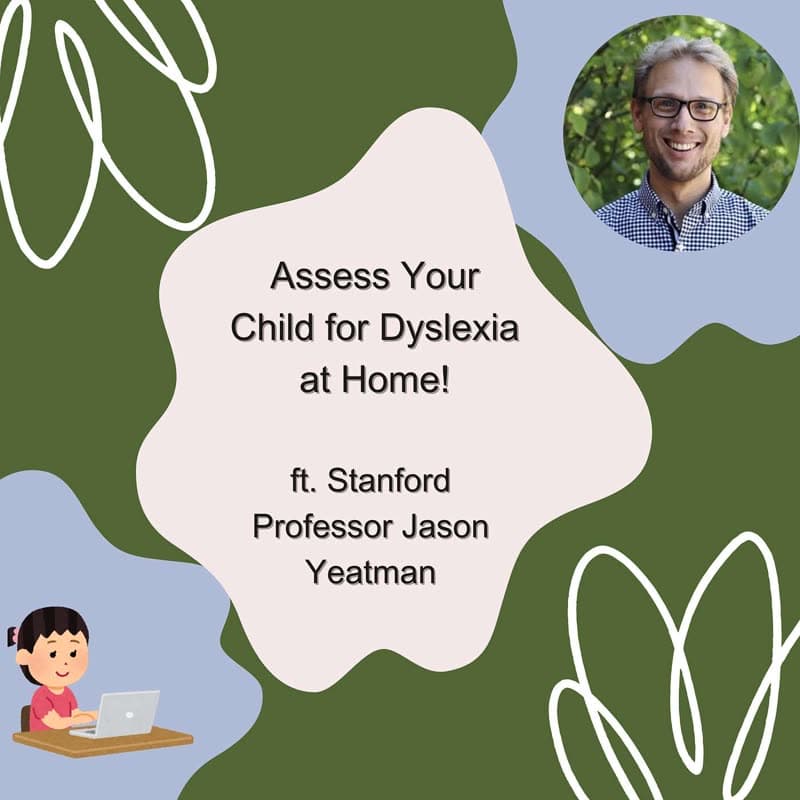
How to Assess Your Child For Dyslexia At Home For Free!
Re-aired Dec 31, 2025.
About this episode
I don’t want to bury the lede, so here’s the link to the new ROAR@Home online literacy test that your child can take for free! https://roar.stanford.edu/homesignup/
The full interview is well worth a listen as well. Dr. Jason Yeatman is an Associate Professor in the Graduate School of Education and Department of Psychology at Stanford University and the Division of Developmental and Behavioral Pediatrics at Stanford University School of Medicine. As the director of the Brain Development and Education Lab, the overarching goal of his research is to understand the mechanisms that underlie the process of learning to read, how these mechanisms differ in children with dyslexia, and to design literacy intervention programs that are effective across the wide spectrum of learning differences. His lab employs a collection of structural and functional neuroimaging measurements to study how a child’s experience with reading instruction shapes the development of brain circuits that are specialized for this unique cognitive function.
You can read more about Dr. Yeatman at https://psychology.stanford.edu/people/jason-yeatman
Transcript
Full transcript · 6,331 words · about 32 min to read. Press a timestamp to jump to that moment.
So the first challenge we decided to tackle was, how do you assess reading skills when you can no longer sit in a small room and deliver individually administered, you know, expertly scored assessments to kids? So that was the birth of Roar. It was, you know, the idea was, can we build, you know, gamified web apps that tap into the mechanisms we know that are involved in reading and make those scalable and automated?
It got me diagnosed when I was in third grade, and it was the most relieving day of my life because I finally had, like, kind of a place to hang my hat and say, see, I told you, I'm not lazy, definitely not stupid. I just learned differently, like, that's totally okay. We dyslexics, we were often, you know, just set up for failure because, you know, we were given books and tasks that really are not appropriate for the level that we were at.
So how do you expect anyone to be open to learning when their entire relationship with reading, with learning, is physical pain? I wish I had understood when I was younger that the fact that my brain worked differently than people meant that I would be good at things in ways that other kids were not going to be good at. I just assumed I can't be dyslexic because letters don't jump up and down for me.
Dyslexia is not a disorder. It is not a disease. Once you sort of own it and embrace it, then you can have the power to deal with it. It's sort of empowering and also enriching to the whole community. To those who don't understand what dyslexia is, that it's not a negative, it's not a problem, it's, like we keep saying, superpower.
Hey, everyone, we are Sonja and Nick, and this is Dyslexia Journey. And today we are excited to welcome Professor Jason Yateman. Dr. Jason Yateman is an associate professor in the Graduate School of Education and Department of Psychology at Stanford University and the Division of Developmental and Behavioral Pediatrics at Stanford University School of Medicine. Dr. Yateman completed his Ph.D. in psychology at Stanford, where he studied the neurobiology of literacy and developed new brain imaging methods for studying the relationship between brain plasticity and learning.
As the director of the Brain Development and Education Lab, the overarching goal of his research is to understand the mechanisms that underlie the process of learning to read, how these mechanisms differ in children with dyslexia, and to design literacy intervention programs that are effective across the wide spectrum of learning differences. Dr. Yateman, welcome to Dyslexia Journey. Great to be here. Listening to my intro makes me realize how hard it is having someone with joint appointments across many schools.
Yeah, I was thinking that too. Which maybe leads a little bit into the first question here. We just always like to find out, you know, people's personal connection or how they ended up on their trajectory with this work. So how did you come to be interested in reading difficulties like dyslexia and end up on this career trajectory? So I actually started my PhD with a deep interest in how experience sculpts brain development.
So how an infant or a child's experience with the world, be it in school or just visual experience or auditory experience, how it actually shapes the development of the brain. And this is really a basic neuroscience question, right? It's a question about plasticity, about how the brain develops from intrinsic factors, then also how external factors shape that. And I initially got interested in reading as a tool to understand this, right? So a lot of what we know about brain plasticity comes from invasive studies in model organisms, in mice, in monkeys, in flies.
And to study how experience shapes the human brain, you need a paradigm where you can change factors of the environment and measure how it impacts the brain. And reading is an incredible way to do that, right? This is this made-up, kind of arbitrary, cultural invention of modern human societies. The idea of a literate society is, I don't know, arguably not something we've achieved, but best case, something that's quite new. Even, you know, 100 years ago, the idea of having a literate society wasn't a thing.
And so now we can use that as a paradigm to understand how a child's experience with learning this new, brand-new cognitive function actually sculpts the development of their brain. Now, as I started working my PhD on those basic scientific questions, I also realized, you know, reading is also one of the most interesting things the brain does. It requires the integration of visual information, auditory information, language information. So it's also a way to understand brain connectivity.
And also, it's really, really important in modern society, which I think is the reason you guys invited me here is probably that third part, which I know is part of your journey in creating this podcast. And so it really started off from the basic neuroscience perspective, but through the course of my PhD and then, you know, the last decade plus of being a professor, we've moved more and more in the applied direction.
So trying to take basic scientific insights and bring them to schools in useful ways. Yes. Yeah. So I think that really leads into the next question, which is, can you tell us about the rapid online assessment of reading? Yeah. So this started, so I'll give you a little bit of a history that you didn't ask for, but hey, I'm here. I think it's interesting how these develop. So my lab has always done open source software work.
We've been kind of at the forefront of the open science movement of trying to develop tools that are openly used. So rather than, you know, creating a proprietary thing that just the grad students in my lab get to use, creating software packages that any scientist, any lab anywhere in the world can use. And also making data public, de-identifying it. So, you know, you don't know the people in our studies, but making the data public too, so that scientists can query our findings in different ways.
You might remember March of 2020. I don't know what your guys' life looked there. My life looked like a, I had moved from University of Washington to Stanford. So the lab was still kind of in the startup phase. We had a pretty large group. We had a large team. A lot of us are quite technical doing software stuff. And everything we do in the lab involves sitting one-on-one in a room with kids.
And in March, suddenly that was no longer a possibility. So we were all at home and we started looking for areas where we could innovate with the expertise we had. And so the first challenge we decided to tackle was, how do you assess reading skills when you can no longer sit in a small room and deliver individually administered, you know, expertly scored assessments to kids? So that was the birth of Roar.
It was, you know, the idea was, can we build, you know, gamified web apps that tap into the mechanisms we know that are involved in reading and make those scalable and automated so we can continue our research? And, you know, so we published some papers on this, but it quickly became clear that us continuing our research was not the most important use case of these new tools. So from there, we started partnering with local schools and then we started partnering with more schools and then, you know, we grew an engineering team and, you know, zoomed forward however many years we are now past that period that many of us would like to forget.
And Roar has grown into, you know, a full-featured platform that has not just assessments of single-word reading, but, you know, the whole suite of skills that contribute to differences in reading and math as well. And it's integrated with the major student identification systems that are used around schools, so it can be deployed, you know, automatically, not just for one of my research studies, but across a whole school district, so it's actually, you know, the whole district in 20 minutes.
Yeah, I'm curious to hear, well, did you have a follow-up first? Oh, well, I just, so you have integrations with, like, Classlink and those kind of... Classlink and Clever. Yeah, Classlink, Clever, Google single sign-on. There's more that are coming. You know, unfortunately, the original idea of all these single sign-ons is that it would be, you know, a one-stop shop, but then it was so popular that now there's competition there, which means that we get to continue engineering more integrations.
Right, that's true. I'm curious with Roar, you know, just trying to get that picture from the side of, let's say, the school or the teacher. Like, what, how would that feel for what the information they're getting? Like, what kinds of information would they get? Would it sort of be a general, pretty general assessment? Would it go pretty specific, like, pretty, very, very specific on a particular, you know, skill that a student's struggling with?
How would that look? Yeah, well, there's a couple different use cases. So, we were just, and I'm quite proud of this, we were just approved as a official screener for reading difficulties in the state of California, and then more recently in the state of Ohio and the state of Minnesota as well. So, there is now 42 states that have legislation requiring universal screening for reading difficulties. And I think this is, we'll, I don't know, reach home for you guys, because I know that's something you guys think about a lot, right?
It's like the early screening, early identification. So, Roar's been approved as an official screener for a number of states. So, what this looks like, so when you're screening, what you want is the quickest, kind of lowest cost, most efficient way to flag who's at risk for struggles, right? Who's likely, who's currently struggling and likely to continue struggling if they don't get additional support. So, in that case, that's, you know, that use case would be a district running Roar, you know, at the beginning of the year, actually usually like beginning, middle, end of the year, three times a year, where all their students run the quick 15 to 20-minute screening version, which will, you know, flag students who need additional support and foundational reading skills.
And it'll also give details about some specific areas. So, whether there are specific challenges in phonological awareness, for example, or whether the kindergarten or first grade student has mastered all the letter sound correspondences. So, that type of information. Okay. Additionally, so those are like kind of our core measures that are used as a screener. But we have another dozen or so measures that really provide a deeper dive. So, we have measures that look at morphology, written vocabulary, spoken vocabulary, syntax, right?
So, your ability to understand grammatical structures in spoken English or Spanish or German or Portuguese, actually. We have Roar across a number of different languages and will provide and reading comprehension skills. So, you can kind of think of this as like assessing all the different aspects of reading. And we group these measures into different suites of measures. We have the screen, you know, the foundational reading skills suite, which is typically used as a screener.
And then we have these more detailed measures that provide kind of deep dives into different actionable skills. Oh, that's really interesting. So, our daughter, who we've talked about many times in the show, has dyslexia and it took a while to get her identified. And I think one of the reasons is because she has surface dyslexia as opposed to, I think, the more traditional orthographic dyslexia, I think it's called. Is that a distinction that Roar is able to detect?
You know, those aren't distinctions that I make, per se. Okay. Yeah, I'd love to hear your perspective on that, actually. You know, one of the challenges in diagnosis is that there isn't a real gold standard. And this is one of the challenges, also, that we're hoping to solve. So, I'm going to tell a story, and maybe this is your story. This is the story of many, many hundreds of families that have come to my lab over the years, which is, you know, kids start school, parents are very involved, but, and start to notice that, you know, or start to notice concerns.
But often, like, don't get any information back from the school on that. And, you know, over years, these concerns grow. Maybe now it's second grade or third grade even. And at some point, families, particularly the ones that have the economic resources themselves, start pursuing, like, a private practice neuropsychologist for a diagnosis, right? And, like, just pausing there for one second, right, is the amount of, like, privilege and resources it takes just to have that information, right?
To, like, to, A, B, have the amount of, like, time and capacity to be involved enough in your kids' day-to-day education to notice yourself that things aren't on track, to have the knowledge that, like, there's, you know, professionals that can help with this. And then also to have the resources, I don't know what it costs, I think you guys are in Colorado. You know, I've been in Bay Area and Seattle. And it's, you know, many thousands of dollars to get a professional to give a diagnosis.
Yeah. And that's exactly what we did. We went to a private neuropsychologist for a day and a half, two days of testing for, yeah, thousands of dollars. Yeah, right. And this, you know, and then you guys, and I'm sure you, like, probably talked with them. You were deeply interested and involved. And, you know, this is one barrier that we hope to lift for Roar, right? That, like, that story is the story of hundreds of families that come through my lab for studies on dyslexia.
And we want to democratize access to high-quality data. It shouldn't require, you know, and often the story goes with one of the parents left work to support their kid. I don't know if that's your good story, too, but that's another common story, right? Which, and, like, turns out most families in the U.S. don't have the resources to be like, well, I'm going to stop working to support my kid because, like, we're not getting information.
So that's one of our first goals is democratizing access to data. And the other part, so this was my long answer to your simple question about, you know, different forms of dyslexia. It's not a standardized industry. So depending on, you know, which neuropsychologist you go to, they're going to give a different suite of tests. And, you know, they're going to write up their own interpretation of these tests. And they're professionals. It's, like, no discredit to any individual, but, you know, they come in with their own knowledge base and, like, opinions and interpretation of, you know, based on their own practice, which is great, right?
That's, like, beyond following, like, guidelines of practice, like, skilled clinicians should bring their own knowledge to it. But it also creates, like, in a world where getting services for dyslexia is so hard in itself, that the fact that there isn't, like, a standard definition, a standard set of tests, a standard agreed upon diagnosis as an additional challenge. So those are two things, you know, I talked about the school side of ROAR, and that is one side of, like, having universal screeners.
But as you mentioned up front, I have a joint appointment at the School of Medicine. And one of our hopes is to sync up all these different areas, to sync up the, you know, having high-quality, universal, and free assessments in schools. Also syncing these up with clinical practice. So we have a project in our developmental behavioral pediatric clinic. We're starting to use ROAR as a universal screener for kids coming into the clinic so that clinicians, you know, when a kid shows up, regardless of the reason, whether it's a concern about ADHD or anxiety, which are also two things that go along with dyslexia a lot.
Even if it's not a concern for reading, that that clinician, like, has the same information for every student coming in. And then the third area is trying to democratize access to data by launching ROAR at Home, which will be our parent portal, where parents can sign their kids up. Should say it is a research study. So everything we do, I'm at a university, everything we do is also for research purposes. So if a parent checks out our website and signs up, you'll see a consent form that talks about how we ensure data security and the types of research questions that will be addressed with the data.
So it is, you know, it's not just a free tool. It's a free tool and a research partnership. But we want to basically be able to provide all the same information to parents, to clinicians, to schools. Yeah. And following, this sort of adds on, I think, to what you were talking about, about the clinician, you know, aspect and all of that. Like, but also from the teacher's perspective, like, what, and this may be as individualized, but what do you see as the next steps?
Let's say that a kid is identified as having reading difficulties. Like, what would happen next? Would that mean needing further diagnosis? Would it, would it, you know, presumably it would give the teacher some information for specific things to work on also. But because, you know, this diagnosis is a piece of the whole thing because of accommodations and all that. Like, I'm curious about how all that, as you can see it play out.
Is there sort of a typical way that plays out for a particular kid? There's not a typical way because it's so dependent on the specific school, the specific school district, the specific state, and then intersects with a number of things like the resources to the school. Right. And I'm going to try not to go on a tangent about how our country has decided to organize our educational system. But based on the zip code you live in, the services that your kid is likely to get vary dramatically.
And, you know, I'm sure you guys are aware of the various reasons for that, right? so I think about this in a different way is that, diagnoses are only important because we have decided that they are a gateway to services. But they're also only a gateway to services, usually in affluent communities, in many schools that don't have the resources to provide resources. you know, diagnosis, I'm, kids often don't get diagnoses at all.
And, the diagnoses don't come with the same levels of support. So when we're working with schools, what, what we're trying to do is help them implement an effective multi-tiered system of support. Rather than thinking about like a diagnosis and, you know, triaging a kid to, like a specific intervention program. Instead of what we, what we would like to see in every school is, you know, universal screening and students that are, flagged for needing additional support, start getting a little bit of additional support in their classroom.
You know, maybe additional small group instruction to focus on, you know, the skills that, they're struggling with. And, you know, then you continue to screen over the course of the year. And, some students just needed a little additional support, particularly young ones, right? Kids come in with such vastly different experiences that, you know, the early years of school should be there to, you know, support the, children's reading skills, regardless of their background.
Right. and then, but many students didn't need it, need more targeted support, right? So that's when you then should, school should move kids up to, you know, one-on-one or, or have, time with a reading specialist. And then yes, often like at, at some point, that kid might need a diagnosis and then like a more intensive intervention. Right. But that's the idea of the school system is using a automated tool like Roar to build an effective multi-tiered system of support around the data.
Right. And, so it's not just a teacher giving like a little nudge. It shouldn't be. Yes. That individual teacher's job to build the system. It's like the support around the teacher. It sounds like it's really, yeah, it's trying to systematize and normalize this early screening and this continual screening in a way that it hasn't. Yeah, yeah, yeah, exactly. Exactly. And then, and you know, that's like the, kind of the different assessment suites in Roar is, actually many of the schools we're working with now are actually using the full suite of measures.
So rather than just doing the fifth, the quick 15 minute screener, they, will universally run the whole suite of measures to have comprehension data, have data on vocabulary. you know, have assessments across languages to provide a more detailed profile of each student's strengths and weaknesses. And, you know, that data can then be used to like think about teaching practices and how, instruction can be individualized to every student. And is that full suite also completely, can be done completely independently by the student?
Yep. Yeah. Everything. And that's like one of the parts of Roar, everything's totally automated. So the idea is, you know, you, log in. If you're a little kid in a school, you log in with a QR code usually. so you don't have to remember passwords and usernames, takes you right into, you know, a map of the games. Kids, play the games. The games have just been, have been predetermined by the district.
So it's not up to the kid to be like, oh, do I want to be assessed in phonological awareness today? Right. They just get led through the journey through the different games and the teachers get the score reports in real time. So because it's totally automated, you know, when, if, I think you guys are Denver, you said, if Denver public schools decided to adopt Roar, in that, you know, 30 minute block where the students are on their Chromebooks, taking the test, the teacher could be there looking at the score reports in real time.
it's seeing the students grouped into instructional groups. Interesting. a couple other questions I thought of, one is, have you had any, so we, there's always this sort of, we always tend to caveat this, like all teachers at schools are very well intentioned. Right. But, but as you've mentioned, they're often very short of resources. and because of that, there's been some pushback on universal screening from teachers unions and things like that. have you seen any pushback about this?
Yeah, definitely. I mean, people push back for, a variety of reasons and, you know, I, you know, screening on its own won't, won't solve any problems. If there isn't a effective multi-tiered system of support built around the data, right? So like, well, I guess screening on its own actually does do something for high resource families, that, so in California, for example, schools are required to send home school reports to parents. So that parents are, are informed.
and so that means that, you know, schools ideally have an effective multi-tiered system of support, but they don't. And, you know, parents can step in on their own, but then of course that just stratifies based on, like income. It's like who, who can afford to purchase services on the, on the free market. yeah, no, I think this is a huge challenge. I don't, I don't have the solution. I think it's an area where we probably need broader reform of our systems.
We're just requiring screening, you know, is only as effective as the systems response to that screening. So not the individual teacher, right? It can't be the expectation of every teacher to retool themselves as a dyslexia specialist. That's not a, I mean, unless the district is, providing the resources and time off for professional development. And which means that the state of the federal government is, is paying those costs, right? These are like real costs of people's time.
yeah, I, I, I, I sympathize with that perspective, but I am also, of the perspective that, you know, without data to highlight the problems, the problems are easy to ignore. So actually when we're working with districts, we're often trying to get them to go beyond just complying with the legislation. So California requires screening grades K one, two, roar is validated grades K to 12. and the schools we prioritize working with are the ones that actually want to adopt roar K to 12 or at least K to nine.
Nine is actually a good grade because it's, there's a lot of students that still have struggles in high school. and their, their struggles are due to actionable challenges with foundational reading skills. that, that's my ideal scenario is actually like implementing this universally through the upper grades. Yeah. Yeah. So the data is there. Yeah. Yeah. Oh, go ahead. I was going to say, I, well, I was going to change topics to the research and validation.
Well, okay. I do want to talk about that too, but since you just spoke about the older, older kids, I was watching some of the informational videos. It was on your website and, you know, I noticed that there was some talk about that. So I was wondering if you could speak to that, how roar can be important for the older kids. Of course, the early screening is so essential that, you know, a lot of people aren't, we're not, we don't standardly really have right now.
So that's really, really key. But how is it, do you find it extra useful for the older students? Yeah. Well, you know, decoding skills are a bottleneck for everything, right? If you are, a ninth grader who's still slowly struggling through decoding words, you know, slowly and effortfully reading sentences, how can you be expected to, you know, go home, read a book, write a book report? Right. Or even, you know, do math problems, which are more and more word problems, right?
That have complex syntax and often long multi-syllabic words like trigonometry or, thinking back to my high school, Pythagorean, right? Like, reading is important for everything. And so ninth graders, you know, come into high school, teachers have very little information on their students and schools, you know, most, in high school, usually there are state accountability tests. And so schools are aware of the students that aren't meeting standards on those tests. Those tests, you know, are summative, try to encompass, you know, all the skills that are all the knowledge that, that student, that students should have.
Relative to some predetermined state standards. and schools know that students, which students aren't meeting these standards, but they don't know why. And that's where Aurora can come in. Because, if you're not meeting the standards, because, you know, this is often the assumption, like, you don't have enough background knowledge. You just need, like, you know, more, more focus on different areas of curriculum, or, you need larger vocabulary. You don't know, you don't understand some of the words.
These are areas that high schools are, are, are well-equipped to, intervene and support students. But a lot of students, it's because they haven't mastered foundational reading skills, right? And so that means that all these interventions likely aren't going to be effective because they're not targeting the root of the problem. So, many of the schools we work with, implement universal screening up through ninth grade. because this is, you know, ninth grade is when students are entering high school.
Teachers have very little information on them. And that will flag the students that, need additional support and foundational reading skills. Okay. Interesting. yeah, I was curious about the validation aspect since you, you said earlier that there is kind of no gold standard for diagnosis. I'm curious how, sort of methodologically, how you went about validating ROAR. Oh, yeah. So, you know, validity, there is, we often think about it as like, is it valid or not?
But the way we should think about it is, you know, is it valid for what? I wish it a question of like, what does this tool, what does this instrument like reliably tap into? And so these studies often start off with like small lab studies where we have a hypothesis about, you know, a new task that can tap into, for example, single word reading skills. and there's a variety of different, you know, widely used measures.
So I'm guessing, your daughter probably was administered the Woodcock Johnson test. Yeah. Okay. I got it. Yeah. Right. So that, that's one that's just, you know, widely used. we, everyone knows how to interpret it. It's been, developed and validated over many years as, you know, and as a part of, dyslexia diagnosis. And so, we start off with a small lab study where we had students take the first version of ROAR. we individually administered them, the Woodcock Johnson, we look at the correlation.
It's quite high. It's like above 0.9. then we go through and like, you know, systematically start expanding. It's like making more, more efficient, more reliable. and then running a larger scale validation studies. Often the Woodcock Johnson was our target for our single word reading measure. But, we'd also in our partnerships with school districts, ask them what measures they're already using. And so there's, you know, a whole suite of different measures that are used in schools.
And, if you go into the long and extensive ROAR technical manual, you can see validation studies, you know, starting off with like, you know, relatively small detailed lab studies, then going to larger study schools where ROAR just use standard of practice. so there's some schools that have been using ROAR three times a year, and are interested in partnering with us on a validation study. We're actually running a large one right now, looking at, predictive validity over like a two year timeframe where the school has been using ROAR universally in grades K one, two for two years.
Now, my team's coming in, actually my whole team is there right now, working individually with students and, individually administering the kind of these, outcome measures to look at the predictive relationship between ROAR and future assessment scores. And we're also then looking at the other assessments the school uses. Sometimes this is like state tests too. So in the case of middle school and high school, actually just published last night, an article, in the ROAR technical manual, looking at how, single word reading predicts performance on, you know, these long multi-day summative state assessments.
And, you know, the takeaway there is that students below a certain threshold, it's been referred to as the decoding threshold, basically students whose decoding skills are, are, are, quite low for a middle school or high school student. Almost all of these students are, not meeting state standards too. So we can look at the predictive relationship in, in a number of different ways and build up a, a case that ROAR is valid for X.
Right. Yeah. That's great. Well, I'm curious also, about, you've mentioned, of course, the, the at home ROAR. So this is part of it, but maybe even wider down the line, you know, thinking really big here, like what are your hopes and dreams for the trajectory of all of this? my high level. So, we've decided to keep ROAR as a, program run out of Stanford university. And my high level vision is to see deeper systemic relationships between research and practice.
I want to re-envision, academia's role in society and society's relationship to academia and education. It's just one place for this, right? There are, are brilliant researchers in, you know, every domain. And often we find ourselves, you know, addressing academic challenges, talking to our academic colleagues, but not in conversation with society. And I see this as a incredible opportunity to, create that pipeline and not, and not just a one way street, not just, you know, a way to get research to the world, but to make sure that the, research questions we're thinking about are grounded in the lived experience of students, of teachers, of administrators, of communities.
because that makes our research so much richer, right? That my, you know, I mentioned publishing an article in the ROAR technical manual last night. It's one I was working on over the weekend. and the data reflects students from all around the country. It's not just a study of struggling high school students in Palo Alto, you know, the community around Stanford university. It's a study of, struggling high school students. I won't name the districts.
We keep our district partners, you know, it's up to them whether they want to be named. Some of them are, some of them like to be named in our writing. Others, others don't. but the, the students in that really reflect the true diversity of learners around the United States and, you know, diversity in the broadest sense that the, the, the educational experiences of, of a student in, Ohio versus Minnesota versus California versus Louisiana is quite different.
We want to make sure that our research reflects that and that the benefits of our research are also, you know, distributed around the country. That's not just a benefit to the community that is right around the university. Yeah. That's, that's a, a wonderful vision. Yeah. for our, our listeners who are interested in using Roar at home, can you, or what's the best, you know, do you have like a website that's sort of the central hub for Yeah, we do.
And maybe you guys have shown us that you can put the link in. And so it's Roar.Scanford.edu slash sign up. That'll take you to the page that, lists our current research studies. So every time you're signing up for Roar at home, you are signing up to be part of a research study and can click the link, create accounts for your kids and yourself, and start using it. you get score reports in real time or not in real time.
Cause as your kid finishes the assessment, and you can, you know, use it multiple times over the year. And, we plan to, this is like just the release of this tool, but then to also offer, you know, opportunities to participate in different kinds of research studies through Roar at home. So the first thing that'll be up is kind of our, our access to our, our basic assessment suite. And then with kind of a couple additional new measures that we're just starting to validate, you know, built into that.
but we have another upcoming study of, a online AI based tool for tutoring students and reading fluency. and that'll be another research study that, you know, we'll be inviting Roar at home users to join. Maybe your kid wants to join. Yeah, that's great. yeah, I mean, I can really see this as becoming, because so often, with people, with parents who have kids who are worried about, their reading difficulty. I mean, this is, this is a fantastic, like first place to point them.
I feel like we're at home like, okay, you're worried. Like go have your kid do this 20 minute assessment. Like, this is amazing. Yeah. That, that, that's the hope. That's the hope. you know, the worry though, is, that we're going to have a lot of frustrated families who then email us and want additional information, want services, want us to be a service organization, which we're not, and that's going to be a challenge.
For us, we're going to have a lot of frustrated families who are, who wish I responded to every email I got, but unfortunately I can't, but hopefully, you know, there's a broader understanding that we're all doing what we can. Right. Exactly. But this is so important, this screening. I mean, cause really, yeah. I mean, the accessibility of what you're doing, particularly the validity of obviously, but the accessibility I think is so, so key and really like is something that's so needed.
So yeah. Cause it's just for so many parents, it is really like, you just, you know, something is not quite right. And I don't mean that pejoratively. I just mean that, you know, your child is not learning to read at the same speed as, as other children and to provide just a gut check of like, okay, we can just go to this assessment and validate. Yes. Like this is true. Yeah. And, and contribute to the research space while you're doing that.
Yeah, right. Exactly. Well, thank you so much for the work you're doing. It's so important. and we really appreciate you sharing all of this here with us today. Great to chat. Bye.
More from the show
40% of Stanford Students Get Disability Accommodations. Here's Why That's Not a Scandal.
A recent Atlantic article revealed that nearly 40% of Stanford undergraduates receive disability accommodations — and the takes have been bad ever since. In this episode, we break down what the outrage gets wrong, why the 40% number actually makes sense, and why the real question isn't 'why so many students?' but 'why…
When Phonics Isn't Enough
In the world of reading instruction, phonics has long been hailed as a cornerstone for teaching children to read, particularly for those with dyslexia. However, a recent article raises an important question: is there a limit to how much phonics can help as students progress into middle school? In this episode, we'll…
She Didn't Know She Was Dyslexic Until She Learned English ft. Haiyu Zhang
Haiyu Zhang grew up in China and moved to the US as a teenager. You can find her online at https://hz2784.github.io/.
Never miss an episode
New episodes every two weeks. Follow wherever you listen.