
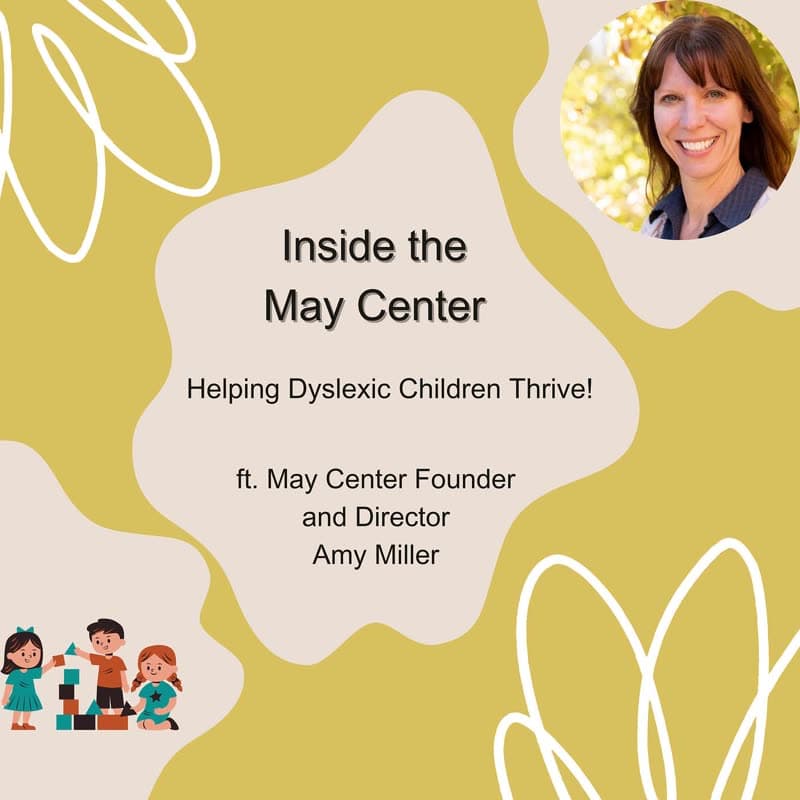
Inside the May Center: Helping Dyslexic Children Thrive ft. Founder and Director Amy Miller
About this episode
Amy Miller, founder and director of the May Center for Learning in Santa Fe, New Mexico, has dedicated her career to helping dyslexic children. In this interview we dig into the May Center for learning, as well as how Amy is helping educate the educators in New Mexico and beyond!
You can find the May Center at https://www.maycenter.org/
Transcript
Full transcript · 9,746 words · about 49 min to read. Press a timestamp to jump to that moment.
But it was incredible. I mean, we had these 8-, 9-, 10-year-olds standing up in front of a legislative committee talking about their experience with dyslexia, talking about why they thought this law was important, you know, that no other, no kids should feel stupid the way I felt stupid. It got me diagnosed when I was in third grade, and it was the most relieving day of my life because I finally had, like, kind of a place to hang my hat and say, see, I told you, I'm not lazy, definitely not stupid. I just learned differently, like, that's totally okay.
We dyslexics, we were often, you know, just set up for failure because, you know, we were given books and tasks that really are not appropriate for the level that we were at. So, how do you expect anyone to be open to learning when their entire relationship with reading, with learning, is physical pain? Wish I had understood when I was younger that the fact that my brain worked differently than people meant that I would be good at things in ways that other kids were not going to be good at.
I just assumed, I can't be dyslexic because letters don't jump up and down for me. Dyslexia is not a disorder. It is not a disease. Once you sort of own it and embrace it, then you can have the power to deal with it. It's sort of empowering and also enriching to the whole community. To those who don't understand what dyslexia is, that it's not a negative, it's not a problem. It's, like we keep saying, superpower.
Hey, everyone. We are Sonja and Nick, and this is Dyslexia Journey, and today we are excited to welcome Amy Miller to the show. Amy Miller is founder and executive director of May Center for Learning. Amy is a nationally certified academic language practitioner and a certified trainer for the SCE Multisensory Language Teaching Program. She is a frequent professional development provider for the New Mexico Public Education Department, school districts, schools, and nonprofit organizations, focusing on best practices for students with learning differences, the science of teaching structured reading and writing, and the importance of structuring the learning environment to improve executive functioning skills.
Amy is currently president of the International Dyslexia Association Southwest Branch. Amy also founded Dyslexia Justice League, a community that connects students with dyslexia with adult mentors through superhero stories and artistic expression as a vehicle for learning about self-advocacy and their own personal strengths. Where I come from, a book that Amy co-authored with May Center Students won the 2014 New Mexico slash Arizona Young Adult Book of the Year. Amy, welcome to Dyslexia Journey.
Thanks for having me. So, we always like to find out, you know, how this journey has been for you. Like, how did you get to where you are now? So, we'd be curious to hear about, you know, how that played out for you and sort of how you had that connection with learning differences and, you know, potentially dyslexia specifically. Yeah. Well, I was a literature major in school and then decided I was going to be an English teacher, a middle and high school English teacher.
I think like so many people, I had one hour of one day of my coursework to be a teacher devoted to learning differences. And I left that class really thinking like, oh, I won't have these kids in my classes. Like, they'll be in other people's classes, you know. And I just didn't leave with any deep understanding of it at all. And then I became a teacher, I started my career in the public schools in Washington, D.C., and then moved around the country and worked in both independent and public schools.
And no matter what, where I was, I always had kids in my class who I knew were really smart, who had some of the most intelligent things to contribute to our class discussions. But then when it came time, you know, for them to turn in a paper and I would see their writing, I would have this moment of shock where I would be like, this is not, this is unexpected. Given my experience of them in the classroom.
And so I didn't know what to do about that, nor did I have any, you know, resources to really turn to. But I always felt like I failed those kids. And that went on for a long time. And then I was here in Santa Fe working at a small independent school. And there was a parent at the school who had gone to the Shelton School in Dallas for her own children to be evaluated when they were sort of upper elementary and middle school age.
And she came back and they had been diagnosed with dyslexia. And she, you know, she was sort of evangelical about saying like, A, I don't understand how my kids made it this far in school without anyone recognizing this was going on. B, you know, we have nothing like this in the whole state of New Mexico. We have no resources like this at all. So I was interested and she was willing to fund myself and my co-founder of May Center to go there and see Shelton and get some training.
And at the time, I really just thought I was going as a teacher who wanted to be a better teacher for her kids. But when I went, I was so excited and blown away by the model that I saw at Shelton, not just because I was very interested in how they worked with kids who had learning differences, but really because I thought, oh, this is a shift in the paradigm of education that I'm really interested in.
So I started going there more and I became close with Dr. Joyce Pickering, who had been the head of school there for a long time and was there the head of their teacher institute. And so after, you know, several visits and several conversations and Joyce came here and, you know, I kept saying, God, I wish I wish New Mexico, not alone, let alone Santa Fe, but New Mexico as a whole. I wish we had something like this.
Joyce just was like, Amy, just do it, you know, just start something. So she was really instrumental in helping me believe that I could. So I left my teaching job and started a very, very small little, we started as a half day program. We had about, I think, 12 kids at the beginning of the year when we started our first year. And by the end of the year, we had 20. We were in like an old doctor's office, you know, just working with kids in their language therapy and executive functioning skills.
And then they would go to another school, several other schools in town for the rest of the day. But by the end of that first year, we had enough families that really wanted a full school. So we started Masoner, the school the next year. And then, you know, fast forward. So that was about 13 years ago. When I first started Masoner, I have two boys and they were five and two when I started the school.
When my younger one was seven, he was diagnosed with dyslexia. And I did not know that dyslexia ran in my family. I did not have any personal experience with it, really. But when he was identified, he had been at Masoner since kindergarten, just sort of because, you know, it's easy as a mom to have your kid where you are. So he'd been getting great instruction. But I was still like, by this point, of course, I knew what I was looking at.
And I was like, yes, I'm going on here. So, you know, it's interesting. I feel like in some ways I started in a whole school and organization for my own kid, even though I didn't really realize that's what I was doing at the time. Yeah, it's really interesting how that all played out. Yeah. Yeah. So now he's a sophomore in high school and doing great. Great. Interesting. Yeah. I mean, we got into this dyslexia education and dyslexia advocacy because of our daughter, who is dyslexic.
Neither of us are dyslexic. Yeah, I think that's often how it starts, right? Yeah. When you see it from the parent's perspective. And I think for me, being a parent of a child who's dyslexic allows me in my professional role to just have, you know, a lot of empathy and understanding for what it's like. I've really sat in that chair as well. So I appreciate and, you know, value that experience. Great.
Yeah, definitely. So let's talk a little bit more about May Center. So, you know, we're interested in everything about it. What does it look like now? How many students do you have? And then talk about sort of the overall philosophy and approach. Sure. So May Center, our school is still quite small. We have about 70 kids pre-K through eighth grade. Very small class sizes. So an average of six children per teacher in a classroom.
All of the kids who attend May Center, with the exception of some of our youngest kids, have been diagnosed with a learning disability and come to us. I mean, everybody's journey is unique. I mean, everybody's journey is unique, but typically how it happens, right, is that families have been trying to find a place that really works for their child. They've kind of had environments that haven't been very successful. Oftentimes we have kids who are coming into our environment feeling, you know, not smart or not good at school, although oftentimes their evaluation really tells a different story there, you know.
But that's how they felt because that's what they've experienced. And so our classrooms are really designed, we use a program called Montessori Applied to Children at Risk, which was developed by my mentor, Dr. Joyce Pickering, and the woman who Shelton is named after, Dr. June Shelton. And they, Dr. Shelton was a Montessorian by training, and Joyce was a speech language pathologist. So they got together and basically took the pedagogical principles of Montessori and the multisensory materials of Montessori, but paired it with best practice for kids who need a much more structured, explicit, and systematic approach to learning language.
And so what I love about that is our classrooms look like a Montessori classrooms, especially in the elementary. Kids are given the opportunity to work through a work cycle where they really are explicitly taught how to take responsibility for their learning, how to plan out their learning, you know, how to self-regulate, all of those pieces. And then they have very explicit language instruction built into the day. So we don't expect them to discover language, which I think in a traditional Montessori, you'll often see that.
And the smart kids that we work with will also often fake that they're, you know, sort of doing well with that piece of it. But then, you know, when you really sit down with them, you realize, oh, they've just been faking that piece of it. And they've been getting great things out of the other aspects of the environment, but not so much the language portion. So we take a very explicit approach to that.
So I would say, you know, our, our, when we think about, you know, what we hope for our students, it's number one, that they recognize themselves as smart, capable learners, that they recognize their strengths as well as the things that might be challenging for them. And that they know how to advocate for themselves when they leave us so that when they, you know, we have kids, usually kids either leave us at kind of the seventh grade mark, because here in Santa Fe, that's a typical time when kids transition to middle school.
Or they stay through eighth grade and then transition to high school. And in both cases, you know, our goal is we want them to be able to go anywhere they want and feel very successful doing that. And, you know, I would say that our approach is to look at what the strengths of that child is, are, and then to use those strengths to kind of support and access the weaknesses. Right. So that's, that's our philosophy.
That's what we do. And then we have a number of other elements to our work, because one of the things that we felt was so important was that we didn't want to just be a small independent school for kids who could afford to come to school here. You know, New Mexico is last in the nation for educational outcomes, last in the nation for reading scores right now. And so when we started May Center, we really wanted to kind of be a lab for best practice and then figure out how we could engage with the broader educational community in Santa Fe and New Mexico to, to influence outcomes overall.
And so more and more, that's the work that I'm engaged in and others of my colleagues as well. Okay. Wow. There's so much to dig into there, because I'm really curious about that work you're doing now. But before we leave off of May Center, and if this is, you know, possibly that I'm only a little bit familiar with Montessori, I'm curious, like what a typical day would look like. Does that, and maybe that's different for the more elementary age versus the middle school, but does that look like, like different subjects or how does that sort of play out?
Yeah. So in our, I'll talk about our elementary classrooms first. That's the kind of the most Montessori style that we have. So in those classrooms, kids come in, they have a morning meeting where they sit down and kind of go through a routine that's the same every morning, a little social emotional learning. And we have, we use what's called a mood meter. So the kids put their picture where they're feeling and they are welcome to talk about that a little bit if they want.
So just getting an opportunity to check in with themselves. And it's one of the things that when I give people tours, they often say, oh, we need a mood meter in our workplace. Because we need to know how our colleagues are. It's actually a really good idea. Anyway, so they do that. Then they go into their morning work cycle. And work cycle is basically, they have these things called work strips, which are like a visual checklist.
So it's a ribbon. And then it has different cards on the ribbon with pictures that represent the different tasks that the child is, we're hoping they're going to accomplish that day. And what I like about that is when kids come to us at first, the teacher can sort of decide what those cards are, put them on in the right order. And like the child just follows them in that order. But then as the child is here and gets familiarized with our environment, we're always wanting to kind of scaffold the amount of responsibility that we give the child.
So at some point, the responsibility starts to shift to the child where they, the teacher might say, okay, here's the cards that you need to complete today. But you get to choose the order, right? So giving them a little more autonomy and sort of that planning piece. And then if they're not complete, so then they take those cards off the strip one by one when they're done and they check them off.
They put them in a little folder. So it's a very, well, it's satisfying, I think, right? We all like to check things off. But it also is very concrete for them. Like, okay, I'm accomplishing things. So that's when they're in work cycle, then the teacher can pull smaller groups. So let's say there are six children in that classroom. We might have four kids working independently on different works from their work strip, most of which are, you know, pretty traditional-looking Montessori works.
And then the teacher's pulling two over for their language therapy time. So all of our teachers are certified language therapists or certified academic language practitioners. So they pull two kids over working right at the level they need to be at while the others are working independently. And then that cycle kind of happens, right? So it really allows for individualization, not only of the language therapy, but of all what they do in the classroom, although that language therapy, of course, is such a critical piece for our kids.
So then that work cycle might last 75 minutes, something like that. And, you know, if the teacher needs to take a pause and go help out a student or whatever, you know, that's happening. But it is pretty amazing to watch. A lot of our kids have attentional issues, right? It's one of the reasons they're with us is that in a larger environment, they struggled to regulate. And so when I give parents tours, they often say, I don't think my kid could do this, you know, because it's like a really sustained focus.
But I always tell them, like, they didn't start out this way, you know, like, if when a child comes to us new, we're meeting them right where they are. So maybe they're having, you know, five minutes of independent work to start with before they need to have a check-in, you know. So, yeah, and then they have some of the same specials you would see in other schools. So they have music, they have art, they have, what am I forgetting?
Oh, we have, like, a library class, which is really just about the love of reading, encouraging kids to enjoy reading. And that could be ear reading. It doesn't have to be actually reading. And, you know, they have lots of outdoor time. We have an outdoor program. Right now, kids are doing the ski and snowboard program once a week. So in some ways, it looks like a regular school. But it's just ensuring that we're putting the emphasis on the language development across the board.
And then as kids get older, yes, it does look a little more like subjects. So in the intermediate program, the kids typically have two main teachers. One teaches math science. The other teaches kind of the language arts. So they flip between those. And then they also have other specials as well. Interesting. Well, and I'm curious, too, about, I guess, these other pieces that always seem to provide or not provide, but to cause maybe sort of issues, particularly with people with learning differences in regular school.
Things like homework, whether, you know, I don't know how testing works in the Montessori method either. So, like, do you have to do things like, you know, compensations and accommodations? So, first of all, the assessment piece, most of the kids who come to us have already had like a full, either a neuropsych or an educational evaluation. But we do our own assessment that looks very similar to that, not quite as comprehensive, but some of the same tests, similar assessments as part of our admissions process.
So that's the first piece. We're getting more information, and it helps us to place kids in our different programs and that kind of thing. So we do that at the onset, and then once a year we do that on a rolling basis with the students so that families are getting that more sort of standardized normed data about their students' progress. We also use things like DIBELS. So internally we use DIBELS and DIBELS progress monitoring as a reading piece.
The C program that we use for our language therapy has built-in assessing. And then what I think is sometimes the most powerful is that in the Montessori classroom, teachers are really encouraged to use observation and record observation so that you can sort of gauge things like attention span, focus and concentration, even things like social skills, right? Those sort of areas that are a little less quantitative in terms of how we can measure them, but I think just as important or sometimes even more important for kids' long-term success.
And so we have a system that we have what we call the Mayway checklist, which is basically a number of different behaviors that we're looking for in students, and our teachers use those to kind of make observations and then report progress to parents. Remind me again what the second part of you had something before. Oh, yeah, homework. Yeah. Oh, yeah, homework. So important. Any other accommodations. Yes. So a lot of the kids, when they first come to us, have had really negative experiences with homework.
It's been a real source of stress in their home life. So no matter what the age of the child, for the first semester that they're with us, we do no homework at all. And that's intentional because we want to reset the relationship with homework. They're working really hard when they're here, really hard. And when they get home, they're exhausted. A lot of the kids that we know, you know, that have come to us, they kind of coasted sort of under the radar.
And one of their coping strategies was to kind of blend into the background in their classroom. Like, okay, if I don't draw attention to myself, then, you know, I won't be put on the spot. So now they're suddenly in a classroom with six or eight children. That's a big difference for them. And they feel sometimes a little bit under the spotlight at first. You know, it's uncomfortable. So I think that contributes to mental fatigue is what I'm trying to say.
So when they get home, they're tired. So after the first semester, then we really individualized homework. So we're looking at the age of the child, their previous relationships with homework, and the idea that we do want them to build that skill set so when they leave us, they can be successful. So as a rule, we don't send home anything that we haven't practiced in the classroom to the point where the teacher feels confident that the student can do it independently.
Now, that said, that doesn't mean that they are successful at doing it independently. They may have a lot of emotion around it that, you know, immediately they're like resistant. So if that happens, we always just tell the parent to communicate that to us, that we don't want it to become a battle at home. We would rather than have that child bring that work back and work with the teacher to complete it.
And usually what we see is over time, everybody starts to relax around the homework and that sort of, you know, trauma of the previous experience with it starts to abate. And so when that happens, then we can kind of reset it. And meanwhile, we're practicing all of the skills of planning, organizing, doing all those things every day so that the kids are building those skills. And then we don't do traditional accommodations because kind of everything in our whole environment is so individualized anyway.
But if a child came to us, say, from the public school setting and they already had an IEP that had accommodations documented, we have yearly meetings with the public school representative to keep all that paperwork current, to document what we're doing that works in the classroom so that when they return, if they return to the public school setting, there should be no gap in their services that they have all those things documented.
Yeah, that's an important aspect of it, actually, is the documentation. Yeah, absolutely. So it sounds like most of the students, is it safe to say, have some experience in public school before coming to my center? Yeah. Now we're getting, we're getting, sorry to interrupt you, we're getting more younger ones. So like more that are coming in at age four or five. And so, but even then, oftentimes they've been in a previous preschool.
Oftentimes a public preschool, where it was so overwhelming for them, the environment was very overwhelming. But yeah, anybody who's older than that, the vast majority have been in public school settings. Okay. Yeah. Yeah, I mean, that makes sense. In our case, we didn't really realize the extent of how much our daughter was struggling in public school until kind of halfway through first grade, I think. Yeah, I think, I think you're fortunate that you, you even had it, you know, come to your attention then.
Cause I think a lot of times here, I mean, it's, it's better. It's much, much better than when we started May Center. But, you know, there's still sometimes is that kind of, well, we just, let's just wait and see and everybody develops at their own pace and that kind of messaging, which, as we know is just detrimental because meanwhile, every day that child's sitting there looking around going, okay, why are these kids getting this?
And I'm not getting this, you know? And they start to tell themselves a story about that. And I think we see that happen so young. Yeah, for sure. yeah. So I was going to ask you about the sort of balance between remediation and challenging work, but it, it sounds like everything is so individualized that, it's kind of whatever the child needs. It is. And yeah, and it's a great question. I think, you know, we have a number of kids at our school who are identified as twice exceptional in the public school setting.
So they're identified as gifted and also with a learning difference. And, you know, those, I think those kids are the hardest to serve in all kinds of ways in any educational setting. certainly their past experiences in school was, were either, you know, they, their intellect was fed, but their basic skills were neglected or. their basic skills were, were attended to, and they were bored out of their minds and miserable every day, you know?
So we really try to, structure our curriculum around the strengths of people who have learning differences, people who have dyslexia, right? So looking at what are those intelligences that are really well-developed and then how can we create a curriculum that engages those? So for example, our, social studies and science curriculum is extremely hands-on. It's extremely, it's focused around, there are big topics, but it's also focused somewhat within those topics around student interests so that students have opportunities to dive deep and do research on a topic that they're really interested in.
there's lots and lots of project-based expression of learning, lots of artistic expression, you know, lots of acting it out or, you know, we've got lots of kids who that's their preferred method. So, so what, yeah, we, we really do try to engage those strengths overall, but then, yeah, it is individualized. And that's one of the luxuries of having so few kids in a class. It's not easy as a teacher, you know, sometimes when I interview teachers, they're like six kids, that's a dream, you know?
And then they get here and they're like, oh, I see. Cause it's really a flip, like from thinking about teaching a group of children and then maybe I'll just accommodate over here or over here, right. To like, okay, I'm teaching this, but each, I have to figure out how each child is accessing it and, you know, then, then really follow each child in terms of their, what they're showing me. And that's, that doesn't, that's not for everyone, for every teacher.
I think you have to have a certain, disposition yourself to want to do that. But for me, when I saw that at Shelton for the first time, I was like, oh, this is the kind of education I want to do, you know? Yeah. I was going to say also that these principles that are part of the May Center, like or attributes, I guess they're success attributes. I feel like I have a sense, I'll say what they are first, I guess, literacy, empowerment, advocacy, and principles.
I'm getting a strong sense of a lot of that already, particularly the literacy and empowerment. but I'm wondering if you want to say anything more about those. Sure. Yeah. We, we structure kind of everything we do around those principles and that's been really helpful for me, certainly. And I hope it is for everyone who's on our staff and our families as well. because it's kind of become like these things where we can check in with ourselves and say, okay, does this thing that we're now talking about or, you know, implementing support one of those four pillars?
And so to make that real clear connection, not only helps us to understand what we're doing more deeply, but it also helps us, you know, avoid going off the rails with something that seems like shiny and cool, but doesn't really serve those pillars. So, yeah. So literacy, you know, obviously we think of literacy, not just as reading and writing skills, although for a lot of the kids that come to us, that's the primary, reason they initially come, but also as like just all communication skills.
So the ability to communicate and collaborate in any environment, the ability to, you know, understand, any kind of communication that's coming at me and then be able to accurately express myself. and then, empowerment. Yeah. You know, for us, it's the idea that, we want our kids to be able to take responsibility for the themselves and their destiny, to recognize that they have that capacity to do that. and, and that they can, you know, follow the things they want to follow basically.
So that's a work in progress for all of us, I think. and then advocacy, you know, I think is identifying the things that you care about and then how do you, how do you negotiate the world in a way that expresses that, right? So, we give our students opportunities to do things like, you know, choose a cause that's meaningful to them and, do work for that cause. we do a lot like with dyslexia justice league, we often have adults come in and talk about their experience with dyslexia, share that with the kids.
Also, then the kids have done things like, we're about to be engaged again in this legislative session, but in 2019, I was very involved in, a bill that became law that mandates now that, all first graders are screened for dyslexia in New Mexico and also mandated, education in the science of reading and structured literacy for all elementary teachers. So I shared that with the kids, at the beginning of that session, really just as a, Hey, what do you guys think about this?
You know, and then the kids really identified, we want to go to the roundhouse and we want to testify at these committee hearings. So they did and, we're really fortunate. We're just like two blocks from the roundhouse here at our location. So we literally walked them down there several times, but it was incredible. I mean, we had these eight, nine, 10 year olds standing up in front of a legislative committee talking about their experience with dyslexia, talking about why they thought this law was important, you know, that no other, no kids should feel stupid the way I felt stupid.
I mean, really, you know, meaningful, authentic, stuff. so, and now we have another, bill that's coming up in this legislative cycle that I hope, we, I, I hope our kids will want to get involved in again. So that's the advocacy piece. It's also being able to advocate with teachers and parents about what's best for them. And then the principles piece is kind of that, you know, sort of meta over the whole thing.
Like, how do I even know what I value, what I care about? how do I live a life that's in alignment with that? You know, so again, we just try to have that theme running through a lot of what we, a lot of what we do here. Wow. That's amazing to hear about the, about them testifying for that committee. Yeah, it was really amazing. Cool. And wonderful to hear about those, that, those laws that passed as well.
Yeah. Yeah. Yeah. Yeah. It's made a huge difference in New Mexico already. We have a ways to go. It's a huge, huge, huge start. Yeah. We had a similar one in Colorado. They didn't make it out of committee a year or two. Oh, really? Oh, very good. They're still, they're still, they're still, they're still about to come here, hopefully. Yeah. So I guess to kind of round out the discussion of, the school, can you talk about what, the kind of typical, typical paths are for the Mesa undergraduates?
like you mentioned that your son is in, public school now, I think, is that kind of the typical path to go to like a public middle school or public high school? It really varies. we have kids who've basically done really well at almost every high school here in Santa Fe, which, you know, we're really proud of. there's one kind of, you know, typical independent sort of small private school that, a lot of families, want their children to go to.
One of the things I'm most proud of is not only do our kids get accepted there, but, we often hear feedback from them that their writing skills are, are oftentimes some of the best in, in the class, which I think is amazing. given where, you know, who they are, we have, we have an art school, New Mexico school for the arts that's based here in Santa Fe. It's a statewide charter school.
we have several kids who end up there because they're have real interest and passion in the arts. And so that's a great fit for them. we absolutely have kids, do really well at high, public high schools and charters. we have a one charter, particularly that we've had kind of a closer relationship with, in that, in the past, we've actually had a tutor from Mason or go over there and work with not only our kids, but others who've been identified as, benefiting from that.
And, so that's been really nice. yeah, so, you know, they do well and now we already, you know, we've been around long enough now that we have lots of kids in college and a couple, some that are even in graduate school at this point. So, we're actually in the process of kind of gathering up stories about our alumni. and, you know, some of them are just incredible. We've got one who's a senior at Vanderbilt this year, and she sent me, a paper that she had written about being identified with dyslexia, which she wasn't identified till she was in sixth grade.
And then she came to May Center for her middle school years. but, you know, that's my favorite thing in the world. When you get to see where kids are now and their, their own kind of ownership and reflection on their whole process and experience. So, yeah, it's fun now that we're, we've been around a while to see where they end up. Yeah, that's great. Yeah. so I, I'd be curious to hear a lot more about, cause you mentioned, you started mentioning this, towards the beginning there about the work that you're doing to sort of expand all of this beyond May Center.
I mean, if there's in these ways, like where you're working with that other school, but it sounds like there's also some component of, professional development with teachers and consultation and that kind of thing. Yeah. So, we, when we started the school, we also started, a teacher Institute. and, the intention of the teacher Institute was always to use our school as a lab for best practice, but then to figure out how we could support, educational outcomes and particularly literacy outcomes in New Mexico.
So we started just by, oh, and one important piece of that is, we offer a national certification to become a certified academic language practitioner. There's only one other organization in New Mexico that offers something similar. So, really anybody in New Mexico who wants to be a dyslexia specialist, we, we offer that avenue for them. now since the pandemic, it's all on zoom. So we actually work with people from all over the country, but that was kind of how we started.
So we had people who would just self-select teachers who'd be like, I really want to pursue this. so we started doing that and then slowly, slowly they would tell their colleagues, right. Or they would tell their principal. So then we started going into schools and kind of doing more like one-off trainings, like an overview of learning differences or a simulation of learning differences or the basic elements of, you know, the science of reading, those kinds of things.
but, but over time that really gained momentum. And so now that's, it's actually a huge part of our work. so we work with, schools and districts all around the state of New Mexico. Most of the time now we do that as a more sustained relationship. So for example, I'm in my third year of, of coaching principals in Roswell, Roswell has been very, it's one of our communities in New Mexico that I've been so impressed by.
They've been so aggressive about, making literacy a priority. And so they've actually identified, I think it's, I don't want to get it wrong. I want to say it's, it's between six and eight, literacy model schools within their district, that their principals have committed to a number of things regarding literacy. So I go and work with, in my second cohort now of principals, to help them develop kind of systematic leadership around literacy, develop, you know, what do I look for when I go into classrooms, identify areas of needed professional development, all of that.
in other communities like Rio Dozo, we're working with one elementary and we're really coaching the teachers on the implementation of the science of reading. all of our teachers in the state of New Mexico are required to take elementary teachers are required to take letters, which, was part of that initial 2019 bill. and then what we see is that letters provides them with that really great foundation for the science of reading. But oftentimes when they're in their classrooms, the bridge to practice isn't as clear for them.
So they're like, okay, I, now I have all this knowledge, but what do I actually do with the kids? So our Masoner coaches, will spend, you know, a year or two years working with a school, to coach on those practices within, in the classroom with, with kids. and then one of the relationships that I'm most proud of is we've been working for, this is our fourth year, working with, an elementary school in Puaque, New Mexico, which, is Puaque is one of our Northern Pueblos in New Mexico.
and we've trained the whole school, every teacher in the school, in our dyslexia specialist program, every teacher in the whole school is using it as their primary curriculum, which some might argue, well, not everybody's dyslexic. No, but when you're in a state where 22% of, you know, third graders are reading at proficient levels, you're absolutely right. Not everybody is, not everybody is dyslexic, but everybody is, is in need of some systematic instruction, right?
And that school in Puaque is very representative of our state as a whole. So anyway, we've been working with them for four years. We have a literacy coach who's there once a week still. and, and, the data from 2022, 23, demonstrated they made the largest literacy gains in the state of New Mexico, which, you know, to me is so important because what it means is that, yes, we have this ideal environment here in all kinds of ways.
but the practices that we're doing here can be translated to a larger public school setting. And once teachers have the support and understanding, to do that and don't feel, you know, one of the major things we really work on is creating a relationship that's trusting that doesn't feel evaluative or like, you know, oh my goodness, now I have to do another thing. Right. but what we see is that it, it does make an impact and it is transferable.
So that's exciting to me because my, my dream is that New Mexico is, I don't know. I mean, I don't even want to be like in the top 10 in the country, but I really would like to see us, do what Mississippi has done, you know, really, really improve literacy outcomes for our kids. So that's the work we do. We also engage in legislative, legislative advocacy. we do public events. We just screened the right to read, the last two Saturdays, one in Albuquerque, one here in Santa Fe.
So we just try to do as much as we can, to engage, the community. Well, it's a lot. I mean, it's wonderful to hear, you know, and those changes and the direct effects that it's having and all of it. That's wonderful. Yeah. I was thinking as you, as you were talking that one of, so we, put our daughter in, in private school for, I guess it was several different schools, but it was third through eighth grade.
so about six years of private school and, none of them were, specifically for people with dyslexia. but I, I often thought, and, you know, to carry out that, of course we were, you know, privileged to be able to have her go to private school. but I often thought that, you know, a lot of what you're paying for in private school is the kind of small class sizes and individualized attention. And so it's really, exciting to hear that you're able to, I guess, help, teachers in school settings where that's, that's never going to happen.
Like in a public school, you're never going to have six kids per teacher, right? and so, yeah, it's really exciting to hear that that can be kind of the methods and pedagogy and, and whatever that you've explored in, in, and developed in such a small school setting can be applied to, settings that are less ideal. Yeah, I, I agree. And, you know, what I would say a lot of it has to do with is, first of all, you just have to make sure that that tier one instruction is strong and aligned with the science of reading.
but then the next piece, and I think this is often where, schools really struggle with implementation is that small group intervention is just critical. And so a lot of the work that we do, we sort of tackle tier one first, but then where we end up kind of really sinking in often is helping our teachers figure out, okay, I've got 20 some kids in my class. I would like to be able to pull four at a time to a small group table for 20 minutes, you know, a day or 15 minutes a day.
but what do I do? How do I have the other kids, you know, supported? Some have an assistant, a lot don't. there's a lot of behavioral needs in the classroom, right? It's challenging. So that's where we try to take the principles of the Makar classroom, the Montessori applied to children at risk and look at how can some of that be applied has to be modified, but how can it be applied in that larger classroom setting so that kids can start to learn to take more responsibility for their learning can be a little more self-regulated instead of only regulated by the teacher, which is, you know, really challenging.
but we're seeing it happen in a number of schools. And, I will tell you for the teachers, you want to talk about empowering, like for the teachers, it feels so much better, you know, they feel more successful. They feel like, oh, I'm not just giving my kids academic skills. I'm also teaching them how to self-regulate, which is like such an important skill, you know? so that piece I feel like is something, you know, I don't know if it's, I would say unique, but it's a passion of mine that I think we, we bring.
Yeah. And it sounds like that may be your biggest advice or tip for teachers is that it can be empowering for them and that it's possible even, but I didn't, yeah. What, what, what other sort of, advice would you say you'd give to teachers about this whole, about all of this? Yeah. Maybe to a teacher, like here in Colorado. Right. Yeah. Let's say there's two, two. They're not able to benefit from their, you know, direct instruction in New Mexico.
Yeah. Yeah. So less maybe about, you know, the exact, that exact piece of what they're bringing in, but how to start even thinking about all this. Yeah. well, first of all, I, I always want to acknowledge. I think education is one of the only fields where currently we are saying to teachers, okay, we know you went to school for this and we know that you spent all this time and effort and money on your education.
And now we know that you're working a full-time job. And also like, now we want you to learn all this new stuff. so it's really, a big ask of teachers and teachers are superheroes for that reason. Well, for many reasons. so I think to me, it's starting with one manageable change is the most important thing because it can be way overwhelming if you try to think I got to do everything differently.
So for me, the very first thing is if I'm not teaching an explicit phonemic awareness curriculum and I teach second grade or younger, that's the first thing that I want to look to implement. Can I add in, you know, 10 to 15 minutes even of explicit phonemic awareness instruction each day? Because we know that that's going to have the greatest impact on young readers. if I teach older students, right? Oftentimes like this was my experience as a middle school teacher.
I was like, I'm not a reading teacher. I teach content, right? So I teach novels. I can talk about a good novel, you know, love talking about a good novel, but like, I don't know how, when I look at these kids who can't read the words in the novel, I don't know what to do for them, you know? So I would say that first of all, just being curious about your students and recognizing that, okay, yes, they should have learned this stuff before they got to me, but they didn't.
So here are the kids I have sitting in the chairs. They're not like the platonic ideal of students. They're like real humans, right? And here they are. and if they don't have these basic skills, they're not going to be successful. So, if I don't know how to teach them, what resources can I refer them to in order to help them learn that? Are there online programs that can, now there are some really good structured literacy online programs that can be helpful.
You know, I'm not a big fan. I always think a real teaching is better with a real human. but not everybody has access to that. and then also just helping, I think one of the biggest things is if you see a child who you know is smart, but they're not successful, don't just think it's somebody else's problem. I think that's been a lot of it, you know, to help just recognize like, Hey, I'm curious about why this is difficult.
And to say to that child, even, Hey, I see you, I see you're smart. And I see that readings hard and that has nothing to do with how smart you are, you know, because I think we don't all have to be an expert at literacy, but as teachers, we have this amazing power to change kids' self-image, you know? And that to me is more important than any academic skill. so those are the things that come to mind just off the top of my head.
Yeah. That last point was really, really great, great advice. But I think pulling in the piece about the overwhelm, because I even think of, you know, sometimes maybe we subconsciously, if we see a situation where we are, have some responsibility towards it, you know, if it feels like, Oh, we'd have to completely, you know, do everything, you know, like if you, if you take it in that kind of a way, like even just with like trying to find out what's going on, I think that that attitude of like, just take those steps and that, and that those steps can be important and it doesn't have to be like this complete jump into changing your entire life or something.
Right. I mean, I think a lot of things in life are like that. We just have to take the next step, not like thinking about the 20 steps that follow. Right, right. Exactly. Because I think otherwise our subconscious can help us to avoid things. Yeah, exactly. so we like to, close all of our interviews with, kind of two, two questions. The first is, if you could tell the general public one thing about dyslexia that you think they need to know, what would it be?
Well, the first thing that always comes to mind, well, I got to, can I say to the first thing that came to mind immediately is just sort of tagging onto what I already said, which that is dyslexia, has nothing to do with intelligence. I think I still run into people all the time who have that misconception. and then the second thing is that the earlier that we identify a brain that's processing language differently, the better the outcomes for that kid.
And, it has nothing to do with, you know, I, I don't even care whether we label it dyslexia or not as not, you know, nothing to do with special education, nothing to do with any of that, but it's that if even before our child learns to read, if we can identify, oh, their brain isn't processing the sounds as consistently as typical brain, we can start to do things with that child, with their regular old teacher or with their parent at home.
We can start to play those sound games. We can start to work out that part of their brain and that will impact the rest of their life. And I think that oftentimes there's still sort of this mentality that, I mean, when I started May Center, New Mexico was still very much of the belief you couldn't even identify dyslexia until kids were in third grade because that's when they fail. And so we have to wait to see if they fail.
And then if they haven't learned to read by then, and there's several grade levels behind, okay, then we'll identify it. Of course, the sad thing there is that we wasted all that time and the child's self-image was negatively impacted. So the earlier that we're able to see, oh, you know, because what I always say to families is, so even like they'll say to me, well, my five, if my five-year-old starts language therapy, right, at May Center, and then by the time they're seven, we realize they're not dyslexic, then what?
And I'm like, well, then they got some really good reading instruction, you know, like it's not like it's going to hurt them. You know, I think we come from this old special education paradigm where we were so afraid of labeling and the stigma attached to it for really good reasons. I totally understand that. But it doesn't have to be that way. We can take it just as a, hey, I want to give my kid every advantage if I can.
And so that's certainly the approach I try to take with public schools. I don't even care if this has to do with IEPs and all this other nonsense, but can we identify the kids who are in your class right now in first grade who are struggling and let's just give them what they need in your class. We can do that. Yeah, when it's so logical as you're saying that, but you're right that that's just not, yeah.
I mean, I don't know if I've ever heard it spoken exactly that way. You know, there's such the model of like, or then get identified first, you know, that kind of thing. I'm not saying that I am for identification in a normal way, but I just think there's so many kids who are not identified and there's so many kids who are struggling readers for other reasons who also benefit from these same practices.
Exactly. Exactly. How about for parents? How about for the parents out there? Any particular advice you'd like to give to them? Yeah.
So as a parent myself, I recognize that sometimes our own self-concepts and our own beliefs around, you know, we have this child, the child comes into the world. We have all these hopes and dreams for that child. A lot of them are extensions of our own hopes and dreams, right? Yeah. And then whatever happens with that kid and dyslexia is just one of a thousand possibilities. They start to individuate, right? They start to be their own person.
And I sometimes see families who go sort of two different ways around that, or sometimes both ways at the same time, there's one feeling of like, almost like, well, this child isn't living up to, not living up, but it isn't, isn't becoming what I thought they were going to be. So with that can come some like, well, they're not trying hard enough, right? So sometimes you get that approach where it's like, if we just try harder, if we just work harder, if we just do more of the same thing, then it's going to get better.
And, you know, I never actually see that being the case. It gets worse because it damages your relationship, which is the last thing that any parent wants to do. So that's one route or another route is sort of the, the, another possibility of the same route, which is like, well, I want to protect my child from everything because I don't want them to be hurt. Right. Like, so for example, I don't want them to be labeled because I don't want them to feel different or I, you know, I want to protect them from the expectations of the teacher or whatever.
And I also very much understand that instinct. And sometimes there are real things we want, we should be protecting our kids from, but, but being an advocate for your kid is different than protecting your child. So I think that distinction and understanding that distinction is really important because we want to empower our kids to be able ultimately to advocate for themselves, to understand themselves, right? To be independent. And so there's ways in which we can advocate for them and help them along that process.
And there are ways in which we can actually stunt their growth in that way, even with the best of intentions. So I would encourage parents to really explore what's, how can I best support my child with dyslexia in a way that gets them what they need. So I'm advocating for them in that way. And then also communicates to them clearly what their responsibility is in this piece at an age appropriate level so that they start to see, oh, my parent does believe that I'm capable.
They do see me as somebody who can do this. I think that's a really important thing. Yeah. That's, those are such important distinctions. They are. Well said. Well said. Yeah. So I guess to wrap up, where can people find you and May Center online? Sure. So we're just maycenter.org is our website. And on the website, you can find more information about the school and also more information about the Teacher Institute and any upcoming events that we're engaging in.
And then we're also on social media. We're on both Instagram and Facebook. It's May Center for Learning. Great. And we'll put that, of course, in the description boxes as well. So thank you so much. This has been wonderful. And not only thank you for coming here and sharing all this, but for all the work that you're doing in so many ways and so many levels, big levels, individual levels. It's wonderful to hear and very inspiring.
Well, thank you. It was a great conversation and it was really nice to meet you guys.
More from the show
The Importance of Early Dyslexia Identification ft. Amy Dobronyi of COKID
Amy Dobronyi (pronounced duh-BRO-nee) is a Co-founder and Co-chair of COKID (Colorado Kids Identified with Dyslexia - https://www.cokid.org/), a grassroots parent group, whose mission is to improve the lives of individuals with dyslexia through advocacy, education, and legislation.
Ensuring Support For ALL Kids Identified With Dyslexia ft. Amy Dobronyi of COKID
Amy Dobronyi (pronounced duh-BRO-nee) is a Co-founder and Co-chair of COKID (Colorado Kids Identified with Dyslexia - https://www.cokid.org/), a grassroots parent group, whose mission is to improve the lives of individuals with dyslexia through advocacy, education, and legislation.
The Flash Method for Mastering Dyslexia ft. Educator Kim Parra
Kim Parra is a teacher and inventor of the Flash Method for helping dyslexic kids. In this interview, she shares her innovative and fascinating approach to helping dyslexic kids! You can find her online at https://www.flashcardread.com/
Never miss an episode
New episodes every two weeks. Follow wherever you listen.