
About this episode
In this episode, we dig into the research around the heritability of dyslexia.
Here are our sources for this discussion:
This is the 2021 study in Sweden that showed a heritability of 52%: https://onlinelibrary.wiley.com/doi/full/10.1002/dys.1681
This 2012 study identified 6 candidate genes: https://www.sciencedirect.com/science/article/abs/pii/S0140673612601986
A study from 2020. https://www.nature.com/articles/s41380-020-00898-x
An explanation of what we mean by heritability: https://medlineplus.gov/genetics/understanding/inheritance/heritability/
An overview of dyslexia and heritability: https://www.understood.org/en/articles/is-dyslexia-genetic
A 2007 literature review of the genetics of dyslexia: https://www.ncbi.nlm.nih.gov/pmc/articles/PMC2597981/
And older (1987) study: https://www.nature.com/articles/329537a0
Transcript
Full transcript · 1,425 words · about 7 min to read. Press a timestamp to jump to that moment.
Does dyslexia run in families? Today we'll dig into a bit of the research on this topic.
Hey everyone, we're Nick and Sonja and this is Dyslexia Journey, where we help you support the dyslexic kid in your life. So does dyslexia run in families? You know, for example, is a parent with dyslexia more likely than a parent without dyslexia to have a child with dyslexia? So anecdotally, we tend to think this is true. It seems to be true in our family. For example, my mom has some dyslexic traits and believes that she, you know, she was never diagnosed, but she believes that she would have been diagnosed with dyslexia if she had had that opportunity to be assessed.
And then there's some other, you know, more extended family as well. Yeah, like my grandmother was never diagnosed either, but we're pretty sure that she had dyslexia as well. So even though neither Sonja nor I have been diagnosed with dyslexia, there definitely are traits within our family. Right. So if you're actually looking at studies, though, like really looking at the science here, is it actually true? Okay, so the people who have done the research in this area are really trying to answer the question, is dyslexia genetic?
And the answer does turn out to be yes, that it is. So various studies have estimated the heritability of dyslexia at between 40 and 60 percent. For example, a study, one of the most recent ones that I could find, that was published just a couple of years ago in 2021, in a journal called Dyslexia, appropriately enough, estimated the heritability of dyslexia in the population at 52 percent. And so I guess, let me just quickly try to explain what the heritability percentage means, because I think that's not necessarily intuitive.
And so heritability is a measure of how well genetic differences account for observed differences in traits. So a heritability of zero percent would mean that it's entirely non-genetic. So that's something like, so entirely environmental, like what language you speak or what religion you practice. A heritability of 100 percent would mean that it's entirely genetic. And most things are somewhere in the middle, right? And if you're wondering how it can be in the middle, how can it be partly genetic or not?
It can be because sometimes traits are sort of modified by our experiences, too. So it's like you have to maybe also have certain experiences for the trait to completely be expressed. Yes. Yeah. So genetics and environment, there's a complicated interaction there with almost everything. Yeah. Yep. And just another caveat is that the heritability number doesn't apply to individuals. So this is something also that's a little bit confusing. So if we say that dyslexia is 52 percent heritable, it doesn't mean that if someone has dyslexia traits that like 52 percent of their traits came from their genetics and 48 percent came from their environment.
Like it doesn't mean that it doesn't apply at an individual level. It's at the population level. It also doesn't mean that if you have dyslexia or your partner has dyslexia that you have a 52 percent chance of having a child with dyslexia. It's it's it's it's it's a measure across the total population. Right. Right. Right. And so the way that this is studied, the way that scientists study this is generally by looking at twins.
Yeah. So usually this would, of course, be identical twins because they have identical DNA. So to take a simple example, if in a study of identical twins, you find that 50 percent of the time one twin has dyslexia and the other one also does, that would mean that dyslexia would be 50 percent heritable. So that's how they come up with that heritability percentage. Right. And that's interesting because in this particular study that I mentioned, they did come up with a heritability number of 52 percent, which is means about.
So if you're looking at identical twins, which they actually did in that study, if one of the pair of twins has dyslexia trace, then then about 50 percent of the time, the other one does as well. Yeah. And they actually just because kind of interesting, they actually looked at nine year old twins and they were interviewing one thousand six hundred and eighty parents in that study. So they did this twin study.
Yeah. And I guess one caveat there is that it was a little more complicated because they also did interview parents. of non-identical twins as well in that study. And then they did some complicated math to to sort of based on the fact that non-identical twins share 50 percent of their DNA to come up with a sort of an overall heritability number. But that's not super important. It's easiest to understand if you just think about the identical twins.
Right. And I mean, honestly, that would probably affect mostly like the actual percentages or numbers. I think that the key point is that they're finding significant, significant heritability here. Yeah. I guess looking at these studies or looking at this particular study, we have a couple sort of thoughts and follow up thoughts and questions about it. So first is this this study that we've been talking about was actually done in Sweden, where presumably the native language of almost all of the twins involved was Swedish.
So one obvious question is, is the heritability percentage the same for kids learning English or other languages as a first language? Right. Right. And then another sort of caveat is that it was self-reporting by the parents based on a question. It was a standard questionnaire, but because it's self-reporting and especially given what we know about things like stealth dyslexia, it's definitely possible that it could be undercounting the actual number of kids with dyslexia, because, you know, a lot of people just, you know, we weren't aware of that, you know, until our daughter was diagnosed with stealth dyslexia, that even existed.
Right. So just giving a parent a short questionnaire is not going to be the same as having a day and a half of assessment.
And then on the other hand, or maybe not on the other hand, maybe agreeing or maybe even augmenting that problem with self-reported data. It feels like parents who are more attuned to the problem of dyslexia might be more likely to indicate that both of their children have dyslexia. Right. So so like the concordance between twins might be elevated here if you're aware of a problem like like if one of, for example, if one of your two twins has sort of minor dyslexic traits and then and then the other twin has sort of really strong dyslexic traits versus the other twin has no dyslexic traits.
You might be more likely to identify the first twin as dyslexic, the one with more minor traits because it's like you're more aware because of the twin with the stronger dyslexic traits of dyslexia at all. Whereas you might miss it if you're not not seeing it, you know, in the family otherwise. Right. So that might, I guess, possibly overcount the heritability number. Yeah. And so I guess just overall, this leads to the question of what causes dyslexia, you know, what causes it as a brain difference, we should say, really.
Why are these there are these brain differences if it's around 50 percent heritability? Does that mean it's genetic or not? I mean, I think we can say that there is a genetic component just from these tests. And then is there a way that people develop it, though, if it's not inherited? And we don't really know. Like, it's just it's complicated. So we don't really know all the details about the genetics or the environment, mental pieces.
But we can still we still feel pretty confident in saying that the genetics plays a part. Definitely. Yeah. And then I did forget to mention earlier when I was talking about Swedish as a first language that there are other studies, which I'll link in the notes that have been done on English speaking populations that do also indicate a heritability number around the same between 40 and 60 percent. Right. Do you notice that family members in your extended family seem to either have dyslexia or have dyslexic traits?
We'd love to hear about in the comments.
More from the show
The Importance of Early Dyslexia Identification ft. Amy Dobronyi of COKID
Amy Dobronyi (pronounced duh-BRO-nee) is a Co-founder and Co-chair of COKID (Colorado Kids Identified with Dyslexia - https://www.cokid.org/), a grassroots parent group, whose mission is to improve the lives of individuals with dyslexia through advocacy, education, and legislation.
Ensuring Support For ALL Kids Identified With Dyslexia ft. Amy Dobronyi of COKID
Amy Dobronyi (pronounced duh-BRO-nee) is a Co-founder and Co-chair of COKID (Colorado Kids Identified with Dyslexia - https://www.cokid.org/), a grassroots parent group, whose mission is to improve the lives of individuals with dyslexia through advocacy, education, and legislation.
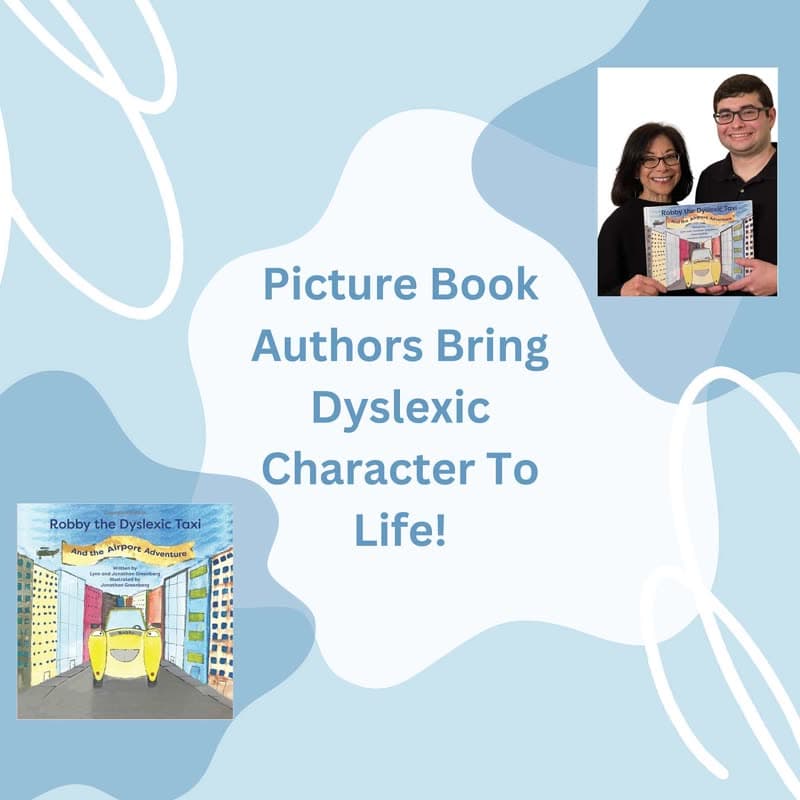
The Importance of Dyslexic Role Models, ft. Picture Book Authors Lynn and Jonathan Greenberg
Lynn and Jonathan Greenberg are the authors of the picture book, “Robby the Dyslexic Taxi And the Airport Adventure”, which is available at https://www.amazon.com/Robby-Dyslexic-Taxi-Airport-Adventure/dp/B0BTZVVX8H/ We are excited to share our interview with them, in which we explore what life was like for Jonathan…
Never miss an episode
New episodes every two weeks. Follow wherever you listen.