
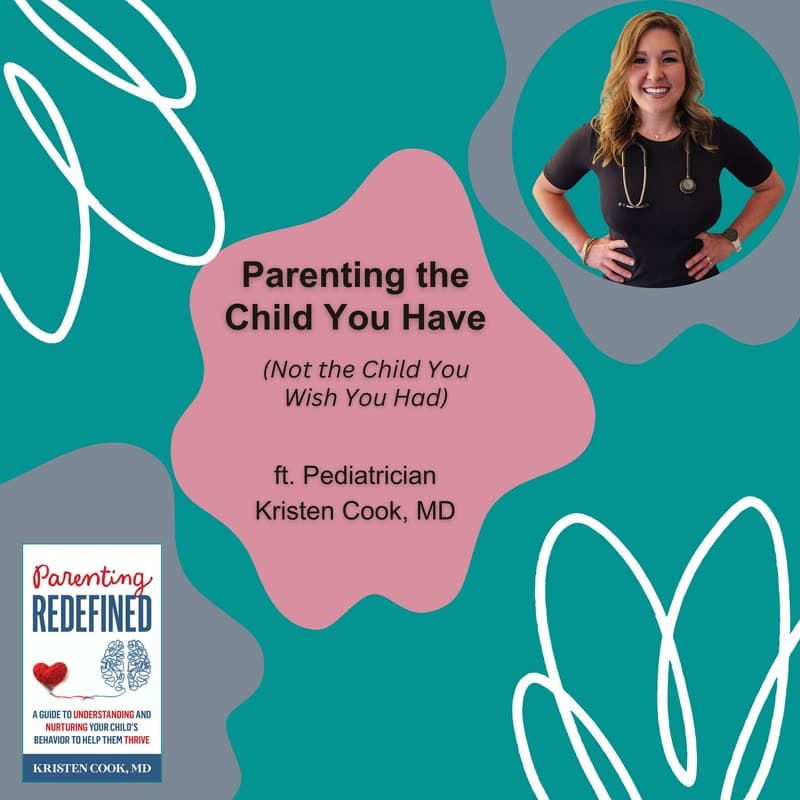
Parenting the Child You Have ft. Pediatrician Kristen Cook, MD
About this episode
Have you ever wished that you could sit down with your child's pediatrician and talk about dyslexia, neurodiversity, and parenting? Well, this is your chance! We recently enjoyed a conversation with Dr. Kristen Cook, pediatrician and author, about neurodiversity, dyslexia, the role of pediatricians, and the general parenting challenges that come with parenting neurodiverse kids.
Kristen Cook, MD is a pediatrician and author of "Parenting Redefined: A Guide to Understanding and Nurturing Your Child's Behavior to Help Them Thrive." You can find Dr. Cook at https://www.kristencookmd.com/, and you can find her book at https://www.amazon.com/dp/B0FZLV5TY4.
Transcript
Full transcript · 5,006 words · about 25 min to read. Press a timestamp to jump to that moment.
Different isn't bad. It's just different. So if we can normalize that difference, I think that's one of the first steps in helping our children navigate whatever situation it is, whether it's dyslexia, whether it's another medical condition. This is just part of who you are, and it's not bad. It's just different.
It got me diagnosed when I was in third grade, and it was the most relieving day of my life because I finally had, like, kind of a place to hang my hat and say, see, I told you, I'm not lazy, definitely not stupid. I just learned differently, like, that's totally okay. We were dyslexics. We were often, you know, just set up for failure because, you know, we were given books and tasks that really are not appropriate for the level that we were at.
So how do you expect anyone to be open to learning when their entire relationship with reading, with learning, is physical pain? I wish I had understood when I was younger that the fact that my brain worked differently than people meant that I would be good at things in ways that other kids were not going to be good at. I just assumed I can't be dyslexic because letters don't jump up and down for me.
Dyslexia is not a disorder. It is not a disease. Once you sort of own it and embrace it, then you can have the power to deal with it. It's sort of empowering and also enriching to the whole community. To those who don't understand what dyslexia is, that it's not a negative. It's not a problem. It's, like we keep saying, superpower. Hey, everyone. We are Sonja and Nick, and this is Dyslexia Journey.
And today, we are welcoming pediatrician and parenting expert, Dr. Kristen Cook. Dr. Cook, welcome to the show. Thank you so much for having me. I'm thrilled to be here. So we definitely want to talk soon about your new book, Parenting Redefined, and, you know, approaching questions that parents may have that might be helpful from that information. But we've never had a pediatrician on the show before, so we're also very curious to get that perspective, so we'll start with that.
So in terms of neurodiversity in general and dyslexia in particular, we're wondering what that's like for you as a pediatrician, how you see that come into the office, and what's your role? Yeah, that's a great question. So neurodiversity is such an important topic, and it's really interesting because a lot of parents come to me, and they're like, Dr. Cook, I want to know if my child is autistic, which, by the way, is just a portion of the neurodiversity spectrum.
But it's really important for people to understand that most general pediatricians are not qualified to evaluate a child for autism spectrum disorder. It's really best if there is a multidisciplinary approach to it, and there are a lot of wonderful, highly qualified specialty clinics out there available to help parents to determine if their child is on the autism spectrum disorder. But as a general pediatrician, that is not a diagnosis that I feel comfortable making.
Yeah, so that's our understanding with, you know, dyslexia as well, is that, is it called a neuropsychologist? Yes, that's that usually people go to for the diagnosis, but I know a lot of people think that, like, the pediatrician is the first stop. So it sounds like your role is, is in a way to give that information and for a referral. Yes. So I feel that my role is to guide parents towards the appropriate diagnostic process.
And a pediatric neuropsychologist, if you can find one, amazing. That is, to me, the gold standard in kind of assessing for any type of neurodiverse condition. Mm-hmm, mm-hmm, yeah. Yeah, so if someone comes, if a parent comes in and, you know, they have a school-aged, young school-aged kid, and as part of, as part of a general checkup, they, they sort of mention that, oh, yeah, you know, here she is, is below grade level in reading.
Like, what, would you basically then refer them out to a specialist? Absolutely, yeah, absolutely. You know, the other thing, too, is general pediatricians are not trained in school learning disorders. That's, that's not part of our wheelhouse. and, and it's challenging sometimes because as a general pediatrician, I don't necessarily understand the school support structures. And so, sometimes it's, it's, it's frustrating for, for me because I have to tell a parent, well, you need to talk to your child's teacher.
You need to talk to the principal. You need to, to go through the school system. And then it kind of feels like I'm not helping them enough, which is frustrating. And I wish there were more support in place for parents that were concerned about a potential learning disorder for their child. Yes, yes. Yeah. And we're assuming, that some of the ways you might see some of this come into your office is actually with maybe broader categories of things.
And this starts to get into your role as a parenting expert here. So, yeah, I'm curious, sort of just first from the pediatrician perspective, and then we'll switch fully over to the book. what, like, how do you see that come in, in terms of struggles? Like, what is that like from a pediatrician's perspective? Do you see sort of stress in families and that kind of thing? Because I know there's some questions, I'm mostly, it's focused, you know, on different things in a pediatrician visit.
But, you know, sometimes there's those, those social type questions that get asked. Yeah, it really kind of varies depending on, depending on the child's age. You know, I have a lot of parents of toddlers that are concerned that their child doesn't seem to want to play with other kids. Well, that's actually developmentally appropriate in the toddler stage. If that same concern was raised in a school-age kid, that's a, that's a different story.
So, it really kind of depends on the child's developmental level in terms of what kind of counseling that I provide. Yes, that makes sense. And perhaps referrals sometimes to therapy or something like that as well? Yes, yeah, absolutely. Because some of the features of neurodivergent conditions overlap with speech delay or other developmental delays. And so, it's really important not to label a child before we figure out exactly what's going on. Yeah, that's such a good point, too.
Right, so if someone does come in and, you know, it's an eight or a ten-year-old and they're, they're not reading yet or something, what else would you want to rule out there, you know, in addition to considering something like dyslexia? Yeah, so we want to assess for conditions like ADHD because that can affect a child's ability to learn in school. Another really common condition that is often overlooked is anxiety disorders. So, I have a lot of parents that come in and say, Dr. Cook, the teachers are telling me that my child is defiant because they're not doing their work.
Well, they're not being defiant. They are so overwhelmed with anxiety that they just freeze. So, that's an important condition to assess for as well. Yes, yes. Definitely. And what about mental, mental health? Well, anxiety, I guess, is part of mental health. What about depression as well? Absolutely. Yeah, absolutely. So, in my clinic, we actually screen children for depressive disorders yearly starting at age 12 because, again, that can present as, you know, a learning, a learning problem.
Kids that just lack motivation, not because they don't care, but because they're suffering from depression. Right. And that can be an important thing, too, even if it's a comorbidity with something that is a learning difficulty, right, to catch because that plays a role then, of course, too, just in the whole trajectory. Absolutely, yes. Yeah, and I know a lot of people who have dyslexia, and we sort of hear this from the dyslexic community, that they sometimes get told, you know, first, you know, is it a vision problem?
Is it an auditory problem, right? And I think a lot of dyslexic people get kind of frustrated by that, but, you know, from a medical perspective, that's important to investigate, right? Yeah. You know, we, every time a child comes in for their yearly checkup, starting at age three, we do a vision and hearing screening. It's a routine part of the care, and if, you know, they don't pass that screening, then we refer them to an optometrist or an audiologist, because that is an important part of the process to rule out.
Definitely. Let's switch gears a little bit, or maybe just continue, but in the context of your book and your parenting advice. So, let me give you the full name here. So, it's Parenting Redefined, A Guide to Understanding and Nurturing Your Child's Behavior to Help Them Thrive. To start with, could you just give us sort of an overview of your philosophy? Yeah. So, I want parents to parent the child they have, not the one they want.
And I say that without judgment whatsoever, because we all have a tendency to parent the child that we want. And what I mean by that is, if you tell your child to stop crying, you're not parenting the child you have. If you force a child to play a sport they don't enjoy, you're not parenting the child that you have. So, the whole goal of Parenting Redefined is to help parents understand where their child is in the current moment and parent from there.
Yes. That's so important. Mm-hmm. That's very important. Yeah. One of the best pieces of advice, I think, that any parent could receive, you know, whether they are the parent of a dyslexic kid or just any kid. Right. Yeah. Absolutely. Mm-hmm. And I'm curious about some key pieces of advice from the book. During this towards dyslexic families, I know, I mean, this isn't every family, but one thing that can happen, you know, dyslexic kids often need to take, sometimes they have special lessons or sometimes it's just because things take them longer, for example, with schoolwork.
So, power struggles around that are definitely possible, around things that need to be done and schoolwork. But, yeah, so I'm curious about power struggles as one example. Yeah. That's where the concept of a family meeting can be so powerful for children who are suffering from learning disorders. Sitting down with your child and saying, okay, let's talk about what time we're going to attempt to do homework. Let's talk about what we're going to do if you get frustrated with your homework because frustration is normal and expected.
Let's map out a plan to help us as a family be the most successful when it comes to helping you with your homework. And an important part of that is that the parents don't do the homework for the child or that they don't over help, right? Because that's kind of our gut instinct as parents is we go into that protective mode and we want to help our child at all costs. But helping a child with a learning disorder navigate the world is a little bit different.
If we over help, we're actually hurting them. And to follow up on the family meetings, one important aspect of that is to kind of enable the child to buy into the plan, right? Yeah, it's so important for those meetings to be collaborative. It's not the parent telling the child, this is what we're going to do. It's working together to figure out the best solution. And in case some people are not as familiar with family meetings in general, maybe we could just talk about those a little more too.
Like what do they look like? Are they regular or if there's only problems going on in different ages too? Yeah, it really depends on the family. So some families will have a family meeting every Sunday and kind of map out what the week is going to look like. Other families just have meetings when there's a stressful situation that's coming up. So it's essentially, it sounds very formal, but it's not. It's essentially a family coming together and saying, hey, we need to talk about XYZ.
And then, you know, everybody in the family, it's important for them to have a voice. Now, typically, what I recommend is kids less than five years old, you have the option to attend or not because they may not understand what's going on. And that's, and we don't want to force them to sit at something that they either don't have a voice in or that they don't understand, right? So it's really kind of for five and up is what I counsel families on.
And again, it's important that everybody kind of have a voice and it's an open discussion. It's not, you know, hard and fast rules that this is what we're going to follow. It's talking about a particular situation. And when it comes to learning disorders, maybe not all the kids in the family are involved in that meeting. Maybe it's just the child and the parents. Because we don't necessarily need input from a sibling that doesn't have alarmity disorder.
Right. Yeah. That's a good segue actually into our next question. Did you want to? Sure. Yeah, I'm curious about families with more than one child and if one of the children in a family has, is dyslexic or is autistic or has a physical challenge, there's necessarily going to be kind of extra work, extra time involved in parenting that child. And so how can parents navigate that and navigate the potential resentment that might build up in the other children in the family because of that?
Yeah, what a great question. So it's really important for parents to sit down with the other child and say, look, your sibling is not choosing this. This is something that life handed them and we can all navigate the situation together. But I need you to understand that I'm going to need to spend some additional time with your sibling because of their dyslexia or because of their autism spectrum disorder or because of whatever other medical condition that they have.
And really, those conversations need to be age dependent. A two-year-old is not going to understand that, right? A 10-year-old could potentially understand that. And it is important for parents to set aside extra time to deal, not deal, set aside extra time to hang out with the child that doesn't have those struggles. So maybe it's, hey, do you want to pick out what we eat for dinner tonight, even if it's pancakes, you know?
Do you want to go to the park together for an hour, just us? You know, so it's important to set aside that extra time because that really will help the child understand that, you know what? Yes, my sibling has these struggles, yes, my sibling has these struggles, but I'm important too. Yeah. I liked the combination that I heard there, sort of of intentionality, but also some flexibility. Like even when you said, even if it's pancakes for dinner, sort of building in some of that in terms of how these things can actually happen seems to be important.
Yeah, and do you, I'm curious in your practice, do you hear this a lot from parents about kind of, just in general, like overwhelm when they have any kind of, a child that has any kind of challenges? Oh, all the time, all the time, because when we envision becoming parents, we don't think about a child that has autism or a child that has Down syndrome or a child that has dyslexia. That isn't part of our parenting vision, right?
So when it happens, it's a shock. And oftentimes, there's not a lot of great resources off of the bat for parents. You know, they feel overwhelmed. They feel frustrated. Sometimes they blame themselves when they shouldn't because it's just life. Yeah. Yeah, that was going to say the guilt thing. So I know you have a free guide on your website. We'll be talking about how people can find you later, but called Mom Guilt.
And so I'm curious about that guilt piece. I know one thing that often parents can also feel guilty about is, you know, the identification process because it can tend to happen later sometimes than one feels like it should. And so that can sometimes be one thing. But yeah, what do you think about guilt and how to deal with parental guilt? You know, parent guilt is going to happen whether you have a neurodivergent child or not.
Every parent experiences guilt. And to me, the goal is not to eliminate that guilt, but it's to turn down the volume. So instead of having that guilt be at a level 10, let's try to bring it down to a level 2. Mm-hmm. Yeah. Yeah. And what are some techniques that you recommend for doing that? Yeah. So it's really assessing the situation. You know, a lot of parents develop thoughts that are not true about their parenting skills.
I, you know, the other day I had a mom come in and she said, Dr. Cook, I am just failing at being a mom. And I said, okay, how are you failing at being a mom? And what I did with her is I said, I want you to go home and I want you to write down all of the good things that you have done as a mom to your children. And she was shocked that I made this recommendation, you know, because a lot of parents don't think about that.
We have a tendency to focus on the negative, what we're doing wrong, how we're failing our kids. But in reality, most parents are doing so much good that they don't even recognize. Yes. Yes. You have that natural negativity bias as humans. And I think that's so important to make it concrete, like you're saying, too. Because otherwise our attention does sort of float away from the good. Right. Yeah. And then the reframing, I think, too, which is an important technique in sort of mental health in general, right?
Yes, absolutely. For sure.
So in terms of the child themselves and how a parent can help, so with dyslexia, and I'm sure with other things as well, there can often be some shame around it or struggle that's happened. It kind of depends. It often depends on when someone's identified, but all kinds of factors can play in, of course, how the social environment is. But, yeah, do you have suggestions on that if you saw a parent who needed help with that?
Like, how can they help their kid? Who is struggling in that kind of a way? Yeah. So it's important, again, not to have the shame and the guilt. You know, it is what it is. It's nobody's choice. It's not a failure. Nobody did anything wrong. This is what we have in front of us, right? We have a child that is dyslexic. So it's important to put kind of the feelings aside and navigate what is best for our child.
Do they need an IEP or a 504 plan? Do they need resources? Do they need to connect with other dyslexic children? What is going to be best for our child in this situation that we are now navigating? Yeah. Yeah. I think that's true because the parents' emotions can really, I mean, we can't help it. When we're in tune with our kids, we feel their emotions sometimes. And for the children who are different in some way, whether that's physically different or different because they're dyslexic, how can we help them navigate their social life and their school life, you know, and help without, I mean, there's so many things that can happen.
There's bullying, there's, you know, self-doubt and low self-esteem that can happen. There's depression, right? How can we help our children be kind of resilient to that? Yeah. So first we have to normalize differences. Differences aren't bad. They're just different. So when I'm, I'm counseling patients that I diagnosed with ADHD or that I diagnosed with some other medical condition, I always say, different isn't bad. It's just different. So if we can normalize that difference, I think that's one of the first steps in helping our children navigate whatever situation it is, whether it's dyslexia, whether it's, it's another medical condition.
This is just part of who you are and it's not bad. It's just different. And then helping them understand that it's okay to feel whatever you're feeling about this situation. I had a child in my office the other day that did not want to take medication to help his symptoms of ADHD.
And when we got down to it, he didn't like having ADHD. And I completely understand that. But that's just part of who you are. Your brain is just wired a little bit differently. So normalizing those differences is so important for a child with any medical condition. Yes, absolutely. Yeah. Absolutely. I'm curious if there's any other, there's, I mean, parenting advice is such a broad topic. Any other piece from your book or from your work with parents that you particularly want to highlight right now?
Yeah. The importance of making mistakes. So everybody makes mistakes. And our children really benefit from watching us make mistakes and making the proper amends for those mistakes. So I have a lot of parents in my medical practice that struggle with apologizing to their kids. But that is such a foundational aspect of their development because when we as parents apologize for our mistakes, we're teaching our kids how to apologize for their mistakes.
Yes, that's an important one. And I mean, you can see how in many different contexts that makes the kid both normalize mistakes and not feel as bad when they happen. And then like you said, the modeling as well. Yes, yeah, yeah. Because as hard it is for parents to understand, kids learn by watching what we do. So you can't adopt a do-as-I-say-and-not-as-I-do approach, especially with young kids, that will backfire tremendously. You've got to walk the walk and talk the talk.
Yes. Absolutely. I just want a quick personal question about the book, too. I'm curious about how you were inspired. Like, how did you decide that a book was the way to go? Yeah, so I've been a pediatrician for over 15 years, and I have a very diverse patient population.
And I noticed that parents were asking me the same questions year after year after year. How do I manage my child's temper tantrums? How do I deal with picky eating? My kid's getting bullied. What do I do? And these are not things that were taught to me in medical school. So I kind of took it upon myself to gain additional training. And it was the patients in my medical practice that really inspired the book, because I realized if my patients are struggling with these issues, parents all over the world must be struggling with these issues as well.
Yes, absolutely. Definitely. Yeah, I mean, I guess we kind of covered this one a little bit in terms of sort of how to talk to kids about their differences. But I think maybe anything to add to that, like sort of, you know, you said, okay, everybody's different. But in something like dyslexia, any more advice on how to kind of frame that in a way that's more empowering than, you know, discouraging? Yeah.
I mean, it's, you can, as a parent, reframe whatever struggles your child is dealing with as a superpower. You know, you mix up your letters. Okay. But guess what? That can be cool. That can be something neat. It can be something that you learn how to power through instead of letting it define you. Yes. Yes, absolutely. And we hear that a lot from, we have a Dyslexic Voices series where we speak to adult dyslexics, you know, from all different walks of life and different backgrounds.
And yeah, I mean, the challenge part, usually, not uniformly, sometimes it's, you know, gotten people pretty down, especially if it was more in the past and it wasn't understood. But overall, I would say the consensus is it's, it's the struggle aspect of it has actually proven to be something that was useful to their growth. Yeah. You know, struggling with dyslexia and, and powering through it builds resilience. That's, yeah. Yeah. You mentioned earlier that, that dyslexia isn't something that is generally part of the medical training, at least not, not too much.
Would you say that awareness is increasing among the medical professionals or what would you say sort of the state of that is? I don't think so. And that's so frustrating. You know, we're, we're not trained in identifying learning disorders. And to me, it's, it's very frustrating when a parent comes to me and says, I'm concerned my child's dyslexic. And all I can say is talk to the school. You know, I wish there was additional training guidance.
Yes. It's, again, it's not something in our wheelhouse, really. Yeah. And I think there's a, there's kind of a disconnect there because I think a lot of parents, what they hear from their school is talk to your doctor. Yeah. Sometimes the school doesn't realize. I hear that all the time. And I am so glad you brought that up because yes, I hear that all the time. Go talk to your doctor. And, and then the poor parents are stuck in this cycle of the school can't help me.
My doctor can't help me. Right. My child is struggling and I need support. Right. Yes. Yes. And it's confusing, right? Because you can diagnose ADHD and you do help treat ADHD. Right. And so from a school perspective, it's like, oh, well, this child is struggling. Go talk to your doctor. And they don't, they're not maybe able to distinguish between like who can diagnose what. Right. Right. Right. And then there's this, what I've noticed in the last year or two is there's, there's this new thing where schools are diagnosing children with school autism, which is not a medical condition.
Huh. Hmm. Interesting. Yeah. Yeah. I have not heard that before. Interesting. Yeah. Yeah. No. Yeah. Go ahead. And in a sense, it's not necessarily a horrible thing because it provides children with additional school-based services, but it's very, very confusing for parents. I mean, autism, ADHD, those are, those are medical diagnoses. They should not be being made by the school system. Right. Exactly. Well, and I was going to say on the flip side, you know, of pediatricians, not, not being the ones who diagnose being dyslexic, but on the flip side, in terms of just coming into your pediatrician, whether your kid's dyslexic or not, like, what would you want kids, want parents actually to know, like coming in to you, like, what can they talk to their pediatrician about, you know, whether they can directly help them or not?
Yeah. I want you to talk to me about anything, anything and everything that you have concerns about as a parent. I want to know about. It doesn't matter if it's a diaper rash, it doesn't matter if it's your child's learning at school. I want you to be able to come to me and talk about it and I will provide you with every resource I have, even if my resources are not as amazing as I want them to be for you.
Yeah, absolutely. So, so yeah, so in that sense, a pediatrician is a good, a good place to, to mention what's going on. Oh, absolutely. Yeah, absolutely. Yes. Well, okay. So is there anything else as we close out here? Is there anything else you want parents to know, whether there is when they come into your office or whether it's about parenting in general? And then, of course, we want to find out where people can find you.
So, yeah, you know, the biggest thing that I want parents to understand is you're doing a good job. You may not think you are, but you are, because if you are listening to this podcast, if you are looking for parenting resources, it means that you are a loving, involved parent and you're doing a good job. We could all do better, but I need you to stop and give yourself credit for the job that you're doing.
Yes, that's so important. That's a wonderful note to end on as well. Yeah. And so where can parents find you online and where can they buy your book? So the book Parenting Redefined is available on Amazon and the best place to find me is through my website, www.kristencookmd.com. I'm on social media, kind of sparingly. I need to get more into that, I guess. But the best place, again, is through their website.
Okay. And we'll go ahead and put those in the show notes and description box, of course, as well. Thank you so much. This has been wonderful. And like I said, we love getting a pediatrician's perspective. And of course, all that parenting advice is so helpful for people. And I know they'll really appreciate it. Thank you so much for having me.
More from the show
When Phonics Isn't Enough
In the world of reading instruction, phonics has long been hailed as a cornerstone for teaching children to read, particularly for those with dyslexia. However, a recent article raises an important question: is there a limit to how much phonics can help as students progress into middle school? In this episode, we'll…

She Didn't Know She Was Dyslexic Until She Learned English ft. Haiyu Zhang
Haiyu Zhang grew up in China and moved to the US as a teenager. You can find her online at https://hz2784.github.io/.
Do Dyslexics Think Backwards?
Do dyslexics think backwards? Kind of. Based on an article in Drs. Brock and Fernette Eide's February 2026 Dyslexic Advantage newsletter (https://7ca50762.flowpaper.com/February2026Newsletterfinalcompressed/#page=6), we explore why many dyslexic thinkers start with the end in mind and work backward, building mental…
Never miss an episode
New episodes every two weeks. Follow wherever you listen.