
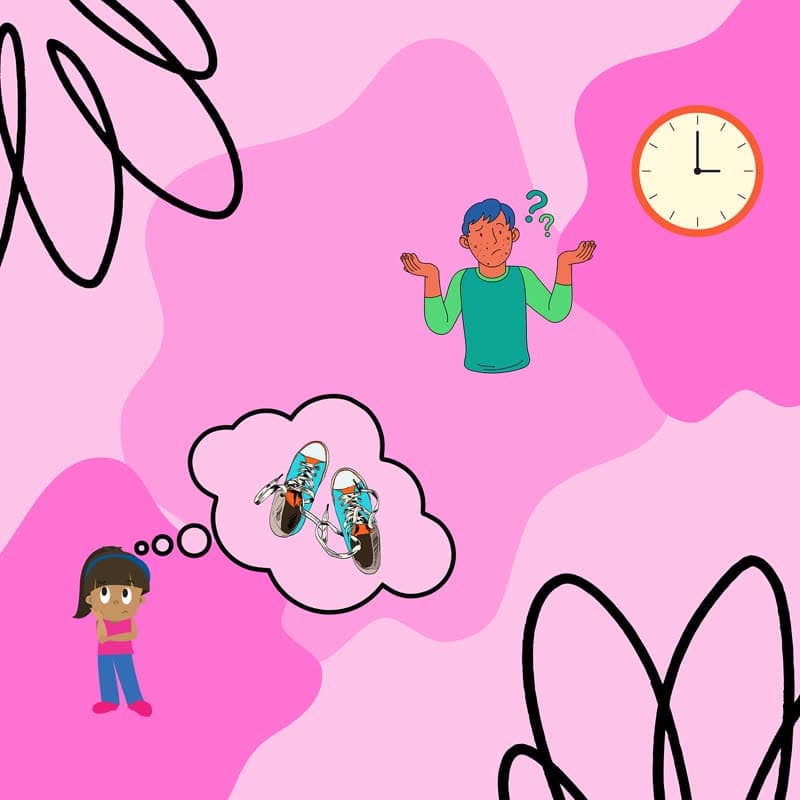
4 More Ways Dyslexia Affects Everyday Life!
About this episode
In this sequel to our popular discussion of ways that dyslexia affects everyday life, we discuss four more ways that dyslexia affects everyday life outside of a school setting.
Transcript
Full transcript · 2,011 words · about 10 min to read. Press a timestamp to jump to that moment.
What does telling time have to do with dyslexia? Today we're going to talk about some aspects of dyslexia that affect everyday life.
Hey everyone, we're Nick and Sonja and this is Dyslexia Journey, where we help you support the dyslexic kid in your life. So today we're going to be talking about four ways that dyslexia can affect everyday life. These particular ones are less focused on reading and writing, so they might not be as obvious. These are kind of anecdotal associations, so it's things that we've observed in our own daughter and things that other people with dyslexia or other parents of dyslexic kids have reported.
So they seem to be associated with dyslexia, they're often listed as potential signs that your child might be dyslexic, things like that. But we don't necessarily understand, in all these cases, what the mechanism is, what exactly the connection is in the RAIN that leads to these particular observations. Yeah, and as far as I'm aware, they're not part of any of the actual diagnostic tests, for example, either. Right, but it's just something that these definitely do seem to be associated and it's, you know, if you go online and look at the forums and stuff, it's people talk about these particular things as being possible indications of dyslexia.
Right. So let's jump in. The first one is left-right confusion. And so this comes in to things like turning left. If you ask a dyslexic person to, say, raise their left hand or raise their right hand, they aren't necessarily going to immediately be able to do that. Turning left, turning right, and in talking with our daughter about this, the best way that she can describe it, the confusion, is that she says that the direction, like she'll say, left switches, right?
So it changes depending on which way you're facing. This is the way that she sees it.
It's not, it's not, it's not like an absolute thing where left, it's relative to your body, to the way you're facing. And this seems to be maybe similar to the way that they are able, one of the aspects of, that makes reading difficult is that they're able to see letters sort of in all their orientations. Orientations, exactly. So like a lowercase d, if you can picture a lowercase d or a lowercase b, I think those are actually the same.
They're just, they're just like flipped in this way, right? And so someone with dyslexia, I think, is able to sort of see, picture like a lowercase b in all of its possible orientations, rotated or flipped. And so it's easier for them to confuse that with the lowercase, the lowercase b and the lowercase d. And I think maybe the same, it's the same principle here where they're able to sort of see all the sort of orientations at the same time.
And then it's harder for them to sort of master the idea of left or right being relative to their own body, if that makes sense. And also, this seems to be possibly related to confusions about the directions north, south, east and west. And so it's hard to keep in mind that when looking at a map, we have this sort of standard that north is always up, south is always down. And I think for dyslexic kids, it seems to be particularly difficult to kind of really, really grasp that in a way that sticks with them, these orientation directions as well.
So the second way that dyslexia affects everyday life that we're going to talk about today has to do with clocks and telling time. And so, of course, I'm talking about an analog clock. You know, I don't know if we always even have these anymore in our houses, but if you have one of the big clocks that has the minute hand and the hour's hand, that can be particularly difficult. We definitely have multiple family members who have difficulty with that and have seen it as well, mentioned online.
There's a couple of different possibilities for why this might be. One is almost more of a sequencing idea. So, you know, if you think about it, you are trying to sequence the order of time spatially. And so that some people think that might be related to a similar to the similar idea where there's sequencing difficulties with the phonemes in a word, for example. I think it also very much can relate to what we were just talking about with left and right and orientation, however.
So if you think about it, you know, you are using the directionality of which way the hand is going, like clockwise versus counterclockwise. And so there's a lot of orientation involved there. And I think getting back to what you were talking about, Nick, about the letters, you know, the small case P and B and also D, sometimes Q too, if it's not, if it doesn't have the curly, curly part added to it.
One thing that I think is helpful for thinking about this orientation, and it's used often to help people understand how those letters seem similar, is I don't know if you've ever seen it, but there is often a picture of a chair that people use. And they show how if you change the chair to upside down, you flip it around to right, left, you know, it's still a chair. We all are still like, oh, that's still a chair.
And so a dyslexic person might see those letters that look the same, whether you flip them upside down or left, right. And it looks like the same thing, right? It's hard to distinguish. So I think that's a really good parallel for understanding the orientation. And so I feel like I can imagine that and translate that to a clock as well, where I feel like I could flip the clock around different ways where the hands are, for example.
And so to me, that is also a helpful way of thinking about what might be going on there with why it might be difficult to read that kind of clock. Yeah, that's interesting. And one thing I just thought of as well, while you were talking, that's not directly related, but about clocks, is that it's inconsistent. So on some clocks, there's actually three different hands. There's seconds, minutes, and hours. And the three hands all move around the clock in the same direction, but at different speeds, and they mean different things.
So it's kind of inconsistent. Like there's no particular rule that you can grasp there exactly. And I don't know why that seems to cause more confusion for people with dyslexia. And maybe it's unrelated to that altogether and more related to what Sonja was discussing. But I just thought that was an interesting point as well. Okay, the third way that dyslexia affects everyday life in ways that are unrelated to reading and writing, per se, is tying shoes.
And again, this is something that wouldn't necessarily occur to you if you're just thinking about dyslexia as a learning difficulty involving reading and writing. But again, remember, as we've emphasized before on this show, that dyslexia is a brain difference that affects the way that people with dyslexia interact with the whole world. And so one aspect, again, where this seems to come up is with tying shoes. And again, this is anecdotal, but not just our anecdotes, right?
I mean, if you go online, if you talk to other people with dyslexia or parents of kids with dyslexia, this comes up a lot. I mean, so much that it's, like Sonja said originally, it's not officially part of any diagnostic criteria, but it is definitely listed often as sort of an unofficial indication that your child might have dyslexia. And so, you know, so you'll see advice out there for parents of dyslexic kids, like get your kids shoes with Velcro so they don't have to learn to tie their shoes.
So it definitely seems to be correlated or associated. And again, I'm not really sure why. I don't know if anyone actually really understands why this is, but it's just definitely something that we observe. Yeah, and it might look also like having sort of a different way of tying shoes, that the sequencing, so maybe the sequencing also has to do with it a little bit, but there's obviously the orientation involved, too, because in our family, at least, it also looked like having sort of this entirely different method for doing it that made more sense to them.
So it can look like that, too. Yeah, and you may not notice it exactly, but you may notice that your child is kind of just leaving their shoes tied. So maybe they'll slip them off, keep them sort of loosely tied, and then slip them on again just so they don't have to deal with it. Yeah. So our fourth and final way that dyslexia affects everyday life for today is that dyslexic people are often very aware of the physical world around them.
And so that might look like being very aware of objects in the physical world, you know, very aware of the visual spatial space around them. Yeah, for example, our daughter, she kind of always knows where everything is in a way that it's not like she's putting sort of extra effort into this. She just kind of knows, and not only her own stuff, but like our stuff as well. So, I mean, if I can't find my keys or my phone or something, like she generally is the one that we ask to help look for it.
And she kind of just knows in this way that it's like this, she's sort of almost subconsciously just sort of, the world around her is just sort of imprinted on her brain in a way that she notices differences or notices if things are not where they're supposed to be or if things are where they're not supposed to be.
You know, she's always been really good at that. I don't know if you've ever played this game where you maybe put out five or 10 or 15 objects, and then one person closes their eyes and the other person removes one of them. And then the first person has to sort of identify which objects has been removed. She's always been way better at that game than I am, for example. And even the ones, I don't know if anyone gets newspapers anymore, but at my parents' house, she used to, in the newspaper, there used to be a game like that where you were trying to see things wrong.
So sometimes it was something missing. Sometimes it was just little details that were wrong. And she was extra good at that, too, which seems somewhat related. Yeah. So I think it's, you know, from that one in particular, it really helps me to see that broader perspective of the dyslexic brain and how it's different. Like, that example in particular, I feel like, is so almost holistic that it's like, it gives me that impression of how this isn't just about reading and writing, really, ultimately.
But, you know, is very much about interacting with the world and processing information. Yeah, exactly.
Dyslexia really is, to emphasize again, a brain difference that makes some things in life harder, but also has some benefits, which we will dig into in a future episode. But one of those is the sort of physical sense and being aware of where things are in the physical world. So if you'd like to put in the comments any other ways that you see how dyslexia affects everyday life, we would love to hear it.
And if you found this video helpful, we'd appreciate a like and a subscribe. And we'll see you next time.
More from the show

The Importance of Dyslexic Role Models, ft. Picture Book Authors Lynn and Jonathan Greenberg
Lynn and Jonathan Greenberg are the authors of the picture book, “Robby the Dyslexic Taxi And the Airport Adventure”, which is available at https://www.amazon.com/Robby-Dyslexic-Taxi-Airport-Adventure/dp/B0BTZVVX8H/ We are excited to share our interview with them, in which we explore what life was like for Jonathan…
Dyslexia in Everyday Life - Summer Edition!
In part 3 of our popular series on dyslexia in everyday life, we discuss five more ways that dyslexia affects everyday life outside of a school setting.
The Importance of Early Dyslexia Identification ft. Amy Dobronyi of COKID
Amy Dobronyi (pronounced duh-BRO-nee) is a Co-founder and Co-chair of COKID (Colorado Kids Identified with Dyslexia - https://www.cokid.org/), a grassroots parent group, whose mission is to improve the lives of individuals with dyslexia through advocacy, education, and legislation.
Never miss an episode
New episodes every two weeks. Follow wherever you listen.