
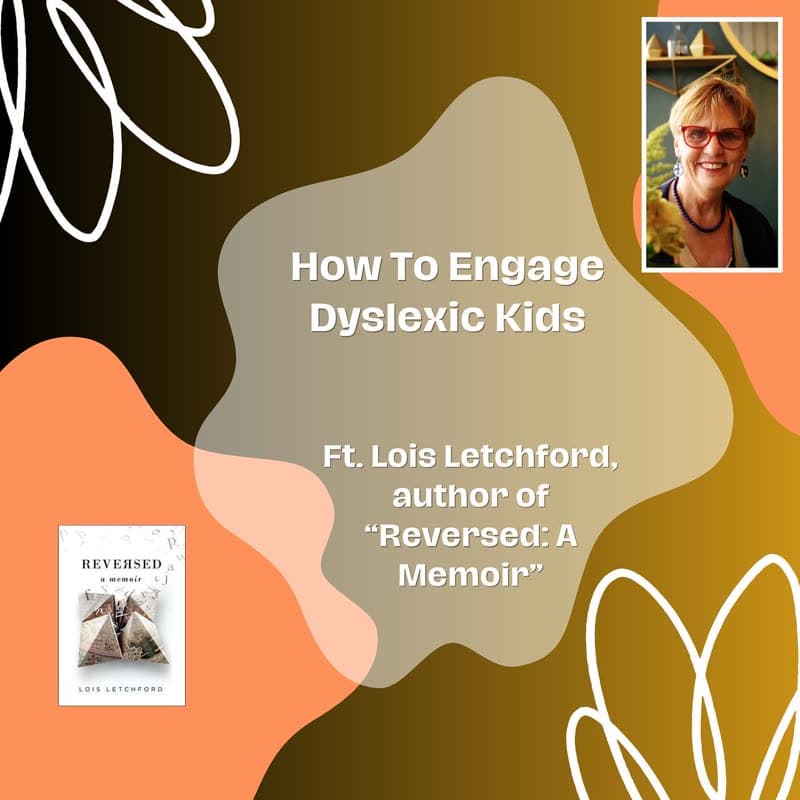
Contagious Enthusiasm: Teaching Dyslexic Children to Read ft. Reading Specialist Lois Letchford
About this episode
In Part 2 of our interview with Lois Letchford, we continue learning about her journey parenting her dyslexic son Nicholas who was told that he was "the worst student ... ever seen" by one of his early teachers, but who went on to earn a Ph.D from Oxford.
Here is a short bio of Lois: Lois Letchford’s dyslexia came to light when she faced teaching her son, Nicholas. Examining her reading failure caused her to adapt and change lessons. The results were dramatic. Lois qualified as a reading specialist using her non-traditional background, multi-continental experience, and passion for assisting other failing students. Lois received teaching degrees in Australia, Texas, and a master’s degree from SUNY, NY.
Reversed: A Memoir is her first book. In this story, she details her dyslexia and the journey of her son’s dramatic failure in first grade. https://www.goodreads.com/book/show/36163388-reversed
Transcript
Full transcript · 3,570 words · about 18 min to read. Press a timestamp to jump to that moment.
You know, they're just dumb, they just can't do it, and they'll never learn to read, and they may learn to write, may learn to read, he'll never learn to write, is what I was told. He got a PhD in applied mathematics? I can't do the level of maths that he can do?
And yet we're willing to write them off so quickly. That distresses me today.
To follow up a little more on Nicholas, how is dyslexia affecting his daily life now, if at all, as an adult? Yes. Enormous. When Nicholas was doing his, they do honours degrees in Australia for undergraduate, and we had him tested, I had him tested to help him with his writing. Nicholas fell on the 98th and 99th percentile in pattern recognition and spatial awareness.
On decoding and phonemic awareness, he's on the second percentile.
And when you speak with someone, you've got, you know, spatial awareness, you can't see.
So when you speak with someone and he doesn't quite hear it, Nicholas looks dumb.
So, the first thing you do when you come to a job and you get an interview.
He married a phenomenal woman.
Nicholas practices for days to do an interview. Okay.
And he didn't do very well in a job. The first job he had because he didn't pick up on the social cues and the other things that he needed to do. But it's a bit more complicated than that. But he didn't do well in that. And the next job, you know, he really worked hard to get and to do the interview and to follow through. And when he had his evaluations on his annual review, he recorded it all and his wife was there with him saying, we have to work on X, Y and Z.
I mean, the pair of them work so hard to make sure Nicholas does well and compensates for all the struggles that he has. You know, the one component, the strengths are easy to do. They're about 30% of your work.
The rest are skills that we don't even teach.
Anyway, he moved to Australia. He got a job in the government, which he hated. And he was getting depressed over it because it was boring. It was and he just hated it. So he's just quit. And he went back and he's now consulting and using his strengths and doing what he loves. The path and the pattern, even once you're in the world of work, is a real challenge.
That reminds me of the active learning as well, again, applied in a kind of different way. Because, you know, as you're describing it, it takes him actively and his wife, it sounds like he's helping, but to actively engage with it. What's happening here, using the strengths, trying to figure out, you know, where the challenge is and what needs to happen. I think you're absolutely right. You know, and the path is not simple and straightforward for dyslexic people.
In his first job in Oxford, they had support for him as a dyslexic person. And I think that was valuable. And that's where he identified himself as dyslexic. But I don't really think our world understands people like Nicholas with this enormous discrepancy. We only just want everyone to be normal. It's interesting, I think, the way that it sort of comes up, even in oral interviews and things like that, which is, I think, something that is probably also counterintuitive to a lot of people, because people's impression of dyslexia is that, oh, it's just reading, right?
And they don't really understand that it really is about an entire difference in the way the brain works. And just because someone doesn't, you know, answer your question immediately, it doesn't mean they're dumb. It might mean that they are giving it, you know, more thought than most people do and, you know, may eventually come out with a, you know, very well thought answer, right? But it doesn't fit our sort of accepted modality of back and forth interview or whatever.
To do a PhD in Oxford or in England, you are required to do what they call a viva, an oral exam. Nicholas's took five and a half hours. And one of the reasons was when the interviewers asked him a question, he had the habit and he was taught, rephrase the question, is this what you mean, before he answered the question. You know, so everything takes longer. It takes more effort on your part and then physically it's exhausting.
So you're right, absolutely right. And I had students who were absolutely phenomenal orally.
You know, so they didn't have this level of problem that Nicholas had, but they still struggled with the literacy component and the writing component. So you're right, each person's different, but that questioning is really, really, really tough. Really tough. And people in our world work, really, they don't want us.
They just want normal. Why do I have to do this? Why do I have to do that to help them? Well, you've got to look at what are the alternatives. What are the alternatives if we don't include these people in our society? And what level of brain function have we left behind? I think that blows me away when you think of Nicholas as a six-year-old and your daughter. You know, they're just dumb.
They just can't do it. And they'll never learn to read. And they may learn to write. May learn to read. He'll never learn to write, is what I was told.
He got a PhD in applied mathematics? I can't do the level of maths that he can do.
And yet we're willing to write them off so quickly. That distresses me today. And we only want, did you pass the standardized test? And you've got to do it by third grade. We can't even give you to fifth or sixth grade to catch up.
So in a minute, I want to ask you more about your own experiences and discoveries about yourself and more about your students. But from what you just said, I'm curious, you know, working with schools and, you know, a lot of it's so frustrating. Have you seen any changes over time in approach? Are there reasons for hope? Does it just go back and forth? That makes me cry because I have seen it deteriorate.
I have seen more standardized tests. I've seen more standardized programs. I've seen big business come in and say, we've got the answers for 100% of people. And they haven't. You know, this goes back to your connections. We lived in Lubbock, Texas. The Voyager program was put in place. And you don't, do you know Voyager at all? No. They start with grade one, two, and three. And they were doing about the sea and the ocean.
Lubbock, Texas is 700 or 800 miles from an ocean. And we forget there's a different experience for those people who are living on the Gulf or living on the coast and who go to the ocean and play in the water and pick up the sand to kids who are stuck in a desert that's waterless, treeless, and flat. And this goes back to my experience. I grew up on a farm. We were poor.
My world experience as a six-year-old was very small. And we're learning about, or learning through the books, Dick and Jane. And I remember these Dick and Jane books, and I wondered, who were these people? What did they do? Because they made no connections to me. I also grew up in a place called Southeast Queensland, Australia. It's hot for nine months of the year. We were poor. No shoes. We wore a coat, one coat in winter.
And where we lived, you need a coat from when you get up till 10 o'clock. From 10 o'clock to 2 o'clock, it gets hot, and you're running around, it gets hotter. My biggest concern was, will I forget my coat at 2 o'clock? Because you take it off, and then you put it on. When the sun goes down, the temperature drops. I made no connections to Dick and Jane at all. And I was just, that's where I learned to read words.
I had no clue who they were. Our cats were feral. Our dogs were working dogs. We never had a lead. Who are these people in books? And there's a disconnect right there between my world and the world we were reading about. And funny the things you remember. We learned about tugboats. Or read a book. Interesting, I thought. Interesting. And that's all you can say. Yes, there is a, you know, there's a real gap between, this is what the children live, and this is what happens in books, between encouraging children to explore their world and the world that they live in.
And often there's a disconnect. We expect children to have 30 years of experience and know all these things happen. But if we don't help them make the connections to the world of books, we've lost them. My parents worked morning and night in a dairy farm. We had Bible storybooks in our family. End of story. You know, there's been maybe some attention on it, but still probably not enough about this fact of different experiences and different lived experiences and often can have, you know, problems where there's privilege or, you know, not every race is being represented and also socioeconomic things.
I mean, there's just so many problems that fall under this category of what you're talking about.
Chimamandra Nadozi Adichie. Do you know her? Black Nigerian author? Yes. She did a YouTube clip, TED Talk, The Power of the Single Story. It's worth watching. And in that little clip, she says she grew up with Dick and Jane, even though she lives in a tropical place and she's black. And she read about white people doing white things. And so when she at the age of seven started to write, what did she write about?
She wrote about white people playing in the snow and drinking ginger beer because we see reading and writing as exotic. And when we alienate children like me, I could never write like Dick and Jane because I've never experienced it. She had the ability to write. I couldn't even write because nothing I do is of value. So you devalue and undervalue anything within that child's life.
You're right. It's become a real hot point of when I'm teaching. Who am I teaching? Have I engaged them? And if you've read my book, I talk about my student Twain. And it was a critical component for him to say, I see myself here. And once he got that, then the learning started. But up until that point, forget it. Now, could you speak a little more about either that example or another with your students?
I feel like those case like examples in the book were so helpful, too, because it's it really, you know, until it gets more abstract, you know, as we're even as we talk about it. But when you hear people's lived experiences and how it actually plays out and then how they actually aren't learning and then do learn, it's just really, it just makes it really, really real and vivid. And I think we can understand it a lot better.
I'd love to. My first student in Lubbock, Texas, was a boy called Christian. He's 13 years old. He spent four years in a phonics-only reading program and came out non-reading. And you think, how can this happen? Because we focus only on the decoding. And in that particular case, it was on learning of the rules of the language, which is even more abstract. He knew more rules than I did. And I met his mother before I met him, and I said, I think I can teach him.
I taught him in 13 weeks what he couldn't do in four years.
And the first thing I knew I had to do was engage him. Because we're learning over the summer. It doesn't matter where you're learning. But learning over the summer was really important. So, and it was two hours a day, five days a week. When I first taught him, I used a book and I turned it into a play. But I remember, I remember it was like he had been lying on a bed.
And for the first time in his life, he got up and used muscles. His brain was exhausted from thinking. He was physically tired.
And teaching him really taught me a lot about learning, that active engagement. And he says now, I thought, she won't be able to teach me because I can't learn. I've spent four years there and I can't do it. And he was shocked that I was able to teach him to read. And it was, the critical part was gaining his attention. And I spent hours with him writing down every word he spoke, every word I spoke.
Now, Christian, read it back. Oh, I can do it. I can do it. And it's amazing to watch him grow. And every year I had him in school, you know, he was six foot when I met him, I think. He would stand up tall as he went to school every year until he left me and went into high school. And then he was exited from special education. It was just amazing. And the last year or something, we spent hours typing and rewriting so that he not only could read, but he could write effectively.
And it goes back to my philosophy, you learn to read by reading and you learn to write by writing. And you have to do a lot of work in both of those.
You know, we think of dyslexia as a real downer for children and they're not normal and they're not this and that and the other. But when they have to work so hard and they have to persevere at the beginning of their lives, they learn things that other children don't. They learn to persevere. They learn they have to work harder. They learn they have to put in more effort. They learn they're okay.
So, yeah, that was my Christian and that's what he learned. Twain, Twain and Pedro, that was fascinating because I use the same story with Christian and I use it again with Twain and Pedro and it didn't work.
And I worked out it took me a long time to work out why it didn't work, because the first one, it was a story of a father and a mother and a son. My boys were, one was black, one was Hispanic, single parent household.
Fathers weren't coming home and doing things. So that story fell flat. And Mem Fox in her writing, Mem Fox is an author and an educator, says we've got to look at a child's response. And I looked at their response and I had to throw away that and start again. And I didn't have many choices of stories that I could turn into plays, but the next story was called A Mouthful. That was written about girls.
So I have another problem. Two boys reading a story about girls and I had to really calm them into listening. But they got it. And changing that story from female to male was transformative for me. And then I've got my students. I've got it. They're engaged. They're loving it. Until, as you know, three quarters of the way through, I've got Twain sitting here saying, We wouldn't say that. What's happened? It's not their cultural experience.
Change it, Lois. Change it. And the changing again was another transformative moment. Ah, now these are my words. Ah, now I can do it. Yes. And to do a play and perform it, children have got to practice, practice, practice, practice. So I use the iPhone a lot. Read it on the iPhone. Send it to grandma. Send it to aunts and uncles and anyone else will listen because your first recording may not be good enough.
And every time they read something, they get better and better and better. And the self-esteem goes up. I can do this. It's another component of learning. You know, I just wanted to pop back to Mem Fox and even Marie Clay. You know, these people get alienated. They say we don't like them because their whole language or this, that, that. All of these people bring something to the science of reading and the understanding of where we've got to to go.
We cannot just wipe them off and say don't read them. The book of Mem Fox's, Radical Reflections, I read over a weekend, blew me away and still sticks with me. Power of humor.
We're going back to the first thing is engagement. Sit, you notice I'm not talking about decoding.
I'm talking about all of the other components that are critical to help our children learn to read.
I love teaching reading. I love the challenge. It's a problem to be solved, not something to throw into, a child into. And we've got to look at every component as we're walking along. What's working? What's not working? What else do I, as a teacher, have to do? You know, we're coming up one time. The paper that drove me. I taught Nicholas to read. I went back to become a reading specialist. And the paper was called Beyond the Deficit Theory, written by Australian Professor Brian Panborn.
And he wrote, when children fail to learn to read, the first thing we do is blame the child. Well, look at their IQ. Well, look at their home background. Well, look at this. Look at that. That was my lived experience. Your child is dumb. And we fail to say, what else do we have to do? And it was, I saw a cat. The reading teacher sent Nicholas home with the sentence, I saw a cat climb up a tree.
And Nicholas sat there and read, I saw a cat. He said, I was a cat. I said, add a cat. And I add, no, he said, and he just handed paper because it didn't make any sense.
And I, you know, it really still gets me upset that the reading teacher had failed to provide an example that had met child's needs. She forgets the word, Saul's got three meaning. She hadn't even bothered with that. That was obviously irrelevant to her. And so the teaching fails our children on so many levels. And what are we talking about? Decoding.
Yeah. Wow. Well, I guess to wrap up here, a couple more quick questions. Yes. Let's circle back to the book, Reversed. Yeah, I see you have a copy there. Thank you for showing that to everyone. So I guess you want to talk a little bit about sort of how you decided to write it and, you know, what your hopes are for it here? I decided to write it because Nicholas was written off in first grade and no one expected anything of him.
And the experience of going from the bottom to the top was extraordinary and way beyond the normal.
That blew me away. And I, my husband moved around the world and I followed him. And in 2013, Nicholas had a scholarship to Oxford. I thought his story graduating high school was good, graduating the two undergraduate degrees was good. But to do a PhD amazed me. That's why I wanted to write it. And then I needed a lot of support to write it. And it cost me a fortune. Anyway, so what?
I've written it. I've written it because we cannot lead children like Nicholas stuck in the classroom and told you can't learn. Yeah, just a final question then. You've had so much wisdom to share with us and practical advice, all of it. Are there any final words or tips that you'd like to leave for dyslexic kids or their families? Okay, I'll give you two. The first one is you must create active learners.
The second is believe in that child who's struggling and tell them you're a future rocket scientist. Yeah, those are great. That's what I love, you know, because we have to change their mindset. They think they'll fail us. We have put that on them and we have to turn that around and say, you can do anything. We're going to teach you to read. You can do anything. You're a future rocket scientist. Yeah.
Yeah. Well, thank you so much for joining us. Thank you so much for writing the book. And thank you so much for your work in the world teaching so individually these kids to read. Thank you, Sonja and Nick. I love this conversation and I hope a lot of people share it. Connect with me and believe in our children. Believe they're capable. And I think your daughter will rock the world.
Yeah. Thank you. Thank you. Thank you.
More from the show
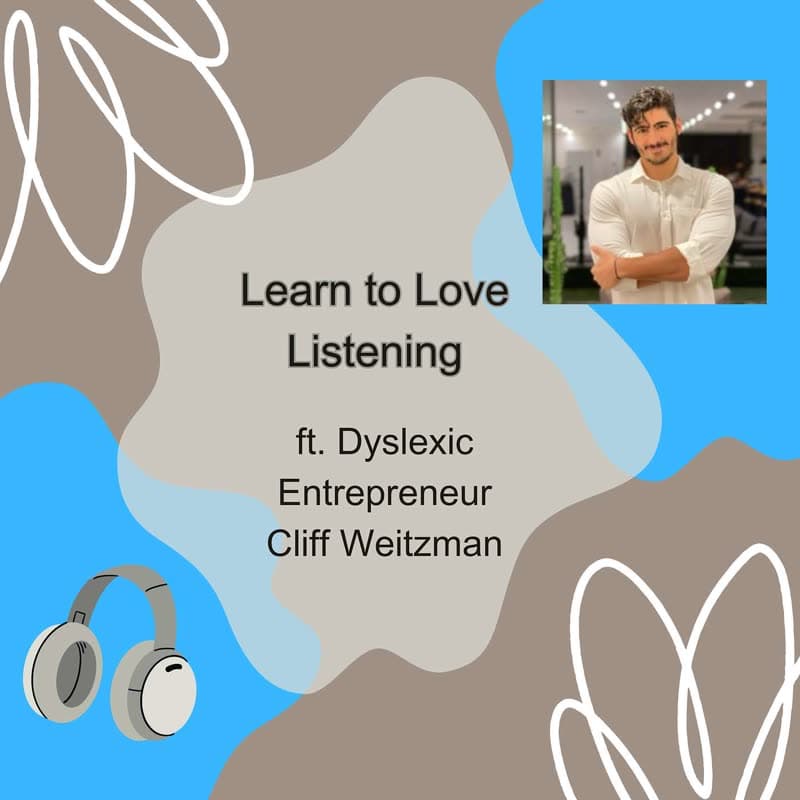
Learn to Love Listening ft. Cliff Weitzman, Dyslexic Founder and CEO of Speechify
In this installment of our Dyslexic Voices series, Cliff Weitzman, founder and CEO of Speechify (https://speechify.com/), tells us about his experiences growing up dyslexic, and shares his advice for how to succeed as a dyslexic child and adult.
Make Real Progress on Big Goals For Your Dyslexic Kid!
We all have goals for our dyslexic kids, but they often seem overwhelming and out of reach. In this episode we provide specific, practical tips for organizing the goals into smaller chunks and making daily progress.

The Attacks On Your Kids’ Rights to a Free Appropriate Public Education ft. Attorney Laura Heneghan
With all the changes in the US recently, it’s hard to keep track of all the implications. In this episode we dig into the changes at the Department of Education, executive orders, lawsuits, and more in order to understand how these changes could directly affect your kids!
Never miss an episode
New episodes every two weeks. Follow wherever you listen.