
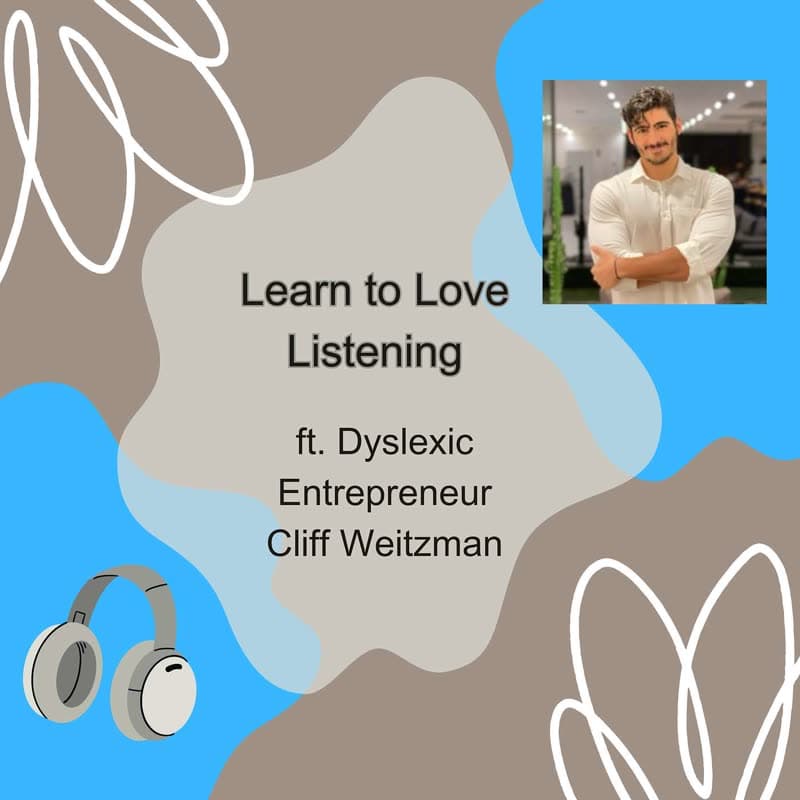
Learn to Love Listening ft. Cliff Weitzman, Dyslexic Founder and CEO of Speechify
About this episode
In this installment of our Dyslexic Voices series, Cliff Weitzman, founder and CEO of Speechify (https://speechify.com/), tells us about his experiences growing up dyslexic, and shares his advice for how to succeed as a dyslexic child and adult.
Here is his bio:
Cliff Weitzman is super dyslexic and couldn't figure out how to read in 1st to 4th grade. He learned English by listening to Harry Potter audiobooks when he was 13 and fell in love with listening. He listens to 2 audiobooks a week and has done so for more than 15 years. When he studied renewable energy engineering at Brown University he found his books didn't have audiobooks so he built a text to speech system that could read out anything to him.
Today SpeechifyAI is the largest speech AI platform in the world over 25 million users and over 100 engineers. Speechify has been the #1 app in its Apple and Google AppStore categories for 4 years. and has the largest collection of dyslexic users using it for dyslexia of any product in the world. What OpenAI does for text Speechify does for speech. The team started developing AI models in 2016 for speech synthesis, NLP, & computer vision. Today, they make the most realistic human sounding AI voices in the world.
Transcript
Full transcript · 6,692 words · about 33 min to read. Press a timestamp to jump to that moment.
He got me diagnosed when I was in third grade, and it was the most relieving day of my life because I finally had like kind of a place to hang my hat and say, see, I told you I'm not lazy, definitely not stupid, I just learned differently, like that's totally okay.
Hello, everyone. We are Nick and Sonja, and this is Dyslexia Journey. And today, we are happy to welcome Cliff Weitzman, who is going to talk about his journey with dyslexia. Hey, welcome. So, let's just start at the beginning. So, what was it like before you were identified as dyslexic? All right, well, Nick and Sonja, thanks so much for having me here. I'm glad to be with you guys. What was it like before I knew I had dyslexia?
So, in preschool, I was a really precocious kid. You know, I loved to perform on stage, to write songs. I was like relatively good in like history and math, but the whole reading thing, I couldn't pick it up in preschool. And I was my parents' first kid. And so, they were like, oh, it's fine. Like, he's supposed to learn it, you know, in first grade. And I couldn't figure it out in first grade.
And in second grade, I couldn't figure it out either. And in third grade, it also kind of wasn't clicking. And so, my teachers thought I was slow. My parents thought I was lazy. I thought I was awesome. I just needed to find a way to prove it to people. But there was a very big dissidence between who I saw myself as, even back then, and the evidence that the world had to judge me by.
And I have four younger siblings, who are my best friends in the world, and we're very close. And they're all very gifted. And our school had an advanced placement program. So, my brother got into it, and I took the test, and I did not get in. And I convinced him to let me take the test again, and I still didn't get in. And then my sister got in, and I convinced him to let me take the test the third time, and I still did not get in.
And I remember very vividly, I taught my sister Alex how to read, because I knew all the rules. I just couldn't apply them very well. And so, within, you know, a couple of days, she was reading faster than me.
And I grew up in a family, we're Jewish, that really values education. And when I was in preschool, I wanted to be prime minister of Israel, I grew up in Israel. I wanted to be prime minister of Israel, a billionaire, and a pop star all at the same time. And my dad made reading feel like such an important thing in life, that it became clear to me that I could not be the person that I wanted to be if I did not learn how to read.
And so, I really cared about it. I just was very bad at it. And I held the belief that at a certain point, I would figure it out. But, yeah, it just happened to be something that was very frustrating. And I didn't have probably the cognitive tool set that I have today to diagnose myself with how I was thinking, you know, write a daily journal about it, you know, do affirmations or anything like that.
I just knew that I liked being me. And this was something that I wanted to improve. And for lack of a better term, I kind of held it as a constant over here. And I had hoped that at some point in the future, it would change. So, it sounds like you really were able to not let it affect your self-esteem, I think is what you're saying. Not at all. Correct. Yeah, that's amazing.
What, I mean, other than, it sounds like you just sort of innately had this sort of self-confidence. Are there any, like, tricks or anything that you can share about that? Yeah, of course. So, I think that confidence, like most other things, there's a nature versus nurture element. So, naturally, I have a massive amount of self-confidence. It doesn't matter, like, what field the topic is. But the real key is that I'm one of five kids.
And I grew up in a family that gave me a lot of unconditional love growing up. My family is very physical. We hug each other. We kiss each other. We dance with each other. We sing to each other. And we're, like, and we're five kids. So, we're, like, we're on top of each other all day. For my sixth birthday, I wanted my parents to get me mats because I saw a movie where Jackie Chan did a backflip, and I wanted to be able to do that, too.
And so, we had these three gigantic mats in our living room, and we would just dogpile on top of each other all the time. And there was a game we used to play in Hebrew. It's called Nemerim, tigers. And we'd just, like, be tigers on top of each other. And my siblings really were my best friends. And I think that, above everything else in life, what people want is to be loved.
That is the number one thing every human desires. And I knew that I was loved. And so, there was a floor below which I could not sink because I had two parents and four siblings that really loved me, and it was clear. And the fact that I was not good at reading did not make me less than. Yeah, I think that's really astute. I mean, I think you're right. That's such a basis of everything else.
Yeah. No matter what the other situation is. Yeah, and really good advice for all the parents. Right. Everyone's going to do this. Yeah. Yeah. Definitely. And I will add, on the parent's side, it's not like my parents are saints. They happen to be very good at giving love. But my dad would get really mad at me for not paying attention. Like, Cliff, you're never paying attention. You're always fidgeting. You're so lazy about this.
Like, why don't you do this? Like, oh, and this is the other thing. We know that you are smart. Never in my entire life did anyone in my life ever even imply that I was not smart. Like, I hope that I'm actually smart. But even if I didn't know it, all of the evidence, all the spoken evidence in my life indicates that I am smart from everybody around me. And so I believe that I was smart.
And I think that if I naturally, let's say, had a low aptitude for intelligence, which, hey, according to all the standardized tests I took growing up, I did, I would still believe that I had some sort of type of intelligence that was useful because of the way that my parents and my family spoke. It's interesting because it's, you know, we're always talking about that connection between, you know, see if there's something going on that you need to check out because you can see, you know, how your kid's smart.
But then often it has been where then it's like, oh, are you lazy or you're just not paying attention to it? And so you can see how it could really go either way with that particular, like, assessment. My, my, my, the word I hated most growing up was the word lazy. Yeah. So it sounds like you also, you know, we're compensating a lot and we'll get to that in a minute. But when was it that you actually got diagnosed or identified?
Yeah. All right. So my mom is very good at research and every child in my family, by the way, has some sort of a deep learning difference. My brother, Tyler is blind in his left eye and astigmatic in his right eye. You know, my brother, Eric's has very strong ADHD, so it does my dad. And my mom's really good at research. And so she just read a lot of books. And one of the books she read, she found the concept dyslexia and dyslexia was not, you know, particularly well known in Israel.
And we got me diagnosed when I was in third grade and it was the most relieving day of my life because I finally had like kind of a place to hang my hat and say, see, I told you I'm not lazy, definitely not stupid. I just learned differently. And like, that's totally okay. And so for me, it was, you know, amazing because, okay, at the age, at that age, probably I couldn't discern the difference between a learning difference and a disease.
Cool. I have a disease. Great. These are treatable. Let's treat the disease. Not a problem.
And then how did that, how did it progress from there? Then were you able to, like, did you get some extra help? Was it, was it like, how did that go? Yeah. After that, I don't actually recall getting any extra help through school. but my mom found a program called brain gym. and brain gym is predominantly focused on increasing the connection between the left side and the right side of the brain.
So you'll draw figure eights. You'll look at the window and you'll do basically like the British flag over and over. And it actually had a massive impact on my ability to write clearly. Before I did brain gym, my, handwriting was extremely jumbled. Letters are different sizes. They're on top of each other. There's no spaces between words. Obviously the spelling was bad, but after brain gym. and I remember there was a woman who'd come to our house, you know, twice a week and did this with me.
my writing became a lot more legible. The spelling was still atrocious, but a lot more legible. And so that was one intervention. The other intervention was there was a woman who I worked with. her name is Judy and, she worked with me on reading and I hated reading, but she had jelly beans. And so for every, I think like five sentences, I got a jelly bean and she would literally put the jelly beans at the end of those sentences.
And I would, it was tough, but I wanted the jelly beans. I can still, you know, 20 years later, I remember vividly the taste of those jelly beans because I earned them. and those were the two, big interventions. Now, my case is a little unique because I then moved to, to the UK. And so I learned to read in Hebrew, which is a far more difficult language than English to read. the vowels literally, they take them away two years in.
and there's a lot more letters that phonetically sound the same, taf, it, tet, alef, v'ayn, but English is an easier language. still not the easiest. and, my dad at this point knew I had dyslexia and would take me on bike rides. And, and like, this was, you know, my dad was my hero and all I wanted was my dad to be proud of me and, he would sit with me and for every 30 minutes we sat and studied reading.
I got to ride my bicycle with my dad for 30 minutes. And so that like, to me, it was like the coolest thing ever. So I would sit with him as long as he was willing in order to get bike rides. we moved back to Israel. and by the way, interestingly enough, I have a very vivid memory. in general, I remember nothing from second grade. Like I remember what the classroom looked like and a couple of the students and vaguely the teacher.
I don't remember her name. I remember all my other teachers names, but around that time, I think it's probably where I had the toughest time with dyslexia. but yeah, I like remember very little. We came back to Israel. and the place where I was able to compensate is my comprehension and auditory memory are very good. And in Israel, a lot of the like cartoons were like Bible related cartoons for some reason.
And so like, I had like a very extensive knowledge of the Bible's stories because I just watched cartoons, and that and loony tunes. and so it helped me a lot because in Israel, instead of taking, history lessons for the first, you know, five years in school, you study the Bible, not in like a prescriptive religious way, just like it's part of the, it's literally part of the history of the Jewish people.
and so I knew the stories really, really well. And for me, like, it was great. I just sit in the class and I'd listen to stories and I could take back the topics of the stories. but reading was still very challenging for me. And I ended up being bullied very severely for about three years, in school. I was also a very, very small kid, with a very big mouth, who was not particularly good at school.
and eventually, you know, I kind of overcame the social challenges. but I really had a clear vision of who I wanted to be. And this dissonance between, I cannot be this person without reading was very stark to me. and so, one, Passover break, my dad became very frustrated at me for not cracking reading and he made it so I was not allowed to watch TV. I was only allowed to read. And, my dad is a lawyer and he's very good at explaining.
And my entire childhood, if I had a fight with my brother or my sister, he's a great arbitrator and he'd explain to us why one side was wrong or the other side was wrong. And like, we never felt that my dad's disciplining was unfair. We actually always thought it was fair. And, I didn't feel like my dad's, verdict of Cliff may not watch TV was particularly unfair. I didn't like it, but I saw the reason.
And so I was invested. Like I believed in the logic and I would go to the public library every single day and try to read. And I remember there was room there with these giant teddy bears and I would sit against the teddy bears and I would try to read essentially picture books. And I was too old to be reading picture books, but I would fall asleep against these teddy bears every single day because I was so bad at reading.
And, what I realized many years later is dyslexia is not a reading disability. It's a decoding difference. there's a part of your brain right here that's in charge of decoding and, it manifests at least in me with reading a sentence takes me as much energy and brain power as most people take to do a long division equation in their head, which means that reading one sentence is absolutely exhausting. Imagine doing 1,343 divided by seven.
Cool. Now do 2,747 divided by 13. Great. Now do 548, divided by 16. Cool. That's what it's like to read three sentences for me. Now imagine doing a chapter. There's no way you're not asleep by the end of it. And definitely you, you didn't comprehend the chapter because your brain did so much cognitive work along the way. And so my challenge first and foremost was the cognitive load. And the second one was the speed because my brain actually works very fast.
And this is especially true for people like me who also have ADHD, your brain's moving, you know, 500 words per minute. Normal people read a 200 words per minute, kind of like adultish dyslexic person might read it like one 80, but like a kid is reading it like 90. So the, the difference between these two numbers is so vast. There's no way this kid is paying attention. There's no way they're going to do it for more than a minute.
And there's no way that if you force them to do it, they will not be asleep. and so for me, learning how to listen was great. So my dad started reading Harry Potter audio books to me and, he was a lawyer, get a cassette tape and he had to work. So if he couldn't make it home, he'd record himself on a cassette tape and I'd sit, I'd stay up and I would listen over and over to my dad's voice reading cassette tape of, Harry Potter.
And by the way, this is before audio books were widely accessible, definitely not in Israel. So I have like a bootleg Harry Potter audio book in Hebrew that my dad made. And when I was 13, I moved to the U S and I already knew the story. I knew who Malfoy was. I knew who Snape was. I knew Hagrid was and what Fluffy is and what a little Homora meant. And so I listened in English and I recognized maybe three out of 15 words.
And they were not the normal words like black or white or I or the, there's a video of me from this time where my dad has a camera and he asks me, Cliff, what is black? What is white? I had no idea, but I knew what Hogwarts was. And so I listened the first time and then the second and the third, and Jim Dale is just such an amazing narrator that it was interesting.
But by the fourth time I understood what I was reading and I started listening at 0.75 X speed and later at 1 X and then 1.25 and then 1.5 and then 2 X. And then for all my books, if I had a chance, I'd find an audio book. And so I owe everything in my life to the fact that I had access to audio books. I've listened to two audio books a week, every week for the last 15 years, on average, a hundred books a year.
and, yeah, that changed my life. I'll stop there, but I'll let you keep going. There's so much there. I mean, part of that was making me think just about how that's a very immersive way, you know, for those who are auditorially inclined to learn a foreign language, but it sounds like it was other subjects too. It was, it was like helping you with all the material. Yeah. Yeah. Everything. Mm-hmm. Yeah. And I wanted to say, I really liked your explanation there of, I think that's maybe the clearest explanation we've really heard about how it's so, and how and why it's so exhausting for dyslexic people to read.
I mean, this is something we've talked about on the show before. It's something we've observed in our dyslexic daughter. and I think people just don't understand that. Like it's not, it's not only that it, it takes people longer. It's that it's just, it makes, they're so tired by having to focus on this. Right. Yeah. And this is the definition for why dyslexic brains work differently. And so, you know, I've obviously looked into this, the best, neurological explanation I've read about dyslexia is there's things in the brain called mini columns that are responding for responsible for sharing information.
a normal person has a normal distribution, a normal length, million column. Someone with dyslexia has fewer many columns that are further apart and are longer. a person with, autism, interestingly enough, has shorter many columns that are closer together, as a result, doing work that is related to, I don't want to say minutia, but, let's call it decoding. It's more challenging for people with dyslexia at the same time, they're better at cross pollinating information between different fields.
And so, another interesting piece of data is when I was 16, by that point, I'd kind of like figured myself out a little bit more and I became, a lot more, eloquent. And, in eighth grade, I found an audio book and I just moved to the United States. Like I spoke with a heavy Israeli accent, you know, you could barely understand anything that I was saying. And we had a book we needed to read for, my eighth grade, American history class with Mr. Blow.
And I found there was an audio book and we needed to write a chapter outline every single day for a chapter that we read. So I knew that I would not be able to read the chapter. I was not able to touch type in English. and there was just no way I was going to pull this off. And so I went to Mr. Blow and I said, Hey, I found an audio book of the thing.
Can I just listen to it? And I'll come to school 15 minutes early and verbally summarize it for you. And he said, yeah. And so that's what I did for the first quarter of the semester. And again, I got like a, like C I think in the grade. but for me, like that was a hard earned C by the end of the year. I had an a, but that was my first foray into using audio books for non, novels.
it turns out that's the only textbook I actually ever found that had an audio book. I got lucky, later I started using text to speech a lot more. but, that was very meaningful. And so some books, especially for English class had an audio book, but most did not. So I remember, freshman year of high school, we had a book called Marley and the amazing book. But I couldn't read it. I read maybe 20% of my own and my mom read the other 80%.
And even when I was 18, before I went to Brown university, we had a book, Sons of Providence and I spent the entire summer trying to read it. I couldn't, I read also again, maybe, maybe a quarter. And then my mom had to read, you know, the majority of the rest. And I had some leftover that, you know, I didn't even finish reading. It's like another method to do it. but, listening in that way was really powerful for me.
but when I was 16, I had a psychologist in my high school that said, congratulations. It seems like you don't have dyslexia anymore because you have A's in all your classes. And I was like, what do you mean? This is not how dyslexia works. She's like, well, yeah, it's clear you don't have dyslexia because you have, A's and you have to have your IEP renewed, at a certain point every few years.
And, you scored really high. And so, you know, therefore you're not going to get accommodations anymore. And I was like, this doesn't make any sense. and so I asked to see the test. And so they give you an IQ test. and there's a bunch of different fields in the IQ test. and, I was lucky enough to score, either 98 or 99 percentile in every single category with the exception of two phonemic awareness and short term memory, where I scored a 48% to 52%.
And she said the 48% of 42% is exactly average. It's a hundred percent normal. You don't have a learning difference. And I'm like, this is not how this tests are read. it is a matter of the discrepancy between your performance in these fields and the other fields. so it took me like literally a couple of weeks until I finally succeeded in still getting accommodations. But the other thing that I learned is dyslexia is characterized by a challenge, infinemic awareness and short term memory.
Now that's how it manifests for me. For other people, there's other ways in which it manifests. I mess up my left and my rights all the time. I'm very bad at remembering names. that being said, I'm a very good freestyle rapper and I'm good at rhyming. Some people with dyslexia are not. and so each person has their own experience. And so for me, the biggest challenges is the cognitive load that is associated with reading.
My skimming is horrendous. And if you code and you do computer science, you need to read documentation all the time. So skimming is actually really important. Very bad at it. and my spelling is, is awful. I couldn't tell the difference between two, two, and two until I was like 19. And the only reason I learned it is I got an iPhone and I started texting girls and I didn't want to mess up two, two, and two when texting.
So I finally had a big enough incentive to get it right. and so actually getting an iPhone with the ability to Google now with chat GPT even better, is like one of the most powerful, ways to teach someone how to spell well. And a plug for, we did an interview, last fall with an educational psychologist who really, emphasized how important is when you're diagnosing dyslexia that it is about that discrepancy, which unfortunately still actually a lot of people don't get even, even the people who are diagnosing.
so I'm actually really impressed that you managed to convince, your psychologist of that. So the trick is, I have a method, I have two methods. The first one is called brute force. so when I tried to learn something and I just like, don't succeed, I brute force my way through and that's how I learned how to read. I brute forced, I read more books than really any other kid in my school.
And I suffered through the entire way. and, I've done the same thing and you know, how to, that's how I learned computer science. Like I just thought it was really important that I learned how to code and though I would misspell variables and I would spell cat, you know, cat one, you know, a variable C A T here, but here I spell it K A T and obviously the software breaks, taking about two months of coding almost every single day from 9am to 9pm, until I started to tell the difference between a bug as a result of a spelling mistake and a bug that was genuine.
And then I became really good at debugging. and I have another system for interpersonal relationships, with people who are not logical, which is called bulldozing. So I just bulldozed my way through and I showed up at her office every single day for two weeks. And every time I bring another teacher or I bring the principal or I write letters or I write emails, because again, I just had a lot of self-confidence, even as a kid.
and every time I had an issue with a teacher who, you know, thought dyslexia was a myth, which also happened. I just won't let it go. Yeah. Power of persistence and that bulldozing. just to jump ahead a little bit here, you've already talked a lot about your compensation mechanisms as an adult too. and we're going to have another episode where we talk to you more about this, but give us a little bit of a hint about where your career path went.
Sure. so after high school, I ended up doing a lot of science fair projects and building like small companies, like I made a company called CliffsCoupons, and then I built a pressurized air cannon that would drape houses with fire-returnative blankets to stop fire from spreading. and, I applied to 26 schools, and we had moved from Israel. My parents really only knew about Harvard, Stanford, and MIT. but I applied to a couple more and, I, again, I brute force the common app.
I realized that if you want to get into a good school, any one of these top schools can take 10 X incoming classes of qualified kids now with 20 X. And so how do you win a lottery? You brute force your way. So I bought more tickets than everybody else. Most people apply to six schools. I applied to 26. And one of them was a school called Brown University. And, I couldn't afford to go visit the schools, but once I got in, I visited the ones that I got in and I fell in love.
everybody was smiling ear to ear and my cheeks started to hurt from smiling so much three weeks in. I kind of like found my people. every single one was, everyone was interesting and interested. There's no, core curriculum of Brown. The only requirements is that you take at least two classes that have to do something with writing during your four years. So you don't have to take math. You don't have to take a foreign language.
I made my own major, called renewable energy engineering. So it was a mix of physics engineering and computer science. And so I did a lot of nuclear physics and photovoltaics engineering. I included some computer science classes in that as well as industrial design classes. It took a long time to get approved, but we'll doze my way through. and I started doing hackathons, which is you get together with a bunch of computer scientists for a weekend and you build something.
And so I did about 42 of these and I won a third of them. I was just good at talking, and good at picking good teammates and good ideas. and, one tools that I built along the way was a text to speech app for my Mac. I learned that I could play with my Mac to make it read out to me in that robotic voice. I am a computer that can talk to you and I could make it speak up to 500 words per minute, but that was not fast enough.
So I started using a terminal to change the speed beyond where the GUI would let me go. So I could listen at 750 words per minute, but sometimes I need to go slower and I needed to literally restart my computer in order to listen slower. So I just built a Mac app for my computer that would let me do this with a GUI instead of having to restart my computer over and over.
And then I built a version of this that would parse PDFs and then I built an iPhone app to let me scan physical books, with OCR and it would read it to me. And then I built a Chrome extension that would make it easy for me to do it on email. And then that got popular with other kids in my school. And then I snuck into a bunch of conferences for kids with learning differences like IDA.
I do a backlink on the stage. People would not kick me out. And then I demo, and then a couple of people would invite me to their schools. I started making YouTube videos about it. They got really popular. and now there's about 25 million people who use, this app, which is called speechify. and, so now there's like a team of 120 engineers who work on, on speechify with me. it supports 80 different languages, and has about 150 voices.
So you can listen. So we built partnerships with like Gretz Paltrow and Mr. Beast and Snoop Dogg. and, there's kids who knew you speechify, that I went to their schools when they were eight in eighth grade. And I was a student in college, who have now graduated college. And, you know, I get a couple of thousand messages every single month from folks who use the product. It's got like 280,000 five-star views at this point.
but that's the, the, that's like 50% of what we do at speechify does like a couple of other products. That's amazing. Yes. And I can see, of course, all those pieces coming together from your background for it. and I, like I said, we're going to get into it more in another episode, so I'm going to go away from it for now. but so just kind of, as we wrap up, this particular episode, I'm wondering if you would have any particular advice, either for your thinking of it as your younger self or for the kids out there.
Yeah, I have a lot. So the first piece of advice is the importance of speed. dyslexia obviously does not mean that you're stupid or dumb or lazy. It doesn't mean you have a challenge of comprehension. It means that there is a challenge in information bandwidth intake to the brain. Cool. You can solve that. Teach your kid how to listen. Obviously give them Harry Potter and audio books, pay them to listen to books and listening requires practice.
Like reading requires practice. It's just a lot easier because you've been listening for hundreds of thousands of years. We've been reading for less than 3000 years. and so here's the trick, teach them how to listen fast and encourage them to listen fast. most people can listen at three and a half X speed. They just need to practice. So do progressive overload that like you do with weights. and, no one enjoys listening to their first audio book, not their second, not the third.
It takes 10 audio books before you get used to it. And when I say, get used to it by the end of the 10th audio book, you can listen to more than one X speed, hopefully 1.5. You can walk and listen, you can bike and listen, you can drive and listen. and, you recall what you have listened to, but you should not expect to succeed in the first, second, third, or fourth book.
it genuinely takes practice. So make sure that your kids love listening. The second thing is learn, make sure they're amazing at touch typing, touch typing. You can learn how to touch type in another language. It has nothing to do with dyslexia. and so try to make sure that your kids are touch typing at above a hundred words per minute, which is very fast. have them play video games regarding it. You know, if they are able to chat with friends, while on Minecraft, like great, but like make sure your kids type really fast.
Because let's say your child has a challenge when writing an essay, and they find that the words are challenging. Well, if you make them able to touch type three X fashion than their peers, it removes 80% of the problem. And then if they can also speechify back the content from the page and they can listen at 750 words per minute, that removes another, not only removes 80% of the problem. Like I got to the point by the end of college that I was writing essays faster than everybody else.
and like getting the top score in the class because we get assigned a chapter and I would just listen to the entire book because I could listen at three X speed while longboarding to breakfast, eat breakfast, work out. And I finished the entire Nick and McKee ethics by Aristotle. And I remembered all of it. And then I would go and write the essay and then I'd speechify it back to myself, catch all the spelling mistakes, edit it, and then be able to submit it.
And I could type faster than everyone. So listening and typing are the most important things that I would say. and then we already discussed the importance of giving your kids unconditional love. and then I think that the other thing that is important is to teach your kid how to self-advocate. So life is like a video game and there are moments in your life when there's a chance to go hard, an opportunity to go hard.
and most people fail at going hard when the opportunity arises. and so you don't need to wait for a moment where like hypothetically somebody kidnaps your kid or, you know, punches you in the face. No, like go hard. As soon as you have the opportunity, you see another kid bullied, go defend the kid that's bullied, even though it's not your business, your teacher like, infringes upon your rights, stand up and make sure that, you know, you don't let that happen.
And, the first couple of times you do it for your kids. The second time you'll be there and make sure that your kid does it for themselves. And then after that, just let them do it independently. and so that means that if you're, you know, going into a restaurant and your kid wants a cookie, tell him you can have a cookie, but you ask for it. I would literally train my little brother, Eric's when he was six years old, we'd go to get, you know, hamburgers really Cliffy.
Can I have ice cream? And I'm like, you can have ice cream. If you go to the front desk and you can, and you ask for free ice cream. He's like, no, no, no, like, no, seriously go and ask for free ice cream. And if you ask for three ice creams six times in a row, I will buy you ice cream. So he went and did it surprise. Eric's has like unbelievable amounts of self-confidence.
and so I think that like giving these types of comfort challenges, games, the kids helps a lot. last thing I'll say, people with dyslexia account for, 40% of people who are incarcerated in the United States. They account for 30% of millionaires and they account for 40% of billionaires. even though dyslexia is prevalence of the population is anywhere from 15 to 20%. there's two options. The first one is you have dyslexia and the world tells you that you're bad and that you're not talented and you go down the dark path.
And the second option is you develop this unbelievable resilience that no other kid has the opportunity to develop because they were not bad at the one thing they were supposed to be good at between the ages of six, seven, eight, nine, and 10. And so you believe that you can do hard things and it's failing is okay. And that translates really, really well to entrepreneurship and many other fields that, actually make people really happy when they're older.
So those are some of the things that I would be mindful of. Those were amazing. Thank you so much for sharing your wisdom with us and our audience. Yeah. Thank you very much. Yeah. Any, any final words before we enter? if you want to, learn how to use speechify, just search speechify in the app store or download the Chrome extension for speechify. Oh, lastly, I don't advertise the Mac app for speechify often because it's slightly more difficult to use in the Chrome extension, but the Mac app is actually the most amazing product that we've built.
And so download the Mac app and learn how to use the keyboard shortcuts and not just speechify, just in general, make sure your kids know how to use keyboard shortcuts. Awesome. Thank you so much. Yeah. We'll put links in the show notes too. Yeah, definitely. We will. Thank you so much. Of course.
More from the show
Make Real Progress on Big Goals For Your Dyslexic Kid!
We all have goals for our dyslexic kids, but they often seem overwhelming and out of reach. In this episode we provide specific, practical tips for organizing the goals into smaller chunks and making daily progress.
The Attacks On Your Kids’ Rights to a Free Appropriate Public Education ft. Attorney Laura Heneghan
With all the changes in the US recently, it’s hard to keep track of all the implications. In this episode we dig into the changes at the Department of Education, executive orders, lawsuits, and more in order to understand how these changes could directly affect your kids!
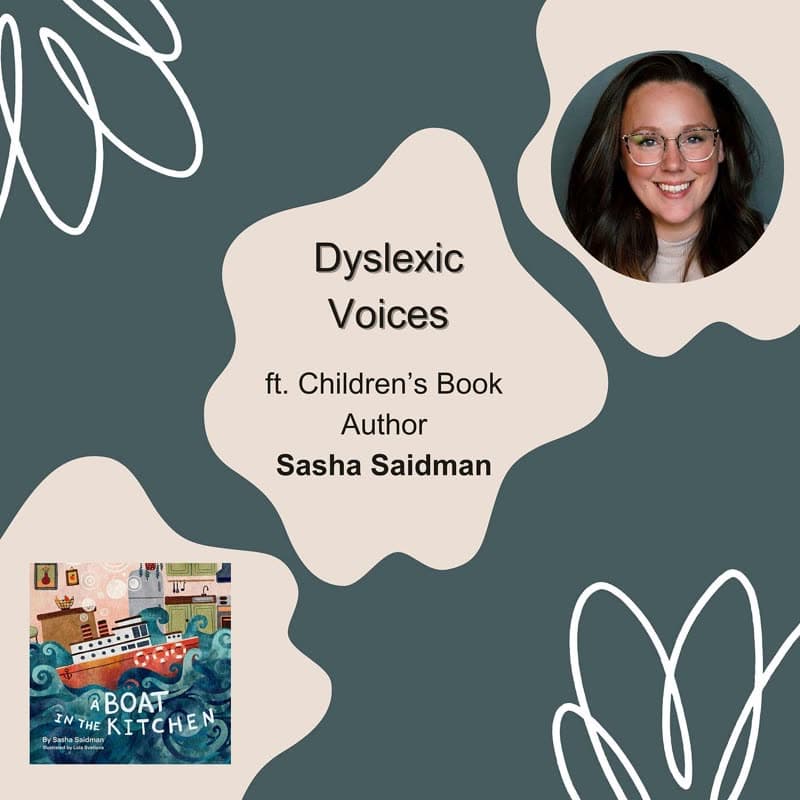
Dyslexic Voices: Children's Book Author Sasha Saidman
Sasha Saidman is a cherished voice in children's literature, weaving tales of wonder and wisdom from her home in the vibrant heart of the Washington, D.C., area. Alongside her devoted husband and their two delightful children, Sasha crafts stories that celebrate the diverse tapestry of families, drawing from her own…
Never miss an episode
New episodes every two weeks. Follow wherever you listen.