
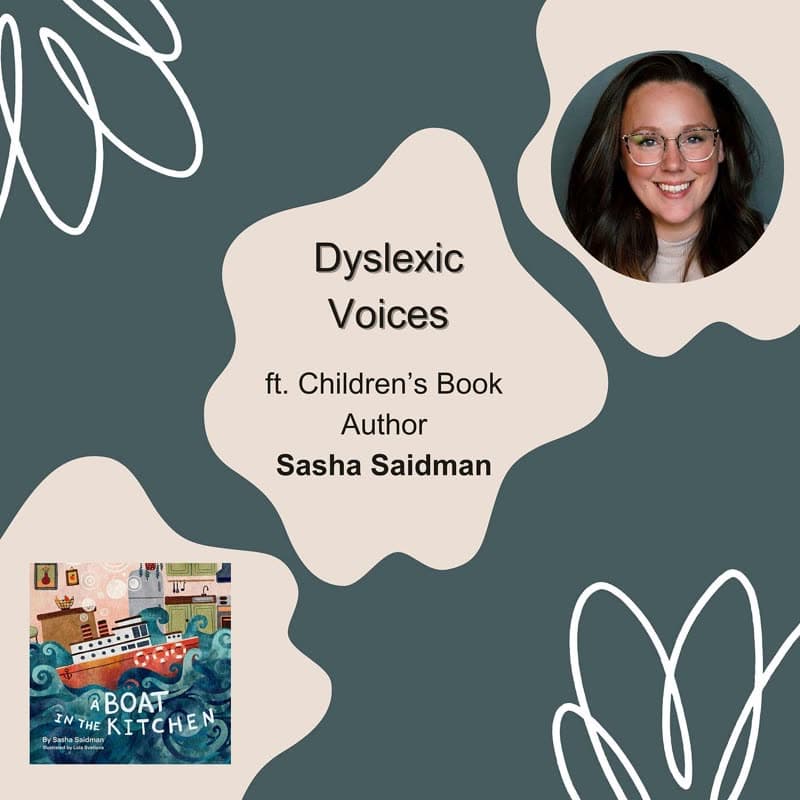
Dyslexic Voices: Children's Book Author Sasha Saidman
About this episode
Sasha Saidman is a cherished voice in children's literature, weaving tales of wonder and wisdom from her home in the vibrant heart of the Washington, D.C., area. Alongside her devoted husband and their two delightful children, Sasha crafts stories that celebrate the diverse tapestry of families, drawing from her own unique journey through life. Despite facing the challenges of dyslexia, which made the written word a formidable puzzle in her youth, Sasha's indomitable spirit saw her transcend these early obstacles. Her journey from a high school dropout to a GED achiever stands as a testament to her resilience and determination, qualities that have guided her path to becoming a beloved children's author. Sasha's work is more than just storytelling; it's an invitation to embrace life's adventures and to find joy in every moment.
You can find Sasha and her books at https://www.sashasaidman.com/
Transcript
Full transcript · 5,484 words · about 27 min to read. Press a timestamp to jump to that moment.
And I remember very vividly walking into my third grade class with my teacher, and my parents were behind me, and my teacher said, hello, Ms. Sasha, and I said, I'm dyslexic.
Got me diagnosed when I was in third grade, and it was the most relieving day of my life, because I finally had, like, kind of a place to hang my hat and say, see, I told you, I'm not lazy, definitely not stupid. I just learned differently, like, that's totally okay. We dyslexics, we were often, you know, just set up for failure, because, you know, we were given books and tasks that really are not appropriate for the level that we were at.
So, how do you expect anyone to be open to learning, when their entire relationship with reading, with learning, is physical pain? Wish I had understood when I was younger that the fact that my brain worked differently than people meant that I would be good at things in ways that other kids were not going to be good at. I must assume, I can't be dyslexic, because letters don't jump up and down for me.
Dyslexia is not a disorder. It is not a disease. Once you sort of own it and embrace it, then you can have the power to deal with it. It's sort of empowering and also enriching to the whole community. To those who don't understand what dyslexia is, that it's not a negative, it's not a problem, it's, like we keep saying, superpower.
Hey, everyone. We are Sonja and Nick, and this is Dyslexia Journey, and today we are welcoming Sasha Sedman to the show. Sasha Sedman is a cherished voice in children's literature, weaving tales of wonder and wisdom from her home in the vibrant heart of the Washington, D.C. area. Alongside her devoted husband and their two delightful children, Sasha crafts stories that celebrate the diverse tapestry of families, drawing from her own unique journey through life.
Despite facing the challenges of dyslexia, which made the written word a formidable puzzle in her youth, Sasha's indomitable spirit saw her transcend these early obstacles. Her journey from a high school dropout to a GED achiever stands as a testament to her resilience and determination, qualities that have guided her path to becoming a beloved children's author. Sasha's work is more than just storytelling. It's an invitation to embrace life's adventures and to find joy in every moment.
Sasha, welcome to Dyslexia Journey. Awesome. Thank you so much for having me here this morning. And I love seeing those, your books there behind you. We will definitely get into talking about those, but to start with, let's go way back as we do, because we want to hear your whole journey. And so tell us just generally what it was like. I mean, of course you have your perspective now as an adult, but what it was like for you before you were identified.
Yeah, so I don't know if you or any of your listeners remember Bob books, but there are these little like paperback Bob books that were maybe five to ten pages, and it would say on one page, Bob has a dog. And by second and third grade, I still could not read at that level, and those were the books that my parents were working on me with. So I felt very behind, and as a young girl in school, I felt dumb.
I mean, that's really the only way to describe it. I did not read at the level of my peers. My teachers were telling my parents that one day I would wake up and know how, and I wasn't. So one of the skills that I taught myself was how to memorize. So I would sound out a sentence or a paragraph and try reading it over and over again until I would memorize it.
And so if I was told to read something out loud, it would look like I was reading fluently. And I've heard a lot of other dyslexic people say that they had done the same, which was surprising because I had, again, felt somewhat isolated by that experience. But my mom had her mom gut, and she caught on. And so second going into third grade, she actually pushed me to get tested. And I did, and they were like, yep, she is across the board dyslexic.
There is no question about it. Your daughter is dyslexic, and she's a visual learner. That's how her brain intakes information the best. And so that kind of started my journey learning as a dyslexic and finding education and classes that worked for me. And my parents found the Lab School of Washington, which is specifically for learning disability and dyslexia in Washington, D.C. And I was there from fourth until 11th. And everything they do is geared specifically for each student.
It's visual. It's interactive. We're getting our hands dirty all the way until 11th grade, where you have internships, where you're really learning on the go and learning with your hands and in the experience versus from a textbook. Wow, interesting. Yeah, we'll want to dig into more of this, I think, because there's a lot there. Yeah. So you were identified around age eight then? Is that right? Yeah, seven, eight. Okay. Do you remember any, like, obviously we remember very well the struggles with reading.
And as an aside, the memorization is definitely something that our dyslexic daughter did as well. And that seems to be, seems to be somewhat common, like you said.
Yeah. Do you remember any of the social aspects of it? Like, did you feel different from the other kids? Were you used to? Yeah. So I don't know. I remember Harry Potter being really big when I was in lower school and everyone was reading the books because the movies were not yet. And I was not able to read the books and I had not yet found audio books. So a lot of those peer conversations about what they were reading, about these cool kind of social aspects of Harry Potter and everyone getting into it.
And people talking about the different houses like Gryffindor I had no understanding for. And I was really felt like I was completely kept in the dark and socially. That was really hard. And also just going in and having those books for school. I mean, I remember reading, you know, Mark Twain and stuff in high school, but my peers in lower and middle were looking at those books as well. And I couldn't relate.
And again, it was just I hadn't found audio books yet. And so that had really affected me. And there were reading groups in our English class. So there was A, B and C. And I always was in the C group. And every once in a while, you would see someone from the C group move up to B or B move up to A. And I would never move up. And I was very aware of just how stationary I was in that lower level reading.
So how was being identified for you? Like, did that just how did that make you feel? Or like, how did you sort of take that in as an identity? Or how did that work for you? Yeah, I don't think I really sunk in. I mean, I think I was so young. I wasn't fully aware of what that meant. I knew that I was going to be switching schools. And I remember very vividly walking into my third grade class with my teacher.
And my parents were behind me. And my teacher said, hello, Miss Sasha. And I said, I'm dyslexic. And I just walked in because I think we were going to have a big conversation with him about that I was going to be leaving the school, going somewhere new. And I was just like, this is me. Like, my parents really empowered me with that. And so once I hit, I'd say fourth grade, fifth grade at my new school is really when I hit my pace where I realized I could learn.
And I didn't fully understand at that point why I was learning so much easier in this new environment. But I realized that I was reading and I was able to understand these random words. And we had like a picture on the wall that said, if you can read this, you're probably dyslexic. And all the letters were flipped. And I remember reading it really easily and being like, oh, that's nothing. And my parents kind of looking at it confused and taking a minute.
And it just came naturally to me. So I think I found the things that fit me during those first few years at the Lab School of Washington. That's interesting. And so you said in your bio that you ended up dropping out of high school. Can you tell us a little bit about how that came about? Yeah, so that goes into mental health a huge amount, which I also love talking about and advocating for.
But I really struggled to find myself from about 10th grade on where I struggled with my own identity, with adoption, with dyslexia, with mental health, anxiety, and borderline personality disorder, which I haven't really spoken a whole lot about. But I was in the wrong crowd. I was surrounding myself with people that were not moving their lives forward, I guess is the best way to say. They were very stagnant in their life.
And it was fun and it was freeing. And I slowly kind of slipped into a depression where I did very, very poorly on my SATs because I did not do any SAT prep. I just kind of was out of school for a week and then got thrown into SATs. And directly after that, I just never went back. And I ended up going to a wilderness therapy program for 10 weeks. I don't know if anyone has seen the Paris Hilton documentary where you have transporters come into your room in the middle of the night and take you away to the middle of nowhere.
But I was one of those kids on July 3rd of 2010. And because I was there and then was most likely going to another treatment program, I had lost my place at the Lab School of Washington because it was a private school. And when I did finally come home later in the fall winter time of 2010, my parents kind of gave me an option where they said, you know, you're not able to go back to the school where you were thriving at.
So you can either go to public school or we can work on your GED, but you will finish your GED. They were like, you have to get this accomplishment. And I was still very not wanting to. And I didn't fully understand why they were pushing it so hard other than them wanting me to go to college. But I had a tutor three times a week and I ended up getting it on my first try.
And I remember feeling so accomplished. And so there's like this finality to it where I did it and I did it within the year. I was supposed to graduate as well. And I just, it felt so big. And I love being able to say that now and that I did it. And I know people who are working on their GEDs now. I know people who have dropped out of high school and not gotten them because they got so far away from their education.
But for me, that was the best path to finishing that chapter of my education, which then allowed me to go to college. And again, not finish college, but my education and life journey is full of paths less traveled. So that was just the first of many. Yeah. So I'm curious to hear then as you got back into education, even in college, like what have been your main sort of accommodations or strategies for you personally?
A lot of them is just immediately going to any office. And that includes with my GED. And my mom helped me a lot with this again, was just saying, you know, I'm dyslexic. This is my reading scores. These are my IEPs. And we don't really go in with a plan of asking for specifics. We kind of go in saying, what do you offer? Because specifically for my GED, I needed help with reading and writing and that extra time.
And I ended up also qualifying for a calculator. So those things just kind of leaving that door open and then transferring that into college where I would just go in to the office. I would meet with my peer counselor and say, I'm dyslexic. What accommodations are available to help people with learning disabilities, people with dyslexia? So I had to do testing, I believe, once just to get retested and kind of re-verify that I am dyslexic.
But after that, it was relatively easy to say, this is my most recent. It's from college. I am dyslexic. I will always be dyslexic. And that's not going to change. Yeah. Exactly. And, you know, people would ask me, you know, oh, well, like you can read now. So you're not dyslexic. I am dyslexic. It's just, I read fluently now, but I still struggle greatly with big books, long reading and intaking the information as I read.
And so that was the struggle in college. As you know, they'd say, read these four chapters and then write a book on it or write a chapter on it or write this. And I would read it, but then I wouldn't intake the information. But if I listened to it on audio, I would listen to it and write things down and I would understand it a lot more. And I would also doodle in class, which was a big, big no-no.
But I ended up finding professors and teachers that helped advocate for me and that need just to keep my hands busy so that I could concentrate more. Yeah, that's important. I mean, I'm glad you brought that up because sometimes there are those specific things like you're saying are so helpful and that, you know, other people just don't understand. But it's good that, you know, you've found people who did. Yeah, there were definitely different professors for different things.
And some people, you know, believe there's one way to teach and one way to learn. And being in education, sometimes you have to try and mold yourself to that if you need that class and you need those credits. And you just kind of try squeaking by and there are plenty of times where I'd have to squeak by with a C or a C minus. But other times I had fantastic teachers that really leaned into my learning style and would take extra time with me or recorded their sessions for anyone who needed them.
And then you could rewatch them online. So I think that as the time goes on in this 21st century, there's a lot more accommodations available. But advocating for yourself and advocating for what you need in the classroom and outside the classroom, I think, is just really the way to do it. And then also advocating for your daughter and doing that and teaching her those things. And I think finding our strengths and not just pinpointing those weaknesses of dyslexia, I think, is really important.
So for mine, it was visual. So having that visual with the auditory was really important. And being able to tell people, this is how I learn. This is not just how I can't learn, but it's how I do learn. So I think that balance of positive and glass half full really worked. Great. Yeah. What do you see as other strengths and advantages of dyslexia? Because, you know, so often we just talk about negatives.
Oh, yeah. No, so many. So I am very visual, like I've been talking about. And for me, it's with parenting, at least now, is I feel like I wasn't torn from the cloth of my parents. I was adopted, but I also had a very different way of learning. So parenting my children now and just being in the world, I love seeing how they learn versus assuming they're going to learn in a specific way.
And so it's opened up my mind to a million other ways that they're going to be intaking information. And also showing them how I intake information and how I learn the best. Another big positive, I don't know why, but it's for phone numbers for me. It's a very quirky one. But I remember the pattern of phone numbers with my finger, but I don't remember the numbers. So if I remember how this goes for my dad's phone number, I can type in the number really easily.
And that's like one of my weird quirks is just the visual of it. So I remember like my first Kiss's home phone number from fourth grade. And I would love to forget it. And I doubt his family lives there. But it's one of those ones I'll never forget. I dialed it hundreds of times a day. Hearing also then sort of how, I mean, we know that it unfolded to be a children's book author.
But was there any other part of that path? Like, did you sort of consider other careers first? Like, how did that all unfold for you? Oh, yes. I started education looking into psychology and arts. And I loved it. But college was difficult. And so I would get some credits and then I would take time off and then I'd get a few more credits. And I ended up going to a secondary treatment program in California when I was about 21, I believe, 20.
And I was supposed to go to a school called SCAD where they had a really good veterinary program. And so that was another passion of mine was animals. And I was pretty good with numbers. So I heard there was a lot of numbers when it came to vet and medicine. So I liked that idea. But that ended up following through due to meeting a boy on the East Coast. So the idea of being on the West Coast was no longer an option for me.
But I transitioned a lot and I ended up finding a really good path in substance abuse counseling with NOVA, which is a local college around here. And I went through the full spectrum of classes. I was about to get my degree. I ended up getting an internship, which was fantastic that everything was very visual. I had a phenomenal experience with the school, with the extra time. I was super into it. The classes were very hands-on.
And I felt like a certificate program ended up kind of being like the best thing for me at that point. And I ended up having a not-so-great experience with my internship, where they judged me based on my mental health and previous diagnoses, saying that I was a liability. And so it put a really bad taste in my mouth. And I ended up not getting the credits that I deserved. And I just kind of gave up.
And I was really defeated. I got married in October of 2019. And then before we knew it, COVID hit. And there was no job openings. There was nothing going on in person. And any classes I could take were online, which were really hard for me to focus on. And so I started doodling again. And I started journaling. And as I became a parent, I had journals about parenting. And that is kind of how my books started to become life and what they are today.
And that's great. I mean, it's interesting how the whole, yeah, because of, you could sort of say because of the pandemic that you, well, because of a lot of factors, I guess. The pandemic, like, forced us inwards, I feel like, in more ways than one, not just in our houses, but, like, internally, emotionally. It was such a struggle for people to be isolated that I feel like we were looking for outlets to use creativity and to make our voices heard and to just put something out into the world that was positive because there was so much negativity and so much fear going on.
And I think, interestingly, mine was writing, being a dyslexic. But it was a way that I could express the feelings I was feeling and also create them for other families to share with their children and not necessarily to talk about this crazy pandemic we were in, but just, you know, the good stuff. How does being dyslexic play into your writing, particularly the process? I'm curious about that. Yeah, so I do most of it on my phone with voice-to-text in my notes section or in a PDF Word app.
And I will do a voice-to-text and then I'll email it to my dad, who is my editor-in-chief. And he will go through and he will add punctuations. He will say, this doesn't really make sense. He'll see if this is in the right format. And then he'll send it back to me and I'll reread it and I'll look at it and I'll say, oh, you changed this idea. This isn't what I meant.
And my voice-to-text changed this word. And we'll go back and forth. But a lot of it isn't really typed. And being visual, I'll often see the visual I want to have portrayed and then I'll figure out the words that go along with it. And so it's a little bit backwards. And then when I work with my artist, I will write out my book, have it edited by my dad, and then I will write out my ideas for the art and I will draw out the ideas for the art.
So I will make my own storyboard and send it to her with each page and the keynotes kind of written in of exactly what I'm seeing. And then she'll send back things and we'll just go back and forth. And I feel really a part of the artistic process. But she's phenomenal and I love sharing her work and sharing how incredible she is. It's just like reading what I'm putting down on the pages visually and making them come to life.
Because they're right there, I wonder if you want it. Do you have a particular one or two you want to show us? Oh, yeah. So I have my Melonade book, which is my dyslexia book. Oh, yes. Okay. About dyslexia, Melonade. It's the play on when life gives you melons, you might be dyslexic because it's the same letters in melon and lemon.
And I knew I wanted to write a book about dyslexia and I wasn't really sure how because I wasn't sure if I wanted to tell my story or if I wanted to tell a more broad story about Melonade. And so I tried to put pieces of myself into the book. We have a part where our character Sam is walking home with all of these ideas from the Melonade stand. And I just remember that's really how I am visual and how when I have an idea, it literally feels like it's coming out of my ears like lava.
And I didn't go to the store and buy the things that I needed. I would go home, look in my bedroom and see the things that I could create and make into what I needed. So I would have cardboard boxes and I would make them into a train for my stuffed animals as a little girl. I wouldn't want a train set. I wanted to create it. If I had a cabinet, I would make it into a doll dream house.
I wouldn't buy a doll dream house. And so I think that that was part of my dyslexia and creativity coming out, really creating what I was seeing. First, just buying something I thought was pretty and then playing in it. I like the actual creation of the item a lot more than playing in it.
So I did that in the book. And Sam, our character, she has a little kitchen and she makes that into her Melonade stand. And it was modeled after my children's kitchen. So I actually was sitting down on the floor trying to sketch out this little kitchen and I ended up sending my artist a picture of it so she could see what I was using as the reference for it. But a lot of these books come from my life and what I see on the floor and through my children's eyes and through my own eyes as a dyslexic.
Yeah. Great. How many books do you have currently? Seven. So I've self-published seven books in the past two years via Amazon KDP with the help of my family, my husband, my dad, my mom. And we're always working on more. I'm working on a larger book right now about my experiences with borderline personality disorder, dyslexia, mental health. And that is very much a labor of love when it comes to the writing process, because I'm actually, it's so funny, I'm dreading rereading it to edit it.
Because right now I'm just voice to texting it. And so I've downloaded software that will just read it to me. And I constantly have to stop it to try and like edit it because it has like these enormous run on sentences. But that's just one of the things that we deal with. Yes. Well, we're definitely going to put all the information so people can find you in the description box. Oh, definitely.
Yeah, no, I would love that for sure. And I always love pointing out my book, All Out of Ducks, has a phone number on the cover, which is 1-833-853-6262, which is the National Maternal Hotline link for postpartum depression and mental health, where anyone who's a parent can call or text the number 24-7 and get mental health assistance when it comes to parenting, which I did not have when I was a new parent.
And I always like to put out there. I was curious what that was, because I did not use a phone number there. Yeah, so I know it's a recorded, but it's a play on the F word being all out of ducks as a parent. So it's a play on that, that it's exhausting, and being a kid with dyslexia is exhausting, and a writer, and a mom, and parents to children with dyslexia.
It's a lot, parenting in general, so it's okay to be all out of ducks. Towards the end of these interviews, we like to always get people's advice and sort of the words of wisdom they want to share with everyone in a couple different ways. So what advice would you give to children who are dyslexic? To children who are dyslexic, I would say to pinpoint those strengths. And one analogy I really like to give is, when you buy a flower in a pot from a supermarket, if you put it inside a closet, and you leave it there for a few weeks, it's going to die.
But would you blame the flower, or would you blame the environment? So the next flower you buy, do you put it outside in the sunlight? Do you say hello to it every morning? Do you water it? Do you make sure it has the nutrition it needs? And then again, do you blame the flower for it to thrive, or do you blame the environment? So I always look at the environment, because it's never the flower's fault.
So I always try and remind myself that if I'm in a bad place, or if my children are having a hard time, before looking at them and putting blame, I say, well, what in their environment is not making them thrive? And what can we add or subtract from their environment to help them thrive? So light, sun, water, nutrients, maybe a little music. And then what about, what would you like sort of the general public to know about dyslexia, that you feel is misunderstood, or that you feel that people just need to understand better?
That it's awesome. Looking at the world from a different perspective is a superpower. It's so great, and it opens up your eyes. And seeing the world with a new perspective is so needed right now. You know, dyslexia, they take over the entrepreneurship in the world. We are the people that are creating new things, new ideas, and that is such a need in this world that we live in now. And so using that, even just going online and Googling who are dyslexics, you see so many amazing, accomplished people and creators.
It's phenomenal. If I'm not mistaken, Einstein was dyslexic. And so it's like, it's such a superpower. It's so cool. And it's something to rock with. And if you're reading comprehensions a little bit slow, okay, that is something we can accept. And then we can say, let's look at all of these awesome things without invalidating the difficult and just find those awesome skills and really keep point on them. But it's so cool.
I love being dyslexic, and I think it's so cool to rock with it. And I don't want to say I'm hoping my kids are dyslexic. I'm assuming they are because I am, and I hope that they take in my footsteps. And we can share this cool visual world of audiobooks and just having fun with it. Well, that's such a positive note to end on. But with that said, I want to give you the chance if there's anything else that you want to say, whether that would be to a different group of people like teachers or parents, or if it's just something that you want to share further.
I would say as hard as it is with being a parent now, and I understand, and I think my parents did a really good job, is that we're coaching. You know, our teachers are our coaches. Our parents are our coaches. And so we're teaching our kids how to play the game of life. So at some point, we can't be on the field with them. And there's going to be games that they win.
There's going to be games that they lose. They're going to fall. And so I think as educators, as adults, as parents, caregivers, grandparents, remembering that our kids are really playing the game, and they're going to figure out the best way to play it. And our job is to coach them and to be on the sidelines and just to practice with them. And so we never know when those little moments are going to mean the world to them.
And just remember, they're playing the game. You know, we're playing the game for the first time, too. So, yes, that's very important. That's just good advice for everyone, I think, out there in all of our kids. Yeah, wonderful. And do you have, like, a website or URL you'd like to share? I do, yeah. It's sashasedman.com. And you can find all of my social media, all of my books, and a blog there, where I talk about dyslexia, mental health, and parenting to young children, which I'm in the thick of right now.
I currently, I don't know if you'll be able to hear it, but I might hear my daughter using her lungs wisely with my husband right now. Yes. Well, thank you so much for sharing all of this. Thank you for what you're doing and getting out there into the world and for your positivity. So we really appreciate it. Definitely. Thank you so much for having me here. And I really wish your daughter the best of luck with her journey in education and dyslexia and just finding, you know, how to go to life to the beat of her own drum.
Yeah. It's really exciting to watch. Thank you.
More from the show
Learn to Love Listening ft. Cliff Weitzman, Dyslexic Founder and CEO of Speechify
In this installment of our Dyslexic Voices series, Cliff Weitzman, founder and CEO of Speechify (https://speechify.com/), tells us about his experiences growing up dyslexic, and shares his advice for how to succeed as a dyslexic child and adult.
Make Real Progress on Big Goals For Your Dyslexic Kid!
We all have goals for our dyslexic kids, but they often seem overwhelming and out of reach. In this episode we provide specific, practical tips for organizing the goals into smaller chunks and making daily progress.
The Attacks On Your Kids’ Rights to a Free Appropriate Public Education ft. Attorney Laura Heneghan
With all the changes in the US recently, it’s hard to keep track of all the implications. In this episode we dig into the changes at the Department of Education, executive orders, lawsuits, and more in order to understand how these changes could directly affect your kids!
Never miss an episode
New episodes every two weeks. Follow wherever you listen.