
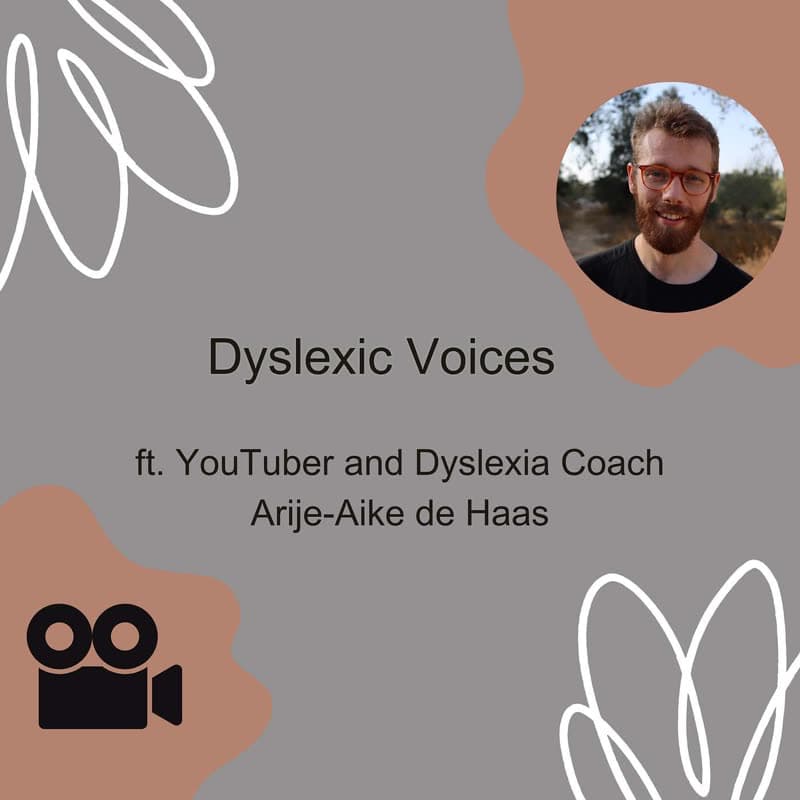
Dyslexic Voices: YouTuber Arije-Aike de Haas Shares his Compelling Journey With Dyslexia
About this episode
Arije-Aike de Haas s an education scientist specializing in dyslexia and related topics. As a dyslexic himself, he truly understands and feels for those struggling with dyslexia. His highly successful YouTube channel about dyslexia has almost 34 thousand subscribers, and some of his videos have over one million views. He also offers 1:1 coaching.
You can find Arije-Aike online at:
@ArijeAikedeHaas
https://dehaas1on1.com/about/
Here is the video in which he shares his personal journey.
Transcript
Full transcript · 4,771 words · about 24 min to read. Press a timestamp to jump to that moment.
You know, sometimes there's still this idea of like, am I going to make it? You know, is this going to work out? And I think that's very characteristic of someone who experienced a lot of failure in childhood. It's like, you know, we dyslexics, we were often, you know, just set up for failure, because, you know, we were given books and tasks that really are not appropriate for the level that we were at.
Hey, everyone, we are Sonja and Nick, and this is Dyslexia Journey. And today we are excited to welcome Arie Aika Dehaas. Arie Aika is an education scientist specializing in dyslexia and related topics. As a dyslexic himself, he truly understands and feels for those struggling with dyslexia. His highly successful YouTube channel about dyslexia has almost 34,000 subscribers, and some of his videos have over 1 million views. He also offers one-on-one coaching. Arie Aika, welcome to Dyslexia Journey.
Thank you. Glad to be here. So we have so much to talk about with you. But we thought we'd divide it up a little bit based on, you know, your own dyslexic journey, which we often call dyslexic voices in that series, and then also talking to you about your current work, and all of the tips and strategies and advice you have from that. So for right now, to start with, let's just go way back and start with your journey. So what was it like? What do you remember about what it was like before, you know, before you knew you were dyslexic, before you were identified?
So before that, like, you know, it's, you know, it's a little unclear when exactly the diagnosis happened for me. But like one of my earliest childhood memories that I have with reading is basically, yeah, sitting, sitting in a corner of the class. And I, and we had this book that was, you know, very basic. And I got the feeling like others weren't really struggling with it so much. And they weren't. And I surprisingly really was. And, and that kind of dawned on me relatively quick, I would say.
And my mom was telling me, you know, next year, we can read and, in our library and, you know, read books together, and it will be a lot of fun. She is an avid reader. And, yeah, that that year just didn't really come. So I kept struggling with that. And, like, reading for pleasure, is also today not really something that I do. I listen to, I listen to a lot of audiobooks. And there I do listen for pleasure. And that's my way of my main way of taking in information. But, yeah, that that's, yeah, that promise of like next year, that was not really in the cards.
So how old were you, approximately, you kind of first had that realization? I think I might have been around, maybe six, something like that. Okay, something like that. Yeah. Yeah. And how is that for you? Just, I guess, I mean, you wouldn't have thought of it emotionally then, but like, as you look back on it, was, was there struggle with your peers, or like, how you thought about yourself? Or, I know, your parents were super supportive. And, you know, we'll get to how they helped you get identified and all of that. But, yeah, I'm just wondering what that, aspect of it, aspect of it was for your life.
Yeah. So, so with my, with my peers, like, my main experience with that whole dyslexic side was like, okay, I got diagnosed, I got the diagnosis. And from then on, I was kind of pulled out of class. And, and put in a, you know, different class with kids that were all struggling. And that was in a different school. So that was one of the main negative experiences, I would say that I have been being torn out of my social environment, and my group of friends, and suddenly I wasn't this, yeah, like, people that I didn't really know.
And frankly, also really didn't really connect to in the same way. So I kind of felt displaced over there. And the main thing I kind of was thinking or, like, seeing was like this clock that like slowly ticking at the wall, and I was just like waiting to get out of there. So that was my, my pullout experience. And now that I looked also into research, I also saw like, ah, okay, so something that happens a lot is that these pullout classes is basically very much very similar to what's happening in regular classes, just in smaller groups.
And that still often isn't effective enough. And also for me, it didn't really result in me, you know, catching up or something like that. So, so that was, that was really before that, before my, before we moved. So at the end of my first school, I had a major exam, I was around 12 at that point. And, and, and then, yeah, I still struggle a lot with reading. And also with math. Disco Cooley has never been officially diagnosed for me. But yeah, it's all, you know, very likely that it, that I should have been.
So I struggled in both of those domains. And I had this exam at the end that determined on which school I could go next. And it turned out that I really didn't have any school opportunity or school to go to that would enable me to then go to university after. And that's what I really wanted. And that wasn't possible after the test in Holland. So then my, my parents decided, okay, we're gonna, gonna actually see how we managed that. And we actually moved countries.
So we moved from Holland to Germany to then, yeah, try and get into a school in Germany that would allow me to then have a path towards university. So we did. And my, my mom was like, okay, we're not going to say anybody, anything about this test. We're going to pretend that it didn't happen. And first school wasn't willing to, willing to take me. and then we approached another one and they said, well, you know, 90% of, success of, me would be the effort that I'm willing to put in.
And, I put in a lot of effort during that time. I feel like that's when, when like life got kind of serious, because I, I was actually put into a class that was with my, yeah, with this kids of my age. But they were further ahead, in Germany. So I really tried to catch up. but then I actually repeated one year. So I was put back one class and, yeah. And then, I slowly made it up and my grades improved, but for a couple of years, it was really like, oh my God, is, you know, is this going to work out?
So we weren't entirely sure about that. yeah. So that, that's, that, that would be the first couple of years, I would say. Were you allowed to use accommodations once you were identified or was it different between the different schools or different classes? Cause I know sometimes that happens where you're supposed to have them, but then it's different with different teachers. Yeah. So in the, initially, I didn't want them. So I was like, you know, I'm going to make it without it. That was my attitude as a child.
I was really like kind of fighting back against that. And I was like, I'm going to, I'm not going to succumb to this, to this thing that is happening and I'm going to kind of make it anyhow. So I didn't really want to listen to the books on tape. There was also like this reading pen that was offered to me. I didn't want that as a child either. and, also like it took me a very long time to also accommodate myself like later in life to be like, okay, it's fine if you're, you know, using text to speech, for example.
and it kind of, yeah, it forces you to accept elements of yourself that you might not, you know, be so willing to accept. But if you do, then that's when really things started to change for me. And I did start using those technological, technological, tools and they really, really benefited me. So that was, it was a good step. And then later I got the extra time, that, that really helped. And in university, when I was studying, Hebrew, at that time, the teacher was actually, that was one of the best teachers that I had.
In terms of, language classes that I took. And, I told him that I was dyslexic. Yeah. It gave me extra time, but you know, you still have this feeling in class that you're, where you're, you know, you're waiting for your turn to read. And this is like, everybody is reading and, it's coming closer and closer to you. And then, you know, you're nervous when, when, yeah, when you're in the situation like that.
So, he actually asked me, if I would be willing. So he, he gave me the choice. He's like, you know, would you like to, read this passage? He's not like you read. He's like, would you like to, and then I could then decide to actually, yeah, do it anyway. And I could decide if I am comfortable with, with it because it is kind of, vulnerable in a way for dyslexic to read out loud that it is really isn't for somebody that doesn't have it.
Yeah. Yes. Yeah. I know there's so many different aspects here. I mean, like you said, even just the different kinds of accommodations, but I think sharing too, that that's something we haven't really talked about yet is that there is a journey with the accommodations, even when one is given them in terms of which ones you use, get used to, feel comfortable with, want to use. I mean, that itself is its own journey.
Yeah. Very much so. I want to go back to, when you moved, you know, obviously your, your parents, have been amazingly supportive, you know, moving to another country for, for your schooling. what was your feeling at the time? were you kind of advocating for moving or did, or, you know, what, what were you thinking then? well, you know, I was hoping, for like a sort of alternative school in Holland, like a Waldorf school or a Montessori school, something like that. That, that was something that's sounded good to me. but, yeah, that didn't really, that didn't really seem to pan out like this, this test at the end that was, which is like, you know, it's such a momentary, just a moment in time where they're like telling you, okay, this is what your future is going to depend on. It's like, yeah, I, I do not agree with something like that, but they do that. And, that kind of, my parents always told me, okay, we didn't really have another choice, but, to go there if I wanted to go to university. So that was then, that was then the decision. And, I grew up bilingual.
So I already spoke German and Dutch. So that helped, that make the trenches to the transition a little bit easier, but at the same time, yeah, I would suddenly be immersed in German, which I was not before. So that really, yeah, made it a little extra challenging for sure. Yeah. Yeah. I was going to say too, just a quick, quick little insert here that, your video that you have on your YouTube channel about your background. it's interesting to hear. We should link that, but, I like that you have your parents speak in their own voices about it. You know, it's just interesting to hear that. Cause often we don't hear everyone's perspective, right. In the same, video like that.
Yeah. Yeah. What they have, what their thought process was too, and what they needed to do. Yeah. I mean, as a, you know, I'm getting a parent myself right now, my wife's highly pregnant. And when I think about that situation for my parents, you know, they got, they got me diagnosed. And back then they also did a, IQ test together with the diagnosis. And they were told that, my IQ is actually incredibly low. So hearing that as a parent is, you know, it's like, okay, what are you going to, what are you going to tell? How are you going to, you know, what are you going to do with that information? It's like, you know, you're going to tell your, your kid you're stupid or what are we, you know, of course not.
So my, my mom actually hit that from me up until like around two years ago. So I was like 30. and she's like, okay, we're just going to put that away and we're not gonna, tell anybody about it. And, yeah. And I mean, you know, I, I got my MA at the end. I got the best grades that I could have gotten. So it's like, clearly it didn't match up, what they, thought I would be in terms of intelligence, but it is, you know, a challenging thing for a parent to, to, yeah, to, to navigate.
Yeah. Gosh, I mean, that really shows the, I mean, your parents were really insightful about that, I think. And that really shows, you know, the potential danger of, of, well, you know, those kinds of tests, which are really inaccurate. and, and just of expectations. I mean, if you had been told those results, it's, you know, if you had known that there were such low expectations for you from the school system, would you have, have had different, you know, success or lack of success in school ultimately?
Yeah. Yeah. I mean, that, that's, you know, you know, you hear about the, the Pygmalion effect. So where basically the teacher have a, has a certain, certain expectation of you and then, treats you differently. And based on that, results do differ and, you know, that could have easily happened to me. but, but yeah, you know, luckily it did not. So that is, that's. Well, it sounds like your parents were giving you that confidence because they were reflecting back to you what they really saw as your potential, because I know you did have some experiences.
Like we had noted talking about an experience that you had in math class where, you know, the math teacher said, I just told you the basics. So that's good enough for you. And, and kind of, you know, at that point you were learning and, and in the academic part, but it was still like this as if you couldn't reach a higher potential. Right. So I'm curious your thoughts on that or how that was for you.
Yeah. That's basically, you know, exactly this different kind of treatment where you're like expected to, or hold up to a lower standard. And then of course you don't have the potential to actually reach a higher one. So, so that is, that is very problematic because you basically don't give the child the opportunity to, you know, reach for the stars, let's say. Right. And, and yeah, and that is, that is really no good. And, you know, they, they had to, or they did pull me aside for this kind of teaching also because I was pulled out for this other class that I didn't really enjoy. so they needed to catch me up a little bit. but yeah, it just goes to show that this whole, strategy of how they've been working for so long, hasn't really been working.
yeah. Yeah. I mean, one kind of to emphasize that point for, cause we have, we have mostly parents who are our audience of this show. you know, as a parent, it really takes a lot of, courage to, to say, okay, I know my child better than you supposed experts who have tested him or her. and you know that we definitely have experience with that. I mean, we, we, we, pulled our daughter out of school when she was about seven and we moved a couple of times, to really try to find a good school for her as well. and so, but it's, it does, it's, as a parent, it's just, it really takes a lot of courage to do that and to say, well, we know better than the school system. Right.
Yeah. Yeah. And I think it's, it's, it's, you know, it's very necessary to do that. even though it's, it's the same thing. It kind of reminds me of the whole diagnosing process itself. You know, you have a lot of experts that say, okay, you know, you have this, this condition, you know, and, and then you look at, I also did a video on the accuracy of diagnosis. And when you look at that, it's like, it's mind boggling.
You know, you have so much symptom overlap where you have like one condition and the other condition and they share symptoms. So that makes it incredibly hard to diagnose. Then you have the issue of like, where does it begin? Where does it end? You know, where do you draw that line? Which is often very arbitrary. And then you have subjective elements like, okay, we're diagnosing based on an interview. so it's like, it is, it is very, very difficult. And then there, you know, people are told that this is what they are, or this is what, what the diagnosis is.
And it can be, you know, it can be plain wrong. so that, that does also happen. And as a parent to then say, okay, you know, I know my child, better than the person that, you know, does a text test for a day is, yeah, I, I do support that. Yeah. Well, still, I mean, it's, it's an interesting balance, right? Because then it's, it can be important to still look at research, right? And try to still take in all that information, not throw everything out. Like there's no expert about anything. Right.
But still keeping our, you know, your own gut and your own, sense of what's really happening too. It's being critical minded in both ways, right? Critical minded to actually find out the current research, but also critically minded about what, whatever process is happening. And, you know, yeah, too. Yeah. You know, I'm not, I'm not saying to throw the baby out with a bad father, but, but yeah, since I have uploaded that video and like, also if people go to the comments and read what has happened to people who were diagnosed falsely, it's like, it's mind boggling.
It's really unfortunate, but it is very prevalent. Yeah. Yeah. so I guess, I wanted to ask you about, you know, you said after you moved to Germany, it was, maybe a rough couple of years, but then you kind of, there was kind of a shift and you started doing well. what do you attribute that to? Do you attribute that to kind of learning to kind of understanding yourself better and how you learn? did you have kind of help from your parents? Did you have outside tutoring? Like what kind of led to that, that shift?
So I would say, so I went to a, a school for focused on sports. So what is, and, and that was like one big element of, my education back then. And what I think came with that is that my, my identity wasn't really wrapped up so much into just what's going on in the academic area. But there was also this sense of like, I'm also, you know, a sports person or like an athlete. And that gave, gave me more balance because you have then these different aspects of your life that are, were differently defined.
And, that helped me see myself in a more positive light. So I think that was one element. And, I did also have a lot of extra tutoring. So for example, for my English, I had a, Norman was, was his name. It's an English Englishman that, that taught me English for a long, long time. And, I had a beautiful relationship with him and that really contributed as well to me having these, these educational experiences that were positive. Same with, with mathematics.
We had a, a neighbor that was an engineer and, like incredibly smart guy. And with him, I actually enjoyed what I absolutely loathed in school. So I think it is a lot also about the teacher student relationship. you know, how, how you relate to what you learned and how much you enjoy these, these things. Yeah. Well, and then I guess continue, you start, you've mentioned some of this already when we were talking about how you brought online some compensation and accommodations that you didn't actually use, you know, when you were younger and that you're even doing as an adult, but yeah, I'm curious if you could say anything more about those or just, you know, what it's like as a dyslexic adult now.
Yeah. So I think, you know, some things just stay right. So for example, if we're watching a movie with, in Korean and their subtitles, you know, it doesn't work. It's just, it's just not, I'm not fast enough. So that is, you know, one really practical, yeah, example of how it is, not really working. and asides from that, when it comes to the accommodations, yeah, because I didn't, didn't really have this idea or lessened this idea or this expectation of myself that I have to do it without.
Then I really started to do the, text to speech and also, yeah. So tech, text to speech. And also that I used my phone, for example, for talking to it. And then it's, writes things down with words that are just not really, yeah. Written in a way that you can memorize, like for example, word schedule. Like it, it just doesn't seem to go into my mind. Like I can, I tend to write it on my, tell it to my phone and then it tells me how to write it.
I'm surprised every time. So yeah, you know, so that is, that is something that is still in my life. And, like on more on the psychological end of the spectrum, you know, sometimes there's still this idea of like, am I going to make it, you know, is this going to work out? And I think that's very characteristic of somebody who experienced a lot of failure in childhood. It's like, you know, we, we dyslexics, we were often, you know, just set up for failure because, you know, we were given books and tasks that really are not appropriate for the level that we were at.
You know, these, these phonemic skills that are really on the, the basis, the foundation of being able to read and write successfully are missing or are not as developed. And then what happens is that you give a child that misses this foundation tasks that, you know, like read this book until the end of the month. It's not going to happen, you know, and then you fail. So then you're set up in a way to fail.
And, and then that failure that happens, if that happens a lot, then it comes more of a pattern and that can then still affect, people in also in adulthood. and also many of my clients struggle with this and we work together on this and, we talk about it and, you know, there are many different ways that we can react to that. But, you know, one is, for example, avoidance that you start to procrastinate more because, you know, this in the back of your head, you have this idea of like, okay, I might fail.
and navigating that can be, can certainly be kind of tricky.
Maybe this would be a good place to wrap up part one of the interview. Yeah. Let's just hear maybe just a couple of words on, on what your career trajectory has been. We're going to go into it in much more detail in the next episode, but, just to sort of a hint of it here, because we want to still say where people can find you and what you offer it all that here too.
So. Yeah. So, so basically, what I started off with was, like a beginning, beginning where I would start. It's with my channel. So my YouTube channel where I, uploaded my first videos and those were actually exams for university. So I wanted to do a oral exam, with my professor and, we wouldn't, weren't able to find a date. So we said, okay, you know, let's do it this way that I make videos.
And then I just published them. And that was the start of everything. And, yeah, I, it's those exams and I got my channel channel up. And from there, slowly people started reaching out. and, and yeah, that, that, that at first that was like, okay, I'm not, I'm not going to do this. Like, I don't really feel ready for this. So I turned people away and then, yeah. and then I started learning more about different methods, like for example, CBT and, schema therapy and, other types of therapy, solution-focused therapy.
And, yeah, also my, my parents, they're both psychologists, so they were also able to guide me a little bit in this whole process of developing my own method in it. And, yeah, I did some courses on, neurolinguistic programming. So that is one thing that I also did and, really, yeah, worked from there. It's also the, the whole process for me is also, okay. I learned something I shared with people and then, and then I, work with my clients on those things.
So it's, it's very much a, whole process of creating content. It's also very much a learning process for me. and that, that helps tremendous to, you know, deepening the knowledge and, figuring out the best way to help dyslexic adults. Well, your, your videos are very, both informative and very, very clear. so, you know, I, it's not as shocked to me at all that some of them have millions of views. So definitely, you know, recommend everyone check it out.
and then of course the coaching too, that, they can find you for. So what is the, what do you think is the best way for, we'll put it in the description box as well. What is the best way for people to find you? Would you say just the YouTube channel and they can see the coaching from there? So under every video that I make, I put my, the link for my website and there you, there you can just schedule an appointment with me.
if you guys just put the, the link of my website in there, then people can go straight there. Okay. And, and then, yeah, I, you know, just schedule a call. I'm happy to talk to, to everybody that, you know, is struggling with these issues. And the first session is free because I want people to try it out, you know, because it's not always, always, you know, it's not always a good fit.
You know, I, I, you know, you need to click in that kind of relationship that you have as a coach with your client. So, that's why I offer people that, opportunity. And then we go from there. Wonderful. Okay. Well, we will hope that you stay tuned for the second part where we're going to get more into, you know, some of your tips and advice and strategies. you know, as you are this adult who is, is sharing all this information and advice, with everyone.
But for now, we'll say thank you for sharing your journey with us. Yeah, you're welcome. Glad to be here.
More from the show
Learn to Love Listening ft. Cliff Weitzman, Dyslexic Founder and CEO of Speechify
In this installment of our Dyslexic Voices series, Cliff Weitzman, founder and CEO of Speechify (https://speechify.com/), tells us about his experiences growing up dyslexic, and shares his advice for how to succeed as a dyslexic child and adult.
Make Real Progress on Big Goals For Your Dyslexic Kid!
We all have goals for our dyslexic kids, but they often seem overwhelming and out of reach. In this episode we provide specific, practical tips for organizing the goals into smaller chunks and making daily progress.

The Attacks On Your Kids’ Rights to a Free Appropriate Public Education ft. Attorney Laura Heneghan
With all the changes in the US recently, it’s hard to keep track of all the implications. In this episode we dig into the changes at the Department of Education, executive orders, lawsuits, and more in order to understand how these changes could directly affect your kids!
Never miss an episode
New episodes every two weeks. Follow wherever you listen.