
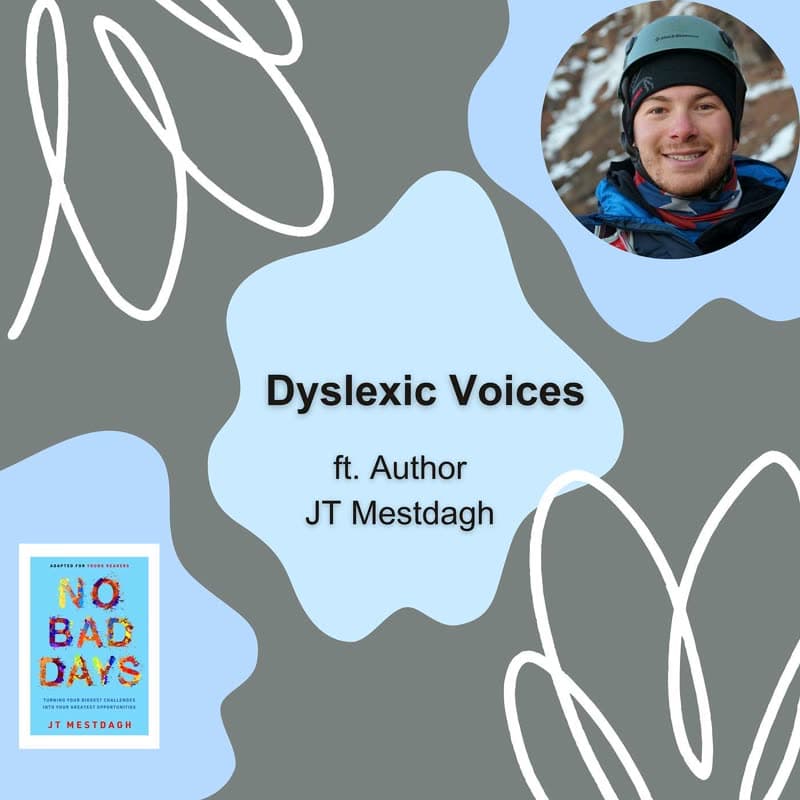
Severe Dyslexia Couldn't Stop Him — JT Mestdagh's Story of No Bad Days
About this episode
What happens when a child born with severe dyslexia and a life-threatening diagnosis refuses to accept his limits? JT Mestdagh's answer: you climb mountains.
JT is the author of No Bad Days and founder of the JT Mestdagh Foundation. Born with VATER/VACTERL syndrome and severe dyslexia, he was told there was much he'd never accomplish — including learning to read. In this episode, JT shares how dyslexia shaped his worldview, what it took to push past labels, and how he now helps kids find their own path forward.
If you're a parent or educator looking for hope and real-world perspective on dyslexia, this episode is for you.
JT Mestdagh Foundation: jtmestdaghfoundation.org
No Bad Days (Simon & Schuster): https://www.simonandschuster.com/books/No-Bad-Days/JT-Mestdagh/9781637632819
Transcript
Full transcript · 5,783 words · about 29 min to read. Press a timestamp to jump to that moment.
I was in the hospital and my dad came into my room and he said, you know, me as a youngster, he said, JT, I'm so sorry for what you're going through. And I said, Dad, it's okay. There's no bad days. There's only hard days, but we get through them with the good Lord. And that message just sort of stuck. And I truly believe that there are no bad days. Every day is a blessing. And with our tribe of people around us, we can get through anything.
They got me diagnosed when I was in third grade. And it was the most relieving day of my life because I finally had like kind of a place to hang my hat and say, see, I told you I'm not lazy. Definitely not stupid. I just learned differently. Like, that's totally okay. We were dyslexics. We were often, you know, just set up for failure because, you know, we were given books and tasks that really are not appropriate for the level that we were at.
So how do you expect anyone to be open to learning when their entire relationship with reading, with learning is physical pain? I wish I had understood when I was younger that the fact that my brain worked differently than people meant that I would be good at things in ways that other kids were not going to be good at. I just assume I can't be dyslexic because letters don't jump up and down for me.
Dyslexia is not a disorder. It is not a disease. Once you sort of own it and embrace it, then you can have the power to deal with it. It's sort of empowering and also enriching to the whole community. To those who don't understand what dyslexia is, that it's not a negative. It's not a problem. It's like we keep saying superpower. Hey, everyone. We are Sonja and Nick, and this is Dyslexia Journey.
Today, as part of our Dyslexic Voices series, we are welcoming JT Mesta. JT, welcome to the show. Thank you so much for having me on. I'm so excited to share a little bit about my journey in life and to be able to spend this time with you guys. So let's just start with that. Could you take us through your journey? I'll let you start wherever you want. With Dyslexia and, of course, other challenges and experiences as well.
Yeah. Well, I think my story starts at birth. And, you know, I know that we're going to be talking a lot about education and dyslexia, which is so important to me. But my story literally starts at birth. I was born with something called Bacterelle Syndrome. And this is a birth defect that affects your GI system. So from the top of my esophagus all the way down, I was compromised. And I had lots of GI problems.
And so I had about 16 surgeries. By the time I was 16 years old, I'd spent over 250 days in the hospital. And with all the medical side of things being a big challenge in my life, as I got older, I'd have what they called tethered spinal cord and would have to have that repaired. And the medical, you know, obviously took priority in our lives. But at a point when I got to about fifth grade, you know, a lot of the teachers and stuff throughout the year said, you know, JT's a boy and he'll catch up eventually.
And that's what we heard time and time again. But we started to really realize that I was deficient in the reading and writing side of things. And so in fifth grade was sort of a pivotal moment in our lives. I went to a school that's special. Well, excuse me, a school that was a private school that basically, unfortunately, had a headmaster and others who thought that, you know, JT at this point, being in fifth grade, they decided that as a fifth grader, they could come to me in the hallway and say, JT, you're not keeping up with the other kids here.
You're not reading and writing like them. And with that, you won't be able to come back here in the next semester. And this being fifth grade fall semester, we'll call it. And as a fifth grader, I ran home crying and upset. And I get home and I'm laying on the floor and in the kitchen. I remember specifically hitting the floor, crying and say, Mom, I don't care about the reading and, or excuse me, the medical side of things at all.
I care about reading and writing like every other kid and being able to keep up with them. And so for my mom, this was a, and my dad, this was a pivotal moment where they said, we got to figure out something. And at this point, I had already tried many programs from Linda Mubelle, Hooked on Phonics, Discovery Read, and you name it, we, we tried it. But the good Lord just happened to put this individual into our life at this unique time of my life that said that he had a program called the TATAM Reading Program.
And this program changed my life and I ended up moving to Denver, Colorado, where he was at the time at a school called Denver Academy that specialized in dyslexia and other learning challenges. And so from there, I would go to school there for the rest of fifth grade and I'd leave there and come back. But as I, as I was leaving there, the, my mom and I and my dad went around to the teachers and were saying goodbye.
And we got to Steve and I was crying and I was upset. And I said, you know, you know, my dad was like, JT, why are you so upset? Like, you're going to see Steve come next year in the thoughts of going back to Denver Academy. So dad, I'm not upset about seeing Steve and no offense, Steve, but I'm, I just want to be able to help other kids that don't have this opportunity to come here.
And, that was a time where Steve said, you know what, if you guys can find the teachers and, and the tutors or whoever to get trained in the program, I'll come to you guys and, and teach more in Michigan. And so, that was an answer to a lot of prayers. And Steve came to the Detroit area and was able to train, thousands of teachers and get it throughout, a lot of our school system here.
And, for me, my journey continued middle school came about and with intentions to go back to Denver. But, we found a tutor that was, a teacher that was trained in the program that would be able to teach me here for middle school. And so we started with sixth grade, went great seventh, eighth grade. And then kind of the full circle moment is I ended up going back to the school that a new headmaster had come into.
That I was told that I wouldn't be able to attend anymore. And I was able to graduate from there and, and never thought I'd be going to college, but I went off to college as well. And I always look at that moment back in my life when that, individual said, you know, JT, you can't come to the school anymore. And a lot of people would say, you know, that they're, of course it upset me, but I look at it as a, an opportunity that, blessed me in so many ways.
And if it wasn't for that individual, I would not be at the place I am today. And so sometimes, a door might close in front of you, but a new one opens and, the good Lord is just directing us in a different path. And, and so I feel very blessed with my story and how I've gotten to where I am. Great. Oh, yes. And we'd like to hear even more about, you know, current things as an adult as well, but let's go into a few items first.
So one thing I just wanted to emphasize from the beginning, what, you know, what you were talking about, just sort of to highlight it, I guess, for the people out there is how that can be a challenge when there's something else also going on. Right. That can be really tricky, like also for parents and for anyone else. Right. To like, yes, it does feel like a balance, right. It does feel like, where do you put that attention?
Yeah. And I mean, your, I think your situation was, obviously your, your medical condition, was, was pretty extreme, but I think a lot of, a lot of parents and a lot of dyslexic people out there can probably relate to this, even if it may be a less extreme level. I mean, there's always, other challenges in life, not just the dyslexia. But also hope that like, it's not too late. Right. Cause sometimes I think, you know, parents can feel guilty or like, you know, that kind of thing that I think, I think really it isn't too late.
And so when it comes up, then, then you can start working on it. Yeah. Exactly. I'm curious to dig into it a little bit. If you, if you, remember, and if you can kind of pinpoint what it was about that particular approach, to help you that really helped you with the dyslexia. Yeah. So, you know, I think, you know, to go more in depth with the TATAM program and stuff and why it was so successful for me and I, I believe anyone that tries it, first and foremost, for my story, I feel that I lacked a lot of confidence in trying to read and trying to write.
And, and so the first time that I met Steve was at like 8 PM at night. It was the only time he could fit us into his schedule. He happened to be in the Detroit area, went to his hotel that he was at and sat down in like a conference room. And if you, if you guys recall, like a lot of the reading programs will use kind of like a flip book where you, it's a triangle looking thing and you flip it and you read a word and you flip it and you read a word and, and just to gauge where you're at.
And for me, that was always kind of a deterrent for me. And just, I was like, this is just another program. So Steve does the flip book with me and he says, okay, GT, you'll never have to see that again. And he pushed it aside and he pulled out a magnetic board and this board, had two sides to it. And one is the vowel, consonant and vowel galaxy, he calls it. And the other side, it's kind of like your, Ible, Asian, shun, chore, different, different, consonants and vowels put together to, you know, make thing, make sounds and stuff that, that we see every day.
And, and so with that, we went right to the backside of the board and he told me to put together two things and he laid out just a few on, on the front side, the middle, and then the end. And I think we started with like two syllables we'll say. And so it might've been pre shun and we would put those together. it might've even been simpler than that, honestly, but with that, putting those things together, all of a sudden created this like, feeling inside of me and the desire to read.
And, because I was seeing bigger words that I could read and I could understand and they were nonsense words. And so from there, the program continued throughout the night, but I'll just, I'll stop on that part. And I'll say that when I left there, I was jumping and skipping and hopping from the hotel to the car in the parking lot. And my parents were like, what's gotten into him? Like, he's got so much excitement about this.
We get in the car and we're driving down the streets and heading home. And I'm trying to read like billboards and street signs. And these are things that I never had done in the past. And being an only child, it was the first time my parents had experienced this. And so they knew that there was something to this. And if it was just the confidence, that was awesome too. And so while Steve was in town, we continued to go out to see him and, we would just try to get as much time each day that we could with him.
And, we did like about 45 minute segments, we'll call it. And the board, so you use the backside of the board, you use the front side, which all is laid out. Like the vowel galaxy is the, you have, is, is all laid out. Like the big dipper, the crescent moon is your R's. You have, you know, E R I R U R and stuff. And all, all very visual and you work with the board on both sides.
Then you go to his books that he had put together in these books, were, you know, phonetically for different reading levels and stuff. And we used a lot of technique like pressure release where I would read after two, three mistakes, he would pick up and take over a sentence or two with me reading with him. And so it's a very fast paced program. I, I, you know, grew from basically a non-reader for someone who needed to find a bathroom all the time with my medical side of things.
There was days there where I couldn't read the word men and women's and I couldn't tell them apart. So, this was huge for me. And that's when my parents decided, you know, JT needs to be really put into this program. I'm at full speed and that's why we moved to Denver. But, yeah, the, the program's incredible and, and, you know, I, I can talk more on it, but, that's just sort of a basis of the program.
Yeah. I like how it has, it has several elements, you know, like you said, the visual parts, but even that part, like you said, I can't remember what word you used, but the, was it decompression? Something like that where, where there's that understanding that it's fast paced, but because we often talk about this, about how it's, it's so, can be so exhausting for people. and so that aspect of it, like that, that's addressed in there, I think is great.
Yeah, for sure. Yes. Yes. And, and the exhaustion side of things too, you know, Steve does different techniques to allow me to, you know, regain some strength and stuff and get back at it too. Yes, yes, yes, absolutely. Oh, go ahead. No, you're right. Okay. No, I was just going to ask, kind of from the identity aspect, I guess. I'm curious how that was for you. you mentioned, you know, how for, so for a long time, they were just saying, oh, he's a boy, he's a boy.
at some point, it sounds like there was an identification of, of the learning challenge aspect of things. And I'm wondering what that was like for you. Was that like a relief? I mean, did it, you know, did it help with feeling different? Did it make you feel more different? Yeah, I love that question. So I think, you know, for me, I felt, maybe a little bit different in some ways and in different ways.
But one thing that my parents were amazing about, whether it was medical or education, is they wanted me to try everything. And there was no, you know, oh, JT, you know, physically, you can't do that. So let's, let's not try it kind of thing. It was always like, put your best foot forward and try it. If it works out, you know, and it's something you want to do, let's do it. And that kind of went the same way with education.
I mean, I, I do remember clearly that, you know, that I was different. You know, when you're in a classroom, the teacher would go around the classroom and just how it is, like, the person who needed the most help is who they get to at the end. And so they could spend the time with them. And then, then I would also be pulled out of the classroom for, LE programs and, and, and get help outside of the classroom as well from the public schools as well as the private school.
And, I remember, you know, one thing that is, is huge for a lot of people is talking about, you know, bullying and, and the, a mental side of things too, that comes along with having a challenge. But the thing that we all remember is that we all have challenges and yours might be education and someone else might be medical and someone else might be, you know, something family related. And so what I always did is I always just was a voice for myself and my parents really pushed that for me.
And I could come into a classroom and, and the kids knew that I, you know, struggled in different areas, but the ones that I could trust and I knew would understand, I would express my challenges to, and I would share what's going on in my life. And with that, it would open up their eyes and allow them to share with me. And it created this great bond, and great friendships that, you know, many of my high school, lower school friends, I'm still great friends with.
And, and it really, I think just created these connections that were, were forever and is because I could help them and, and bring a positive attitude to, to the classroom. That's great. Yeah. I guess, I'm curious about your school experience from, sort of the academic side as well. did you have like explicit accommodations for the dyslexia in, in, you know, I guess middle school, high school, college? Yes. Yeah. So I had accommodations, from the public schools would come in and they would do, you know, a lot of, different programs.
programs with me, but then also I had, you know, as we get into high school, yes, my reading and writing was, went from, you know, a non-reader in fifth grade. And I didn't go into high school and I didn't go into high school, but just by spending four or five months in the TATAM program and then, and then summer in the program and then going into middle school and all that. My reading went from non-reader to, and, and so very quick program, but, I still struggled.
You know, you know, the comprehension side is something that to this day, is, I feel is continuing to improve, but it's something that I, I struggle with. And so, I would have extra time on tests. I would have a test leader just to take the fatigue away, all throughout high school as well. And those, those programs, were super helpful for me. And I believe that, with, with the TATAM program, but also with just the help, to get me, you know, to where I am today and into college basically is, is what those programs did for me.
That's great. Yeah. And it's so important. we, we talk about this a lot on the show. you know, once you're identified with dyslexia and once, even when you're working on, on it, and even if you're at grade level and reading, it's still so important to get those accommodations because like you said, the fatigue of it and just the speed at which you can, just get through the material. Right. Exactly. Exactly. And I think that, you know, we all have our strengths too, you know, and I think, you know, when you look at dyslexic ADD, ADHD, whatever we're, we're speaking on, we all have our own strengths and being able to find those strengths are so important.
And for me, you know, you know, the classroom test taking might not have been my greatest strength, but with having that support there, I was able to, I had the knowledge. it just was, you know, being able to put it on paper a lot of the times. and that's what those programs are there for and why we should use them. because, you know, after graduating and going on and doing what I do now, which is public speaking, writing books and things like that.
I always joke, I'm the dyslexic that's written four books now. And it's, it's truly, you know, I never thought that that would be my strength, but I feel that, the good Lord blessed me with the ability to communicate and to try to help others. Yeah. And we definitely want to dive into, in particular, that book that I see behind you there. Before we do that, I'm curious. Yeah. What, just what it's like for you as an adult dyslexic also, like how do you approach things like the challenge of writing a book perhaps, or, or just daily life?
Yeah. So on a day-to-day basis, I definitely read most things, just because of the FATM program and my ability. But there are times where I do, like, if I'm want to read a book or something like that, I really enjoy audio books. And, for me though, I do for comprehension side, love to listen to books or whatever text I'm listening to, but I also love to follow along. And that just helps me comprehend things much better.
and then I use good old Siri a lot for different things. like text messaging and, and emails, and just being able to make my day-to-day easier and, more productive. And so those are some tools that I use now when it comes to the book writing. I did a lot of recording. All my interviews of people were recorded. and then I was able to go back and reflect on those things, that we talked about in their story.
And, but I also feel that one of my strengths is, is to just understand stories really well and remember the details of them. but being able to use different technologies to help me get to where I am now. Yes. Yeah. speaking of strengths, I wanted to ask, and we like to ask all our dyslexic guests this, what if any, advantages do you see, to, to being dyslexic? You know, I think that, it probably differs for a lot of dyslexics, but, I think they say about, what is it?
60% of entrepreneurs are dyslexic ADD or ADHD and there, it creates, one of the things that it creates is this work ethic of being able to, you know, have to spend extra time to get things done. but it teaches you how to, how to do that and how to have that work ethic. and I think that goes with any challenge. There's a teaching side of it, of, of getting through it and persevering.
And, I think dyslexia is one of those things, that you learn a lot of perseverance and, and then also communication skills for me. I, you know, love interacting with others and, and working together and, figuring out, you know, what someone else is good at and how they can use that tool to help me. And, and, and vice versa, what I can help with them as well. And so I'd say probably productivity of, of staying on task.
I shouldn't say, I guess, staying on task or, or persevering, is a, is a big part of, of it. And, and then just understanding others as well. Yeah. Yeah. so I'm curious how you got the idea to write in the first place. Like where did, where, where, where did you, when, how did you decide? Hey, I'm going to write a book for the, with the first one. So when I was in college, I realized that there was a lot of stuff in my, you know, younger years that I didn't know a lot about.
So it started with the medical side of things. I just wanted to learn more and I would, with my conditions, I have to stay very close and in touch with, with my doctors. And so I'm very good friends with them and I was able to sit down and interview them and just learning more of the details of the past. And, and from there it evolved and, and I had all these notes and recordings and things and friends and family were like, JT, you have all this stuff put together.
And, and, and honestly, one of the biggest motivators was Steve Taddam, from the reading program. And they said, you know, JT, you really should put this into a book. And so I thought I'd put it into a book for myself just so I could, have it to reflect on. And then they said, you should publish it. And so I went about the publishing self-publishing process, with my first book on tether and I had great success with it.
And my goal was like, if I can help one life with this, that's, that would be beneficial for me. And that's, that's what I want. And from there, I had speaking engagements and other things that I would, I would do and start a foundation to help others as well with education and the medical side of things. And, and with starting the JT Mesta foundation, I started to interact with so many people with medical challenges, but education as well.
And I was like, there's so many amazing stories out here. How can I put that together? And so that's when I wrote my next book, which is No Bad Dates. Yeah. tell us a little bit more about, about that book in particular. and if you can, you know, hold it up to the camera for those who are, watching this in video form. So No Bad Days here is my, this is my second No Bad Days.
This is, the first one, shares my story as well as this one sharing my story. but this is the young reader's edition. And the idea with this book, was that I speak to a lot of kids in that age range and I felt that I should interview younger people. And so we did just that. I went out and interviewed people in an age group closer to me and younger than me as well, to gather their stories and to hear more.
So I'd say this book from the last No Bad Days is about 85, 90% new material. And, the No Bad Days title come from a time when I was in the hospital and my dad came into my room and he said, you know, me as a youngster, he said, JT, I'm so sorry for what you're going through. And I said, Dad, it's okay. There's no bad days. There's only hard days, but we get through them with the good Lord.
And, that message just sort of stuck. And I truly believe that there are no bad days. Every day is a blessing. And, with our tribe of people around us, we can get through anything. Yeah, that's beautiful. That's a beautiful message. I am curious. So, so for the speaking engagements you do, that way people can get a sense of that as well. Like what, what kinds of speaking engagements do you do or where?
So I speak from schools to churches to, you know, corporations. and I do a lot of motivational speaking and I share my love for, helping others, but I also, you know, do a lot of that through adventure sports. and, and so I definitely, take my experiences in life and I use those to, to hopefully motivate others. for example, you know, one thing I speak on a little bit here and there, it's also in the book is climbing Mount Kilimanjaro.
and, and, you know, with my medical complications, they, I never thought I'd be away from a bathroom for more than 24 hours and went on to take on Mount Kilimanjaro and, was able to conquer that mountain and, and, and do that in four days, which was our goal, which usually takes about six to seven days to do. so, when I go out and speak, I, I try to bring positivity, joy, and, and this teamwork, aspect to the individuals that I'm speaking to.
And that's, that's my big goal. Great. Yeah. And, yeah, we saw that photo of you at the summit. Yeah. So, yeah, as we start to wrap up, I mean, you've already given so many words of wisdom and I think people will find more in your book. well, both, all of the books actually, but, but we like to just sort of ask for sort of bits of wisdom or advice to different groups of people on this journey, as we close out.
So starting with dyslexic kids, is there any other message that you would like to convey to them? Yes. I think that, you know, a few big points that I, I like to talk about, is first off, you're not alone. And you have so many people that, are around you here to support you. And I hope that you, you know, use those and, you know, dyslexia, you know, really isn't your identity. It's, it's, it's, it's just something that's honestly can give you so many other tools to work with and allow you to persevere in other ways and to, to reach your biggest journey and goals in life.
And I like to talk a lot about, you know, finding your, your tribe or sharing your story. And I think these two things, are important for all of us to remember. And, and, by finding those individuals, they're going to help you in, in the hard days and in the good days and get you through them. and being able to share and express what's going on in your life, is, you know, instead of keeping it all in, you know, find that person that you trust and can talk to.
Because being able to, to, to, to get let it out and, it allows you to get through it a lot faster and have individuals support you as well.
Yeah, that's, that's great advice. Yeah. For everybody. Honestly, yes. yeah. And then what, if you could tell the general public, like one top thing about dyslexia that you wish that everybody would have. Everybody would understand, what would that be? You know, from my experience, a lot of people have different challenges with it. but one of the bigger ones is probably the comprehension side. And I remember, being in a classroom in fifth grade, it might've even been fourth grade, no fifth grade.
It was, and I had, you know, a classroom of kids that I had gone to school with. Since kindergarten. And, they went around the room and it got to a point where it got to me and I was able to read through what, what, was in front of me. And one of the, students there, she stood up and she started clapping and everyone in the room started clapping as well. And, and I think that, you know, one of the big things for those without dyslexia is just knowing that that little bit of confidence that you can instill and that support that you can give, is so beneficial because that's a moment in my life that I'll never forget.
And, and, and honestly, it was a time in my life that, that I needed it probably the most. And, and then with that, just knowing that, you know, dyslexia might be a challenge with reading and writing or, or those areas. but, those with dyslexia have, a lot of great talents as well and, and have amazing minds that, that have so many capabilities as well. Absolutely. Yes, yes, absolutely. And I love that first message too.
That's, that's really great that because people, you know, we get lost in whatever we're doing and in our own worlds of our daily lives, but it's absolutely true. You also never know how much we can't almost know, but it's worth doing that. It's worth doing to give other people that. Exactly. That, support. So that's wonderful. Yeah. How can people, do you have a website or how could people? Reach you, let's say they want to, for a speaking engagement or for some other reason.
I do. So, JT Mesta foundation.org, will get you to all my sites. also just JT Mesta.com and then social media is also just JT Mesta. And, yeah. And so you can, you can track me down through social media, or through my website. Well, and we'll definitely drop those links in the description boxes. I'll just say, I'll just say really quickly in case people are want to do it just from listening. So it's J T and then M E S T D A G H.
But we won't put that also into the notes. Thank you. Yeah. And, where can people get, find your books? So my book, no bad days, as well as on tether. you can find on my website, JT Mesta.com and also anywhere books are sold, for the no bad days and on tether as well. Great. That's fantastic. Excellent. Well, we really appreciate you sharing the story. I know people are going to be so inspired by it and thank you for spreading all this light in the world.
Well, thank you guys as well for what you do and sharing individual stories and, being such a amazing spokesperson for the education space. Thanks.
More from the show
When Phonics Isn't Enough
In the world of reading instruction, phonics has long been hailed as a cornerstone for teaching children to read, particularly for those with dyslexia. However, a recent article raises an important question: is there a limit to how much phonics can help as students progress into middle school? In this episode, we'll…
She Didn't Know She Was Dyslexic Until She Learned English ft. Haiyu Zhang
Haiyu Zhang grew up in China and moved to the US as a teenager. You can find her online at https://hz2784.github.io/.
Parenting the Child You Have ft. Pediatrician Kristen Cook, MD
Have you ever wished that you could sit down with your child's pediatrician and talk about dyslexia, neurodiversity, and parenting? Well, this is your chance! We recently enjoyed a conversation with Dr.
Never miss an episode
New episodes every two weeks. Follow wherever you listen.