
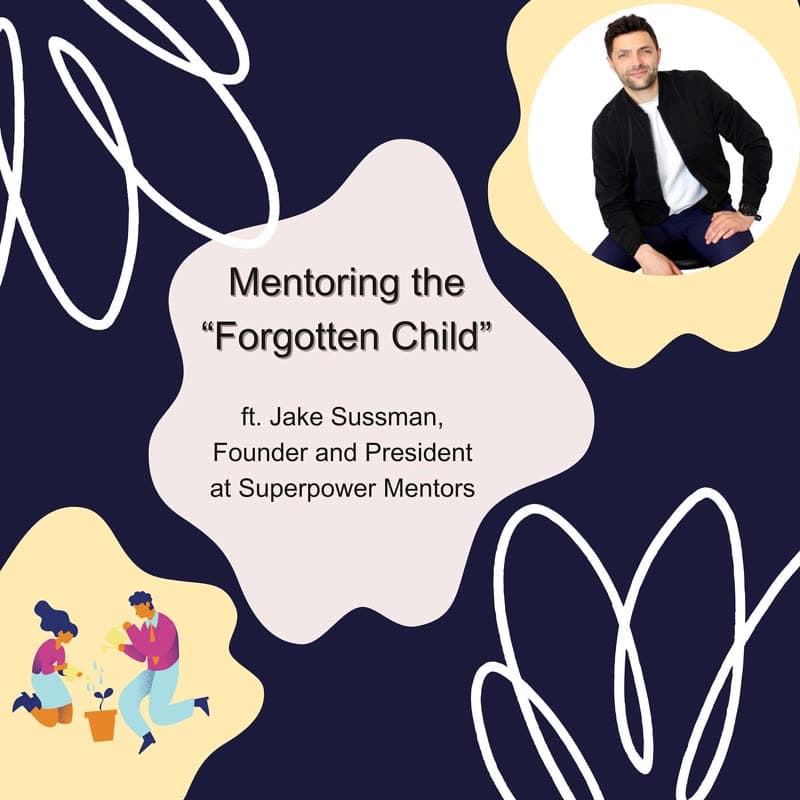
The Importance of Mentors for Dyslexic Kids
About this episode
Jake Sussman, Founder of Superpower Mentors, developed one of the world’s most effective online mentoring programs designed to empower youth and young adults with learning differences to confidently succeed in any environment. Jake has perfected his craft on how to best reach the “unreachable” through thousands of hours of personally mentoring neurodiverse youth around the world. His own experiences with learning differences have been his greatest advantage, as Jake utilizes his stories to bridge the gap between those who think differently and those who do not understand. When Jake is not speaking or mentoring kids, he is training for his next triathlon, working on his museum-quality model train set or playing the piano.
info@superpowermentors.com
https://www.superpowermentors.com/
Hear the complete version of Jake's powerful poem: https://www.youtube.com/watch?v=YBcW-T7pAnw
Transcript
Full transcript · 6,350 words · about 32 min to read. Press a timestamp to jump to that moment.
By the time I was in sixth grade, that was the lowest point of my life, where at that point, I was four grade levels behind in reading, forced to read out loud in class. And I would not, it's like haunts me sometimes when I think about it, because I hear the kids in the back of the class laughing at me. So I developed a stutter because I was always corrected. Even I was told to my face in sixth grade that I would never go to college.
So how do you expect anyone to be open to learning when their entire relationship with reading, with learning, is physical pain?
Hey everyone, we are Sonja and Nick, and this is Dyslexia Journey. And today we are excited to welcome Jake Sussman. Jake Sussman, founder of Superpower Mentors, developed one of the world's most effective online mentoring programs designed to empower youth and young adults with learning differences to confidently succeed in any environment. Jake has perfected his craft on how to best reach the unreachable through thousands of hours of personally mentoring neurodiverse youth around the world.
His own experiences with learning differences have been his greatest advantage, as Jake utilizes his stories to bridge the gap between those who think differently and those who do not understand. When Jake is not speaking or mentoring kids, he is training for his next triathlon, working on his museum-quality model train set, or playing the piano. Jake, welcome to Dyslexia Journey. I am so happy to be here, Sonja and Nick. Let's do this thing.
Yeah, well, we wanted to start actually with your poem, The Forgotten Child, because it really evokes, you know, a lot of your journey in the past and to getting to where you are today. And so, would you be willing to read an excerpt of it? You know, I'd be honored to. And I think it's really fitting because it's actually been almost five years. It's almost our five-year anniversary of the poem launching.
And it is the actual reason why I am where I am today. So, let's begin. Now, I kindly ask you to please shut your eyes so you can fully understand the story that has left me so traumatized. Imagine yourself as the child that always smiled. You were wild and beguiled until the day you were profiled. This is the story of The Forgotten Child. Now, what I am about to tell you will truly make your stomach churn.
They said, I have major concern, Mr. and Mrs., but your child simply can't learn. The child was labeled disabled. He was told face-to-face that he should stop his chase to a higher educational place because he couldn't read any book in the bookcase. From that point on, he was taken out of the classroom all day long from homeroom to three hours past eating in the lunchroom. He became paranoid, full of anxiety and scared because he was told he was impaired.
It felt like nobody cared. He was misunderstood as a result of educators thinking he was no good. He just needed someone to think that he could. You see, negative labels are destructive, counterproductive, and obstructive. Now, I'd like to ask you to please open your eyes to some surprise that Forgotten Child is standing while speaking before all of you guys. So that's a little excerpt of The Forgotten Child poem. And, you know, it's one of those things that I – it's my story, but it's also everyone's story.
Yeah. We're going to link to the whole thing, too, because it's really worth listening to. Yeah, definitely. Thank you. Very powerful. Thank you for reading that for us. Yeah. So, you know, after hearing that poem, it's obvious that Superpower Mentors is super personal for you. So, do you want to tell us a little bit more about your childhood and your struggles with school? Yeah. You know, it's been a while. But, look, and for those of you listening or watching, I'm 29 years old, just to put in some context, okay?
So, you know, when I – my journey started, it was third grade. And I started to realize that, you know, I was really great in group projects. But when it came to independent reading time, I was a total nightmare. You know, as a report card I recently found that my third grade teacher wrote was in a two-paragraph analysis of Jake Sussman. Eight of those sentences talked about my behavioral issue and that I had to be the one to change as a third grader.
I mean, come on. So, that's when things started to happen. Now, I'm the oldest in my family. So, my parents – everyone is figuring this out for the first time, right? So, no one – there's no one is an expert in parenting a neurodiverse child. So, by the time I was in sixth grade, that was the lowest point of my life where at that point, I was four grade levels behind in reading, forced to read out loud in class.
And I would not – it's like haunts me sometimes when I think about it because I hear the kids in the back of the class laughing at me. So, I developed a stutter because I was always corrected. Even I was told in my face in sixth grade that I would never go to college. So, how do you expect anyone to be open to learning when their entire relationship with reading, with learning, is physical pain?
I shut down. You can't force feed it, right? Reading is not – you're not born knowing how to read. So, that was when my parents pulled me out of school without a plan. And from there, I ended up going to a school that specialized in learning differences. And I became obsessed with wanting to learn how to communicate because that's the only thing I'm in control of is what comes out of my mouth.
And it was a great experience. But to be honest, long story short, when I graduated high school, I went to a school that specialized in learning differences. When I graduated high school, I realized – and I'm in college now, despite being told I would never go – a lot of my class started to drop out. So, now I'm like, hold on a minute. Time out. If I'm going to one of the top schools in the country for learning differences, 100% of us get into college, how come most of my class is dropping out?
And I did some research. This is me in college, right? And I realized that it's not just my story. 40% nationally drop out of school every year of college. If we have a learning difference, we have a three times higher likelihood of dropping out. So, there's a huge problem going on here. And I'm like – it was always like sitting in the back of my head. I never graduated college with the intention of building this company.
But it was always lingering. And long story short, the poem I was inspired to write and boom, that's kind of where we are. So, I could keep going. Do I want me to keep going? There's like a little bit more to it. Yeah, I'll go for it. Okay. So, we start – I write the poem. The poem was picked up for – at a poetry slam in college because I wanted to share my story.
I'm like, wait a minute. I shouldn't be here right now. That's not my path. My path wasn't college. But here I am as a junior in college like, oh my gosh, I'm here. So, I needed to share my story. And what I realized was that the more people heard it, the more they started to cry. And they're like, wait a minute. I'm the forgotten child. I'm the forgotten child. When I say I am, it's you, the person that's hearing it.
So, it was picked up by an Emmy Award winning filmmaker, Harvey Hubble, who – very known for – his most recent movie is Hopeville.
Incredible. He's a dyslexic filmmaker. Incredible. Turned it into a film, which everyone is going to watch. That's the link you're going to share. That went semi-viral, which got me to quit my job super spontaneously to then speaking around the country for learning differences. And that – every time I would speak, parents are like, do you work with kids? And I'm like, wait a minute. No, I have a communications and business background.
That's not my – I'm not a teacher. I'm not a therapist. So, why are you coming to me? And I'm like, wait a minute. There's a reason because there's a reason for everything. And what I learned was that my credibility is that I have the thing. Right. That's where mentorship comes from. So, yeah. Yeah. Okay. I want to go back just a little bit and in your story before we go even on more with the mentorship.
Sure. Which is the main piece we want to cover here. Just because we're always curious about people's journeys and like how these turnarounds do happen. So, it sounds like when you did go to that school that specialized in learning differences, that was what led to the turnaround. Can you pinpoint like the factors of why that school was so helpful?
You know, for the first time, I'll never forget when I was in seventh grade in this school, I'm sitting around a group of kids. I was taking out for new students and I'm angry at everyone because teachers, professionals, everyone's trying to fix me. My guard's up. I'm ready to go. Right. So, I'm sitting around and the scariest thing happens, which is your turn to share about your summer – what did you do this summer?
Right. And I'm in a group of like 10 kids and it's like my first week of like this new school and I'm sweating because remember at that time, I have a stutter because I was so insecure. So, when it came time to my turn, I started to speak. Oh, my – what I did this summer was I went to – I started to struggle saying Disney World and then something remarkable happened.
The girl next to me completed my sentence. Disney World? Oh, that's so cool. And I was like, wait a minute. That – she just – she didn't laugh? For the first time, I was around my people. That's when I realized that was it. It wasn't just the school. It was what attracted the people to the school. Make sense? Yeah. Yeah.
Yeah, and that was really, I think, brave of your parents to like just pull you out of the regular school like that without a plan, as you said. Despite everyone, they were like, you're crazy. People were like, you're crazy. What are you doing? No plan? Parents – listen, I work with parents all the time, okay? Because parenting a neurodiverse child, you're going in blind. You don't know what that path is like.
Whatever you think the path was going to be, it's flipped upside down. There's nothing more anxiety-inducing than that, right? So my parents were like, okay, what's step one? My kid needs to be happy. I don't care. Everything else is going to come. We're running a marathon here. We're not running a 5K, right? So first, social-emotional. I need to be happy. Once I'm happy in a safe environment, then we can talk academics, right?
Yeah, right. That was their philosophy, and it worked. Yeah. Yeah, that's really great advice. Yeah, and we've talked about that before on the show. We've had other guests mention, like, you can't – yeah, when you're – you can't learn when you don't feel like you're in a safe environment, when you're, you know, anxious and not enjoying the situation. Absolutely. You know, I don't believe in coddling either, right? And a lot of parents, especially those with financial means, but also any types of – every parent doesn't want to live their kid's pain, period.
Right? Because a lot – this is so genetic that a lot of times the parents themselves are reliving their pain through their kids. So they don't want to relive it, so they want it to go away, right? So, you know, we don't just say, like, oh, like, get all the professionals for your kid, right? Take a minute and look right in the mirror because the answer of their confidence is right in front of them and it lies within their interests, right?
So no matter if you have financial means or not, right? Because I was able to go to private school, but maybe some of your listeners can't do that, right? So regardless of which, finding your kid's outlet is the most critical piece to their success. It's their foundation because even as adults, we all have outlets, right? So if we can help our kids find those outlets and that superpower, we've identified three main outlets that we need for our confidence, but they also directly correlate to how our brain works.
So we can go into that in a minute, but, like, I would say step, step one, invest, find the outlet and then invest in it. That's where the confidence is. Yeah. And it sounds like for you it was model trains and music as a kid. Oh, my gosh. Yes. You know, it's like modern-day Minecraft, right? So, yeah, my – I love trains. Don't know why. I just did. And my basement flooded.
Perfect timing because in sixth grade, that was my lowest point of my life. So, you know, instead of me going out, you know, just sitting in my room sulking, I was building. Having ADHD, I need to be in motion. It's the stereotype of, oh, we can't sit still. It's not literally. It's the fact that I need to feel like I'm making progress in something because if I don't do that, I will fall into depression.
So that's why we love building. That's why we love video games because it gives us an illusion of progress, right? So, model trains, I was God. I could build mountains and towns. I was the man in control. In reality, the life upstairs from my basement was out of control.
Yeah. Yeah. I just freeze. No, we're good. Okay, fine. No, you're good. I think. Yeah, that makes perfect sense. Yeah. Well, so I'm curious, yeah, how this connects then with the mentoring, whether that's like how, like how you came to understand what that exactly means for your particular kind of mentoring you're offering. Along with maybe starting to get into what it is, what you offer. It's so interesting. We have a method.
There's really a method because our society has become obsessed with finding an answer to everything. We want to solve the problem. And our pursuit of the problem, I believe, is the problem. We forget. Think about this. Let's think about your child and all of the people that are in their corner on their team. You have the therapist, the psychiatrist, the coach. You have the amazing podcast. You have, right? You have, you know, friends and family and all these people.
But out of those people, who can actually relate to your kid?
Relatability is the missing piece to the equation. It doesn't exist. And it hasn't because in person, it's like good luck finding the exact replica of your kid but older in your town. Like it's not really going to happen, right? So it hasn't been made available. We offer it in a virtual setting, which is why it works. And I'll get into all that in a sec. But like people have become a – with the obsession with fixing the problem, that becomes people's identity.
This is where things can get a little scientific. So I'm just going to like get a little science-y for a sec. So there is a research study that came out on this topic called stereotype threats. Dr. Fumiko Haft, who is part of the Yale Haskins Lab and at UConn, and Dr. Caroline Richter, who's at the University of Alabama at Birmingham Stars Lab. They together conducted this really fascinating study looking at how stereotypes impact youth with learning differences, stereotype threats.
And what they found was what we all probably see, which is that like I can't tell you the amount of dyslexics that I speak to that literally believe they can't read because of their dyslexia. Having dyslexia does not equal can't read. It makes it really hard. But it doesn't mean you can't, right? Having ADHD doesn't equal can't focus. Having anxiety doesn't equal can't go to the birthday party. But because our pursuit of finding an answer to the problem, that has become our identity.
You get what I mean? It's like – have you seen Shawshank Redemption? No, actually. Okay.
Shawshank – this guy that like is in prison and he escapes prison. Okay. So – but some people are more comfortable in prison for their whole life than actually being free because that is their reality. Sometimes freedom is even scarier because that means option, right? So our kids will tend to identify with those stereotypes. Now, where we come in is that having a role model – this study is what they found – is that if you have a role model within the same stereotype group who has overcome those labels, can help you reduce stereotype threat, which means I have learned indifference.
I have overcome the adversity. So little Jake that's in it can look at me saying, wait a minute. If he could do it, I can do it. That's the concept of the mentoring program. That's what we do every day, right? And that's what we're solving. Yeah. So that's kind of – I think – I kind of tend to use the term sort of mentor and role model interchangeably. But I mean, I guess they are kind of different things.
But in this case, I think the mentors are also serving as role models then, right? You know, they are, but there's a goal. The goal is independence because if you ask any parent, what's the ultimate goal for your kid? It's for your happiness and independence. That's pretty much what they want. So happiness is relative. That will come. But it's really independence then. But what does that actually mean? Because parents, I don't believe, can actually teach their kid independence, right?
Because by default, parents equals safety, right? Independence is going to come from advocating for yourself, proper advocacy. And that's where having a mentor, someone in their mid to late 20s. Like we got a mentor at NASA. We have a mentor that's a professional music artist, entrepreneurs, architects, right? These are young leaders that have embraced who they are and they're doing something about it. But they're kind of like the coolest camp counselor at camp that you get all for yourself all year round.
Yeah. And do you specifically match, and I think you said this already, but just to emphasize, like someone, a kid with dyslexia gets matched with a mentor with dyslexia, right? And like a kid with ADHD gets matched with a mentor with ADHD. You know what's interesting? The answer is yes and no. Okay. Yes and no. Because while dyslexics have a certain experience and people with ADHD have a certain experience, like literally, like dyslexics and people with ADHD, right?
The two different types of quote unquote disabilities, right? We all share the same challenges of being misunderstood, feeling we're alone, being labeled, questioning ourselves, comparing ourselves. Those are universal struggles within the neurodiverse world, right? So while dyslexics on dyslexics work, it doesn't need to be dyslexic on dyslexic because it's really about the shared struggle. And more importantly, their interests, because that's where their confidence is. Okay. Yeah. I'm curious how you find, like, how do you find these mentors?
How many people have been involved at this point? Okay. So we just hit our 10,000th session over the last five years. It's crazy. We worked in a total of seven different countries, speaking a total of five different languages. Our mentors, we have over 8,500 mentors who have applied. We have a 1% acceptance rate. It's very hard to become a mentor. We're not just taking anybody, right? We're looking at a very specific criteria.
You know, ideally, we're looking for someone metaphorically that has already put on their cape and embraced who they are. I'm not looking for perfection. I'm looking for their path, right? Because they can take their own momentum and the kids will feed off it and feel so excited to launch because their mentor is doing it too. That's how it should be. It should be focused on launch, not their struggles. No one wants to talk about their struggles all day.
That sucks. Isn't that just common sense? But it's not right now. Yeah. Yeah. Yeah, that makes a lot of sense. Well, and then so, you know, you don't have to delve into this in too much detail, but I'm just curious, like, what is the training process like? Oh, my gosh. Yeah. So I'll talk. So the training is recognizing that the mentors credit. We're not looking for the Harvard therapist. We're looking for the NASA engineer, Pixar animator, the professional athlete, right?
So their credibility is through lived experience. Then we add strategies on how to be the most effective mentor. And we have a whole method on how we do that, right? It's all part of the course. We don't have set curriculums. We follow what's going on during the calendar year because we recognize neurodiversity. That I can't tell you what's going to happen in six weeks because you may not be feeling it that week, right?
So that's why mentorship is a dance between doing the work and play and the relationship, right? So that's why it's fun. Like, it's not supposed to only be about the issues. But the vetting process is extremely intense. And parents listening, you're involved also. This isn't just for your kids, right? This is a no whole other part of the program where parents get a team. They get a monthly call with us. They get a group chat that will talk to the parents.
Remember, we may learn more about your own kids than you may know. And if we learn how to better reach your kid, you deserve to know as a parent. We can even – I mean, I've sat in IEP meetings before on behalf of our kids, right? So, like, we want to be your kid's bridge while we teach them how to find their own voice. And we want to team up with you as a parent to do that.
Yeah. Yeah. I want to go back to one thing you said a little bit earlier about the importance of focusing on – or, I guess, of not focusing on the struggles. And, you know, so it's really, like – I think the term that gets thrown around is, like, a strengths-based approach, right? Or whatever. Yeah. Can you just talk a little more about that and, like, why that's so important? Yeah. So I'm going to preface.
We're not not talking about struggles, right? Because that's where the work comes in. But you can't – look, there's – everyone is talking about all the things – executive functioning, time management, confidence, self-esteem, advocacy. Like, those are all the big buzzwords. But let me tell you something. Wishful thinking without trust. It's not going to happen, right? And if it does, it's going to happen in, like, three months from your first time starting to work with someone.
We can establish trust within three to six weeks on average with our mentees virtually anywhere in the world. Hmm. Mm-hmm. Working with a population that stereotypically can't – doesn't do well virtually. Right. Yeah. So we just got a study published in an academic journal. It's still in our peer review, but it's been published. It's one of the first studies of its kind looking at the impact online mentorship has on youth with learning differences.
And what they found was significant because for the first time, relatability is now part of the equation. We're no longer limited on geographical location. Okay? Now, going to answer your question on strengths-based approach, we're like interest-based approach, right? Because even if it's Fortnite or Minecraft, there's a reason why they're doing it. Yeah. So let's find it and then extract it and then plug it into the areas of challenge. So I'll give you an example, right?
For kids with ADHD and dyslexia, most likely we're not going to be on team sports. We're going to be the runner, the swimmer, the rock climber. We're going to do the thing that we're in control of the outcome. So if we can predict that, that we, as a parent, can be proactive in putting interest in their corner that they're going to be in control of, that they're going to thrive in. So that's where we can take the things that are good at and then help build a plan so that families can feel more in control of the path and their own kids, frankly.
Yeah. Yeah. Yeah. That's really interesting. And this is so interesting to me because I didn't know, I didn't know a lot about like about the specific work and it's really innovative. I feel like the approach here and, you know, like if you look at the world's biggest, most successful people, they all have it, right? Simone Biles, Elon Musk, Thomas Edison, Albert Einstein. I mean, you all know the names, but those people are unreachable, right?
They're inspiring, but like when you're in the thick of it, having Elon Musk as your closest role model is pretty far-fetched. I'm sorry, right? It is. It is. Like, it's like, okay, great, mom. Thanks. But like, I'm not Albert Einstein. So that's hard. I appreciate Albert Einstein having dyslexia. That's great. But like, I don't feel it. So that's why at some point they put on the cape. All we want to do, a lot of times these people put on the cape really late.
As in metaphorically embracing who they are, cape. I want kids to put on their cape in their teens, in their 10s, in their early 20s. Because once they can do that, they launch. Yeah. That's all we're trying to do here. Right. Right. Yeah. Yeah. Yeah. Oh, go ahead. I was just going to say, you mentioned the study. So, and I understand, we understand that you, you know, in general are very focused on actually quantifying the effectiveness.
So I'm curious just if you could just say a little more about how you do that and why that's important. Yeah. Well, I'll tell you that. I mean, 93% of our mentees have seen an improvement in their emotional well-being. With over half seeing it within the first month. Another statistic that we have, which is actually the craziest statistic of all, in my opinion. So remember I was sharing earlier about the college dropout rates?
Yeah. So one of our strategic partners, they're the largest scholarship foundation in the country for dyslexics pursuing STEM majors. You got to have them on your show also. They're called, they're named the Joseph James Morelli Foundation. Barbara Morelli, she gave a TED Talk. She's amazing. Okay. When she first approached me four years ago, they had a 30% dropout rate amongst their freshmen. They work with kids all over the world. Since working with them, we built the program of where every freshman has a mentor through our method.
Not a single student is chopped out of school that's been in our program. Wow. So it works. It actually works. And that's why quantifying it's important because we're going to take this to Congress. My goal is that I want the first thought when your kid gets diagnosed, not just to go to a therapist, which by the way, we love therapists, right? But that's been the media default. I want their kid to get a mentor.
That should be default one. Yeah. Yeah. So, yeah. That's amazing. So you have big plans. It sounds like. Big plans. Yeah. Yeah. It's bigger than we even realized when we started. It's something that every single one of our mentors say is, where was this when I was a kid? Right. Right. Yeah. So I think the quantification and the stats are great, but it's also important, I think, to focus on some of the individual human stories.
Do you have any specific kind of success stories from the program that you're able to share? Yeah. Yeah. Oh, so many. I actually, it's funny. I just, I just got a text. I just got a text from a family. This was, this was from a family that just started working with us. I'm going to share a long way in a second, but I just got this text. Just wanted to know how great a time blank name had last night.
He cried a little bit about 20 minutes after we asked him what was wrong. And he said, quote, every memory I have with mentor is awesome. So needless to say, he is looking forward to tomorrow. Wow. Right. So these kids, when they realize that they're talking to their person, that just gets it, the guard drops and they get excited now. So I'll give you a really great story. We had a mentee came to us two months into college.
She didn't do a single homework assignment. Completely frozen. On the verge of dropping out. So the first thing, we're not the tutor, right? But the first thing that we do is we get to lay out of the land. We started to build him up and reignite the spark. This young man wants to become a professional music artist. That's his dream. So we use the spark as a way to instill motivation. And within six months, we got him back on his feet.
And then we brought in another mentor who's a professional music artist with millions of streams on Spotify with ADHD and OCD. And now this mentor is helping him not only launch his first music album, but he just finished his past semester last year with A's, B's, and a C.
Like, guys, this kid was dropping out. Yeah. And now he's launching with his first music album. Like, that's how we go is that we just need our why. Yeah. And the mentors have the key. They really do. You know, I'm realizing another thing to come back to was you mentioned three. I can't remember how you put it. Three factors, three. The outlets. Yeah. Was that it? Yeah. I'm just going to let's go into those just a little bit.
Because this, no matter what happens, I love when I do these interviews or when I speak to leave with actionable items to take home. So if there's any actionable items to take home after this call, this podcast, this is what it's going to be. Okay. So at Superpower Mentors, we've identified three main outlets that we need in order to feel confident in ourselves. One is an outlet that boosts our heart rate.
Two is an outlet that boosts our passion. And three is an outlet that boosts our creative expression. Now, why? Why do I say heart rate, not exercise? Heart rate, I don't, exercise is the activity. Heart rate is oxygen to our brain. We need to fuel our brain with oxygen. I'm an athlete. So like I need the oxygen, but like having a, being neurodiverse are, we're working harder than most. Okay. So we need to find a way to do that.
Also, studies have shown that it dramatically reduces anxiety and depressed moods doing cardiovascular exercise. So heart rate to create out the passion. What's the thing that throws your covers out of bed in the morning? If your child is struggling to wake up or get out of bed, they're missing passion. We got to find their passion. Okay. And three is creative expression, which is what helps them feel seen and heard. A lot of times it's Minecraft or video games.
It could be Legos or arts, music, something that helps them. My new was model trains, right? With model trains is both my passion and creative outlet. I can have two in one, right? And then I had running. That was my heart rate outlet. So if you're, I'm no therapist, but it's crazy when you actually reflect on your own life. Parents first, right? Or educators, right?
Reflect on your outlets. If you're feeling off in your life, most likely you're missing one of those three. I'll almost put money on it. Yeah. Yeah. I mean, that's, yeah, that's good advice for everyone. Right. It's true. It's true. Yeah. Advice works for everyone. Yeah. Yeah. For sure.
So I guess for all the parents of neurodiverse kids who are listening to this and saying, like, that sounds exactly what my child needs, sign me up. Like, how does a parent go about getting their child into the Superpower Mentors program? Okay. Amazing. So first of all, they can come to our website, which is superpowermentors.com. They can find us on Instagram, Superpower Mentors, or on Facebook, Superpower Mentors, right? You know, I can put my email or whatever contact you all want to share in this as well.
In the description, we can do that. Let me know that you're coming from this podcast and we'll give you guys a nice discount in our program. So, you know, it's important that we build community here and we take care of each other. So I'll be happy to apply that. But you have to say the name of the podcast. Okay. That's the key. All right. So, and yeah, and that's when you'll speak to me.
We'll talk and see if this is the right fit for your child and your family. Okay. Yeah. Awesome. You will speak to me though. So don't worry. Yeah. And I assume anyone interested in becoming a mentor, also go to the website and it'll be the instructions. Yeah, go to the website. I believe it's on the bottom of the website. You can apply and we'll have our team reach out to you. Okay.
Well, and maybe just a final question here. You could, well, you can share anything you want as your final words here, but I am curious if you want to add into it a little bit about that, like vision, because you started to talk about it and that sounds really cool. Well, like some of the ways you want to take it.
Mentorship has been this missing key, this missing piece to the equation. It hasn't been really, mentorship has been there, but not in this type. Okay. I envision mentors because when the student becomes the teacher, it heals. I healed my past through this work. This is a two-way street. We need the mentees as much as the mentees need the mentor. Okay. So everyone is winning. I envision superpower mentors being the staple solution for families, the family partner.
When families get their kid diagnosed with a learning difference, if they're struggling, their mentor holds the key. And I see us partnering with therapists, with schools, with even companies to provide the service because I want to see a world in my lifetime of where we finally start investing in neurodiverse youth. And I will say my parting thought is this, and this goes into the vision. Our world is filled with many problems, as everyone pretty much realizes.
And the only way that we're going to solve our world's biggest problems are by those who look at the world differently. Those who think differently. Those who think differently are the dyslexics, the ADHDers, and the autistic folks of the world. I want to see a world that we actually finally invest in these students and we change our curriculums to cater to these students because it's actually a national security issue. It really is.
Investing in neurodiverse populations, it's like an asset to a nation, right? Because we're the inventors, we're the problem solvers, we're going to go to Mars, right? That's neurodiverse minds, right? So I want to see that in my lifetime. And mentorship is going to be the piece to get us there. How's that for a vision? Wow. Fantastic. Yes. Lofty! I love Lofty. Give it. Well, thank you so much for being here speaking with us, but also for this work that you do.
I mean, that's just wonderful. It's like so filled with such hope and encouragement and, you know, in a big way, like for individual kids, but also like, wow, like what you just said, like that we can do this. So we, we absolutely can. Once we stop only focusing on the problems. Yeah. I'm telling you, it's unbelievable what happens. Beautiful. Thank you all for the great stuff you're doing. I mean, your podcast is amazing also.
So we're going to, we're going to do this together. All right. Sounds good to me. All right. Thank you. All right, everyone. Take care.
More from the show
Learn to Love Listening ft. Cliff Weitzman, Dyslexic Founder and CEO of Speechify
In this installment of our Dyslexic Voices series, Cliff Weitzman, founder and CEO of Speechify (https://speechify.com/), tells us about his experiences growing up dyslexic, and shares his advice for how to succeed as a dyslexic child and adult.
Make Real Progress on Big Goals For Your Dyslexic Kid!
We all have goals for our dyslexic kids, but they often seem overwhelming and out of reach. In this episode we provide specific, practical tips for organizing the goals into smaller chunks and making daily progress.

The Attacks On Your Kids’ Rights to a Free Appropriate Public Education ft. Attorney Laura Heneghan
With all the changes in the US recently, it’s hard to keep track of all the implications. In this episode we dig into the changes at the Department of Education, executive orders, lawsuits, and more in order to understand how these changes could directly affect your kids!
Never miss an episode
New episodes every two weeks. Follow wherever you listen.