
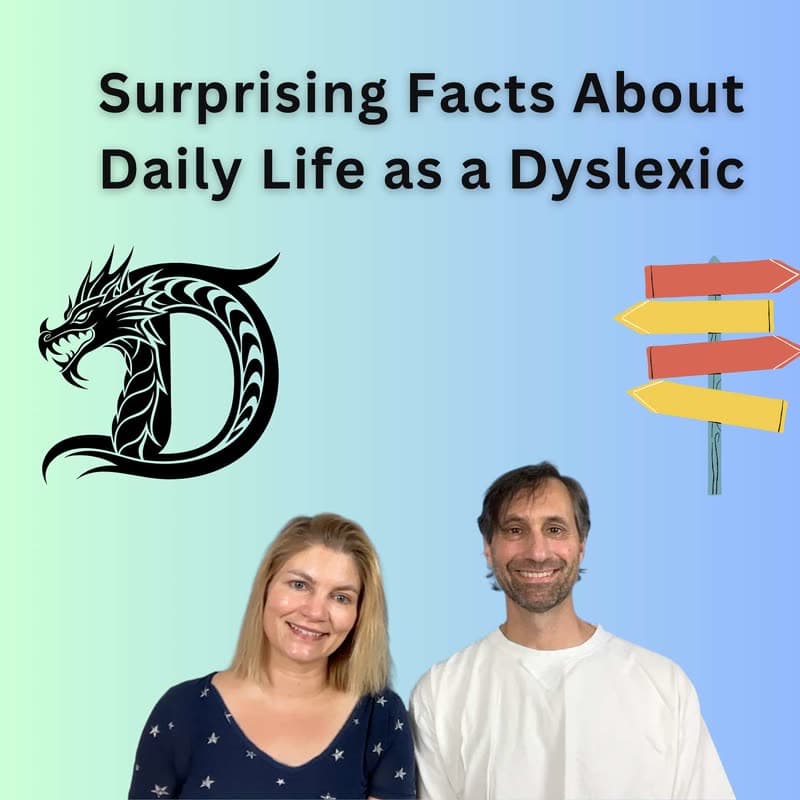
These Aspects of Daily Life as a Dyslexic Might Surprise You!
Transcript
Full transcript · 1,893 words · about 9 min to read. Press a timestamp to jump to that moment.
Today on Dyslexia Journey, we want to share with you a few things that you may find surprising about daily life as a dyslexic person. It got me diagnosed when I was in third grade, and it was the most relieving day of my life because I finally had like kind of a place to hang my hat and say, see, I told you, I'm not lazy, definitely not stupid. I just learned differently, like that's totally okay.
We dyslexics, we were often, you know, just set up for failure because, you know, we were given books and tasks that really are not appropriate for the level that we were at. So how do you expect anyone to be open to learning when their entire relationship with reading, with learning, is physical pain? Wish I had understood when I was younger that the fact that my brain worked differently than people meant that I would be good at things in ways that other kids were not going to be good at.
I just assumed, I can't be dyslexic because letters don't jump up and down for me. Dyslexia is not a disorder. It is not a disease. Once you sort of own it and embrace it, then you can have the power to deal with it. It's sort of empowering and also enriching to the whole community. To those who don't understand what dyslexia is, that it's not a negative, it's not a problem, it's like we keep saying superpower.
Hey everyone, we're Nick and Sonja and this is Dyslexia Journey. And today we want to talk about some things that you may or may not know. If you've been watching this channel for a while, you may know, but you know, if you're just casually listening or you're sort of new to the Dyslexia Journey, you may not know that there's these ways in which daily life is affected for a dyslexic person that aren't just about, just purely about reading or like not in the way where we think of just reading at school or reading a book or that kind of thing.
And I guess we should mention, if you don't know us yet, that our journey with dyslexia started because our daughter is dyslexic and, you know, she's well along her path now. She's just started college recently, but that's sort of like how we got into this. So neither of us are dyslexic ourselves, but that's how we got into all this information and this journey with dyslexia. Yeah. So jumping in, one, one thing that you might not think of immediately, is there's a surprising amount of kind of like embedded reading required, just in navigating the world, particularly in science.
Right. So yeah, so the, these first ones are going to have to do with this embedded kind of reading and, and in science. Yeah. Like it's just something we kind of take for granted. I think often, I mean, sometimes we'll have to read a sign if it's really new. Let's say we're in a foreign country. We're going to really be paying attention to the signs or in an airport we've never been in before, but we maybe have an idea of the kind of signs we're looking for.
But often we sort of take them in and I would say there's just one word on there. We're almost taking it in without really thinking very consciously about it. but often for dyslexic people, it's not the same. Like it, they might, I know our daughter used to talk about it. Like, is it like that she tends to disregard like written things, you know, unless she really focused in on them, she tended to just disregard, disregard them.
So that was difficult in itself just to sort of extra pay attention to, things with words on them like signs. Yeah. I mean, I think to her, especially, when she was younger and, hadn't learned to read as well as she does now. I think the foreign country analogy is, is a really good one. I mean, it's sort of imagine if, if you don't have dyslexia, imagine if you are driving around a country that where you don't know the language, and it might even have a different alphabet. so say you, you don't know Japanese and you're driving around Japan.
you're not going to look that closely at, at the like street names. Right. It's almost like your brain just disregards it because you're like, I, I'm not automatically reading that. So now I almost don't even see it that way. I see it as like a object on the road, but not as having information in the same way. so yeah. So I guess some of those examples, there's mainly in transportation is what we're talking about right now.
So let's say if you're driving around street signs, if you're in an airport, signs telling you where to go, but like, you can think there's so many different examples of where signs can crop up just in everyday life, whether expectedly or unexpectedly. so that's a big one that's, I think people often, you know, their mind isn't just on that when we talk about a dyslexic person. And that, and that can lead and it doesn't always, and obviously not all dyslexic people have, have trouble with, navigation in the world, but it can lead to a lack of competence, in sort of navigating the world on their own.
Right. Right. and then another one, kind of similar is, is certain kinds of forms. like you might have a medical form that you are filling out in the doctor's office, or maybe you just got a prescription medication and you wanted to look at the instructions or even chest out the front of the bottle on the directions. So that's other ways that, language can come forward. And often in those cases, there can be really unfamiliar words, right? Really unfamiliar words, really unfamiliar abbreviations.
Like for example, it says milligrams and it's MG and you haven't encountered that before. so there's a lot of, a lot of newness to it that can also be challenging. Mm-hmm. Yeah. And then the kind of third aspect of this is, sometimes things are in different fonts. or for example, sometimes quote, fancy signs will, will have more like almost a handwritten looking font. and that, that is like very difficult for dyslexic people to read.
Often there's certain fonts. I can't remember off the top of my head, which ones are the best, but anyway, there's certain ones that are better, better for them to read than others because there is this challenge with how letters look. and so, so if you don't realize that about dyslexia, you might not realize how much font can influence it. And if you think about out there in the world, whether, so sometimes we talk about that just with the course of book or written work, but it's also with all these things out there in the world. and I would even lump, like you mentioned, sort of typewritten text.
So it looks like handwriting, but I would, I would say just also, if you have to read someone else's handwriting, that can be challenging for any of us, but for dyslexic person, even if it's, you know, something someone else would find fairly straightforward, it could be more challenging. okay. So another thing that is like super surprising for people who are not dyslexic themselves or who have not been around a lot of dyslexic people is, right left confusion.
this seems to be, I mean, I don't think it's universal among people with dyslexia, but it's very common. And a lot of the people we've interviewed on this, on this show have, have, disclosed that they have trouble with, with right, left and directions. direction. So that can also can mean directions in that, you know, turn right or left when you're driving, but it can also be sort of position of your body directions, you know, if you're doing a dance move or, or something else.
and so, so this can definitely interact with sort of just the physicality of being in the world as a dyslexic person. And that's why, even audio, navigation directions, from your phone, or for example, where it says turn right or turn left are confusing. And that's why it's, it's nice, with, you know, most cars now have a, a nice display screen, where it actually can show the map and show, graphically, visually, which way you should turn right.
That's very helpful for dyslexic people. It is. And then one last way that, being dyslexic can sort of influence everyday life and our interaction with, with information in everyday life, is actually something that, you know, people tend to think of in the more positive way. none of this has to be positive or negative. It's really just about brain differences. Right. But, but, but it's has to do with visual spatial skill that, that dyslexics often relatively have.
So in this case, that can look like having very good visual memory for where something was in the room. So we've often talked about this on Dyslexia Journey, but our daughter's the one who can find things for anyone who's lost them in the household. She's just like knows exactly where they are. And, you know, I, I didn't say this caveat at the beginning, but of course it's going to be different for everybody.
Right. You could have someone who just somehow has less skill and visual memory who is dyslexic. I mean, everyone's still going to be different based on personality and other brain differences and, you know, possibly other even neurodiversity differences, like if someone has ADHD or something. But, but, but overall it's, it's generally true that, dyslexics are pretty strong in visual spatial memory. Yeah. And we've, talked previously about some studies that, that do corroborate this actually.
Right. And I guess just in summary, overall this makes sense, right? Like, because it's not, you know, it isn't literally about reading. We often encounter dyslexia or being diagnosed as dyslexic when someone's struggling with learning to read, but really it is a brain difference. That's why we talk about things like neurodiversity that has all kinds of aspects to it with how, a dyslexic person's brain engages with information. And we've talked about that before, just even scientifically, they've shown that like the columns in the brain, that they're different than dyslexic people.
So it makes sense that there are these differences, but we just wanted to let you know some of those that you might not have been aware of. Yeah. And feel free to, post some comments if you're watching this on YouTube or, send us an email, parenting Dyslexia Journey at gmail.com. We'd love to hear your experiences or what you observed, in your children of, kind of, surprising, surprising aspects of dyslexia. And if you have any questions or topics that you'd like us to cover, also let us know about those.
We like to occasionally do sort of a question roundup. And so we might be able to help you. We'll see you next time.
More from the show
When Phonics Isn't Enough
In the world of reading instruction, phonics has long been hailed as a cornerstone for teaching children to read, particularly for those with dyslexia. However, a recent article raises an important question: is there a limit to how much phonics can help as students progress into middle school? In this episode, we'll…

She Didn't Know She Was Dyslexic Until She Learned English ft. Haiyu Zhang
Haiyu Zhang grew up in China and moved to the US as a teenager. You can find her online at https://hz2784.github.io/.

Parenting the Child You Have ft. Pediatrician Kristen Cook, MD
Have you ever wished that you could sit down with your child's pediatrician and talk about dyslexia, neurodiversity, and parenting? Well, this is your chance! We recently enjoyed a conversation with Dr.
Never miss an episode
New episodes every two weeks. Follow wherever you listen.