
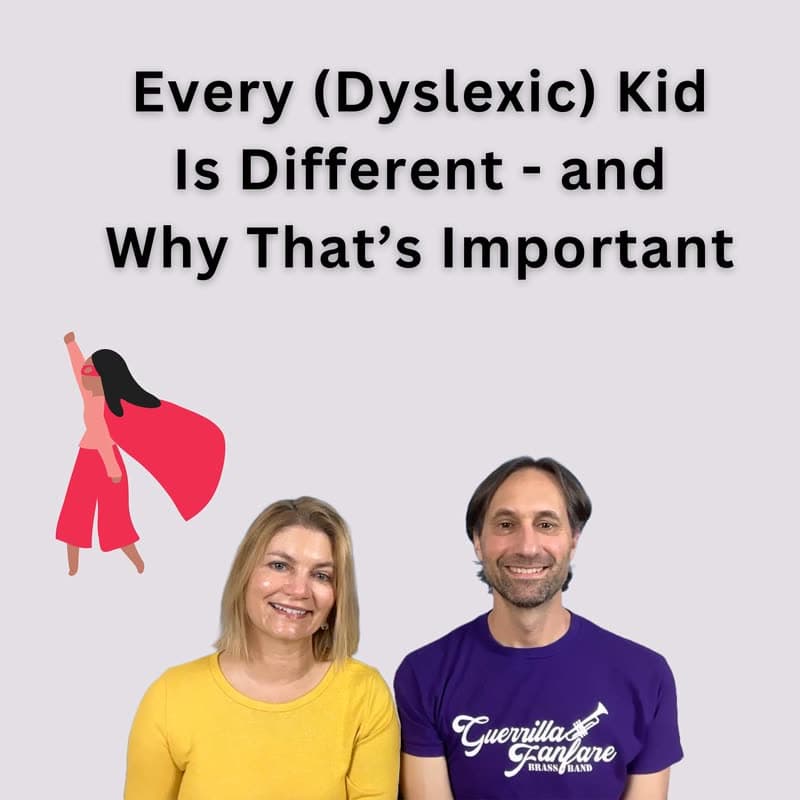
Treating Each Kid Individually, Dyslexic or Not
About this episode
Every kids is unique, but dyslexic kids share certain similarities. Why it's important to treat each child as the individual that they are.
Transcript
Full transcript · 2,571 words · about 13 min to read. Press a timestamp to jump to that moment.
In today's episode of Dyslexia Journey, we want to emphasize the importance of treating your kid or a kid that you're teaching as an individual, even if they have a particular form of neurodiversity like dyslexia.
Got me diagnosed when I was in third grade, and it was the most relieving day of my life because I finally had like kind of a place to hang my hat and say, see, I told you I'm not lazy, definitely not stupid. I just learned differently. Like, that's totally okay. Be dyslexics, we were often, you know, just set up for failure because, you know, we were given books and tasks that really are not appropriate for the level that we were at.
So, how do you expect anyone to be open to learning when their entire relationship with reading, with learning, is physical pain? Wish I had understood when I was younger that the fact that my brain worked differently than people meant that I would be good at things in ways that other kids were not going to be good at. I must assume, I can't be dyslexic because letters don't jump off the downtrodden. Dyslexia is not a disorder. It is not a disease.
Once you sort of own it and embrace it, then you can have the power to deal with it. It's sort of empowering and also enriching to the whole community. To those who don't understand what dyslexia is, that it's not a negative, it's not a problem. It's, like we keep saying, superpower. Hey, everyone, you're Sonja and Nick, and this is Dyslexia Journey, and today we are talking about the importance of really remembering that each child is an individual and treating them as individuals.
Right. And I think, you know, this applies to all children. So sometimes when we're talking about this, we might be talking a bit about siblings, and maybe some of them, you know, could be dyslexic and the other one isn't, or maybe they both are. But it can also be true, like, in the context of thinking about, like, say, in school, if you're a teacher, like, two dyslexic kids and trying to treat them as an individual as well.
And I think the reason this came to mind is, for me, is because, you know, a lot of what we emphasize, of course, on Dyslexia Journey is common traits, things like we're trying to think about, what are challenges that a lot of dyslexic kids are common to a lot of dyslexic kids, or, like, what are typical dyslexic kids' strengths and things like that. And so all of that is true, right? All of it's true, but we just wanted to, like, have a little conversation about individualizing as well.
So keeping all that in mind, but then also making sure we're treating kids as individuals. And that means, of course, in how we approach an individual kid one-on-one, but also in the context of a kid within a classroom, a kid with another student, two siblings, and, like, sort of comparatively how you're treating them, that kind of thing as well. Yeah, and this is in all areas, too. So two children, both of whom have dyslexia, or a child who has dyslexia and a child who doesn't, or two kids who both don't have dyslexia, there might be some similarities if you have two dyslexic kids, but there might be some very important differences.
So, for example, you might have two dyslexic kids, one of whom loves reading, and one of whom has no interest in reading. You might have two kids, one of whom really likes going outside in nature, and one of whom just wants to stay inside the house, right? And these traits, I think what we're trying to get at here, are independent from, like, whether they're dyslexic or not.
But what's interesting is sometimes there are traits, right? And this is what we often emphasize, so I'll just bring it back up here, because we have to keep all of this holistically in perspective, right? Sometimes there are things that are individual to a dyslexic kid, and it is related to the dyslexia, right? Like, there could be particular sensitive points. They're sensitive about reading out loud, for example, but maybe it's not that.
Maybe it's a sensitive point, and it was related to dyslexia and something that happened to them, but it seems less obviously related, right? So we can't always assume that, oh, for sure, for this kid, it's going to be reading out loud, because it might not be. There could be a kid who has sort of a very outgoing personality. Maybe they never had a bad experience with reading out loud. Like, there's all these different reasons why that could be.
So while keeping that as a possibility in mind, it's like you want to keep it in mind as a possibility, because we know these, like, areas that are often in common. But if we can sort of not, like, use it to the extent of, like, almost stereotyping, right? So that we're really, like, making sure to allow that space for their individuality at the same time, I think that's what's really important there.
Yeah, and this often comes up, or is often very important when you're dealing with siblings. So as parents, if you have more than one child, or as educators, if you see multiple children from the same family, there's often an assumption that kids in the same family are going to be similar in certain ways. Right, and I think, you know, often parents, especially if kids are quite different in personality from each other, will, like, from early on see this, like, more clearly.
Less so maybe if they're more similar in personality otherwise. But let's say there's two kids, and they're both dyslexic in your family. I think just trying to remember, like, I think it's very easy to just make the assumption that the next kid's journey is going to be very similar to the first kid. And that's not necessarily going to be true, because it's just, there's just so much influence of experiences, other personality factors, like, all those different things play in so much.
Even birth order probably plays in, right? I mean, there's all kinds of factors that can play in. And so it's just important to keep that in mind, to allow that space for the kids to be individual from each other, and to then, you know, try to respond to them accordingly, right, in terms of what kind of support you're giving them. Right, exactly. And so, I guess, I mean, the main thing then, so in terms of advice here that I would give is, and we've talked about this before, is don't make assumptions.
Don't assume just because, like I mentioned earlier, just because one dyslexic kid does not enjoy reading, it doesn't mean that the next dyslexic kid, maybe your own dyslexic kid, maybe a friend, or if you're an educator, there may be some other dyslexic kid in the class, they might love reading. Right, so it's just going to vary. And maybe they have a different way that they do it or not, like it's just going to vary a lot.
And then I think this can also be an interesting thing to think of, I guess this is a slightly different subtopic here, but it's interesting to think of this in terms of sort of like amount of support given, right? Like, we're definitely people who emphasize, you know, thinking less about exact equality and thinking more about equity, right? So if someone needs something, you're going to respond to them differently. It's not going to be that you give the exact same thing.
You're going to give, like, also according to what they need. However, it can get tricky, right? This can get tricky in terms of, like, time and intention, for example. So I think that the point here is for any, for kids, let's say it's siblings. And so this could be true whether they both have a challenge like dyslexia or if one does and one doesn't, you know, whatever the case with siblings or with a teacher, like in the classroom and trying to give attention to students.
I think the key here probably is to think of it as, like, more about the content's going to be different for each kid because you don't want, you want to avoid giving less time and attention. Like, if you actually think of it as time and attention, then you want to be making sure you're doing that, you know, as needed, you know, like really for the kids. And it may not look like the exact same amount of time, but you're going to want to make sure that, like, when, like, you're, how do I explain this?
It's like, let me see if I can put this. I might have to come up with an example. So let's say you have a kid. Let's take it out of the context of dyslexia for a second here. Like, let's say you have a kid who's just really social, like, and they like to do things with other kids. And, you know, so they, like, maybe almost seem like they have less time for you.
And, like, you're sort of less, like, worried about them. And then you have a kid who maybe struggles socially. And so you try to do a little more with them just to, like, give them more activities to do. And then maybe you're, like, going along for play dates more because they're more comfortable, like, that kind of thing. So that's all totally fine. And the exact amount of time doesn't have to be the same between those kids.
You're wanting to give the equity that that kid needs that. But I think the important thing to do there would be then to think of the other kid and, like, what are ways that your attention, whether it's in literal exact amounts of time, is sort of irrelevant. But, like, what are ways that then when they are available to you, how can you, like, give your attention and guidance to them? So this is, yeah, I sort of purposely took it out of the context of dyslexia for this case because I find it easier to explain that way.
But hopefully that sort of makes sense. But it's, like, it's still about the equity, but it's, like, important not to drop the fact that this other, that a particular kid may need or can get guidance and connection from you, like, in a different way then. Yeah, I think that's a really good point because it's, especially if you have, say, one dyslexic kid and one non-dyslexic kid. I think it's really easy to fall into the trap of, okay, this dyslexic kid needs more, needs a lot of time, like, helping with things.
And this other kid is doing fine in school, is more independent, so doesn't need as much time with me. But, and it may be true that they don't need as much time with you, but they still need time with you, right? It's not a binary thing. It's not like one kid needs your time and the other one doesn't. Yeah, and so it's this balance, right, of the equity of, you know, the squeaky wheel actually needing the grease or, like, the wheel who you see is having trouble.
Maybe they're not being squeaky, but at the same time, then trying to make sure to include and, you know, give attention to, like, for even between two dyslexic kids. Like, we just talked about the case where maybe one isn't struggling as much with reading. So if there's one struggling more or less than the other, like, it's going to feel like you have to give this more attention to the one who's struggling more with reading.
And there's truth to that in the equity sense, but then it's important to not, there's always going to be factors. Like, we're going to tend to see certain things, right? Like, reading's a good example, actually, because of that. Because we tend to, like, really focus on that because it's so emphasized in our schools and our society. But there's always going to be other things, like, that are going on as well. And so most likely for that kid, there's going to be other aspects of school, other aspects of academic subjects, other aspects of social emotional learning, any of that that will be true.
Not to mention just, like, understanding that they, you know, deserve your time and attention, like, as just, you know, a person who's worthy of that. Which is also, and I'm going to just loop back to the dyslexic kid there again, because it's important for them to also be getting attention from you in ways that aren't only focused on, let's say, reading. So that they get that same feeling of the time and attention.
So hopefully, like, if you start to really think about this and be intentional about it between different kids, whether you're a teacher, whether it's your own kids and their siblings, it can sort of create, actually, this positive feedback loop. You know, like, maybe you give a time and attention to the kid who seems like they need less help in some certain way. And then you're like, hey, I want to connect with my dyslexic kid that way.
We only ever spend our time reading. Oh, yeah. So hopefully, it can sort of bounce back and forth, where it's a positive thing, you know, yeah, for both kids and for yourself. Yeah, for sure. Excellent points. Thanks. And I'll just add that if you only have one child, it's still important. And I think the point that you just made is that we can tend to get into patterns or ruts, to use a more pejorative term, in our interactions with our child.
And so it's really interesting to try to mix things up sometimes. Yeah, exactly. And think about kinds of attention you're giving, kinds of connection you're doing, and just evaluate that. But, like, the thinking it through every so often and being intentional can really be important. You know, and we don't always take the time to do that in the context of the busyness of life. But I think it is important to do that.
Yeah. Well, so hopefully you got something out of that. It's been really on my mind in particular. And I was trying to include, like, lots of different kinds of scenarios, you know, with different kinds of kids, dyslexic, not, different situations, school, home. So hopefully that all made sense just in terms of our thoughts. But that's why we did it as more of a conversation. But I'd love to hear your thoughts, too, if you want to put those in the comments.
Or if you want us to talk about this further in a different way, or if you have another topic you'd like us to talk about, you can either put that in the comments or email us. ParentingDyslexiaJourney at gmail.com. Thanks, everyone.
More from the show
When Phonics Isn't Enough
In the world of reading instruction, phonics has long been hailed as a cornerstone for teaching children to read, particularly for those with dyslexia. However, a recent article raises an important question: is there a limit to how much phonics can help as students progress into middle school? In this episode, we'll…

She Didn't Know She Was Dyslexic Until She Learned English ft. Haiyu Zhang
Haiyu Zhang grew up in China and moved to the US as a teenager. You can find her online at https://hz2784.github.io/.

Parenting the Child You Have ft. Pediatrician Kristen Cook, MD
Have you ever wished that you could sit down with your child's pediatrician and talk about dyslexia, neurodiversity, and parenting? Well, this is your chance! We recently enjoyed a conversation with Dr.
Never miss an episode
New episodes every two weeks. Follow wherever you listen.