
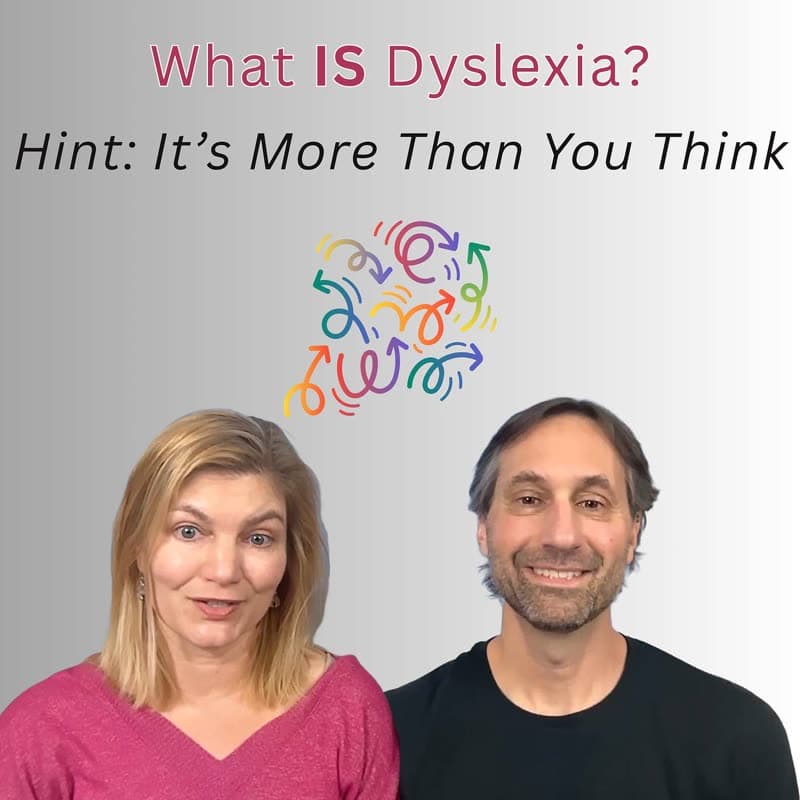
What Is Dyslexia, Really? What the Definitions Leave Out
About this episode
The dictionary says dyslexia is about reading. We say that's just the beginning. After many years of parenting a child with dyslexia, and over three years of doing this show, we break down what the standard definitions miss, from the strengths no one talks about to how it shapes everyday life.
Transcript
Full transcript · 2,372 words · about 12 min to read. Press a timestamp to jump to that moment.
After all that we've learned doing this podcast and interviewing our guests, we thought it was a great time to come back to a fundamental question, which is, what is dyslexia? It got me diagnosed when I was in third grade, and it was the most relieving day of my life because I finally had, like, kind of a place to hang my hat and say, see, I told you, I'm not lazy, definitely not stupid. I just learned differently, like, that's totally okay.
With dyslexics, we were often, you know, just set up for failure because, you know, we were given books and tasks that really are not appropriate for the level that we were at. So, how do you expect anyone to be open to learning when their entire relationship with reading, with learning, is physical pain? Wish I had understood when I was younger that the fact that my brain worked differently than people meant that I would be good at things in ways that other kids were not going to be good at.
I just assume, I can't be dyslexic because letters don't jump up and down for me. Dyslexia is not a disorder. It is not a disease. Once you sort of own it and embrace it, then you can have the power to deal with it. It's sort of empowering and also enriching to the whole community. To those who don't understand what dyslexia is, that it's not a negative, it's not a problem, it's, like we keep saying, superpower.
Hey, everyone. We're Nick and Sonja, and this is Dyslexia Journey. And today we want to talk about that big question, what is dyslexia? So, whether you, you know, are new to this and, you know, this is a burning question that you have, whether you feel like you already know the answer to this or have heard it before, which is kind of the position we're in, I think it's good to come back to it again because, you know, I really have deeper and more nuanced understanding just with our own journey with dyslexia and with this podcast in particular.
Yeah, for sure. It's really easy to get lost in the minutia of the day-to-day, like helping your child with remediation in school and all that stuff. And I think it's important once in a while to step back and talk about dyslexia as a whole because it is, I think, more complex than most people generally understand. But we thought we would go back to, you know, one of the original definitions here just as a way to, you know, bounce off of it as we talk about what our reaction is to that now and how it's been changed over time, you know, to some extent.
So this is the Oxford languages definition. A condition of neurodevelopmental origin that mainly affects the ease with which a person reads, writes, and spells, typically recognized as a specific learning disorder in children. Okay. And then there's one more. Yeah, let me read this. This is the International Dyslexia Association's definition, which is new since we've previously talked about this. This was adopted on October 22nd, 2025. So it's a bit long, but I'm going to read the whole thing.
So just bear with me. Dyslexia is a specific learning disability characterized by difficulties in word reading and or spelling that involve accuracy, speed, or both, and vary depending on the orthography. These difficulties occur along a continuum of severity and persist even with instruction that is effective for the individual's peers. The causes of dyslexia are complex and involve combinations of genetic, neurobiological, and environmental influences that interact throughout development. Underlying difficulties with phonological and morphological processing are common but not universal, and early oral language weaknesses often foreshadow literacy challenges.
Secondary consequences include reading comprehension problems and reduced reading and writing experience that can impede growth in language, knowledge, written expression, and overall academic achievement. Psychological well-being and employment opportunities also may be affected. Although identification and targeted instruction are important at any age, language and literacy support before and during the early years of education is particularly effective. Yeah, it's really interesting because I can see how they really try to include everything but yet allow some flexibility in there for differences.
So it's interesting, but it's still incomplete to some extent, I would say. It is, yeah. So these definitions still feel pretty negative, so that's important. I mean, one thing we like to emphasize a lot are the advantages and benefits. There can be creative thinking. We've talked about this so much. Entrepreneurship, outside-the-box thinking, creative thinking, spatial skills. So, and, you know, that's really coming down to the whole tension that we talk about a lot, where do we talk about dyslexia as a disorder or is it, you know, just a part of neurodiversity, really, essentially, but one that interacts with, you know, the learning systems that we have in place in ways that don't work.
So that's part of the reason why, but yeah, I would say there's still a negativity bias and it's not including the positives and those definitions. And I'd like to, once again, plug an amazing book called The Dyslexic Advantage by Dr. Sprach and Fernette Eide. We actually had them on the show a few months ago that, you can find that episode in our backlog. It's, they have just done amazing work and I really love their book because it includes both really detailed scientific evidence for various advantages, as well as interviews with real dyslexic people who have leveraged these advantages in their lives.
Right, right. And so also in these definitions, it's very focused on reading, writing, and literacy. There's not, I mean, that last definition did mention sort of outcomes in terms of learning and, you know, even mentions future work and things like that. But, you know, there still wasn't this emphasis on everyday life, other things, math, like entrepreneurship, all these different ways that it interacts because it's not really just about literacy, even though that becomes our focus most of the time.
But it's, it's really just this difference in terms of taking in information and interest in how the brain works. Yeah, and it's, it's, it's interesting because that is how dyslexia is identified, right? It's identified when children struggle with reading. Yeah. And so we all, I mean, myself included, tend to fall into this trap of thinking of dyslexia as just a difficulty in reading and writing. But it is so much more than that.
Right, right. In ways that are both struggles and sometimes, you know, struggles out in the world. For example, people sometimes have left-right confusion or things like that that can affect people in other ways. But, and then also the positives though, that are included in other areas. Okay, so let's just talk about then aspects of dyslexia. I mean, we're not trying to put this into a, you know, words in a definitional kind of way, but just sort of aspects of dyslexia from like what we've learned about it and how we think of it now.
so I think for me, the top one that's become more and more prominent in my thinking about it, especially with, with the guests we've got on and talking with them is that it's a spectrum. so that includes both how, you know, how challenging it is, sometimes how it shows up even. And then just the fact that there really are, it's both similarities and differences. It's so interesting because it's like, I don't want to emphasize just that there's differences within people and how it shows up, but there really are.
Sure, but then it's always notable that there's so much similarity too. So, so really both are true that there's these, there's similarities that stand out, but because it's a spectrum, if you took, you know, two individual people, they could look very, very different. Maybe they wouldn't have those particular similarities that seem to show up when you're interviewing or talking to like a huge, huge range of people. yeah, I think, for me as well, it has struck me, and I, I don't even, I've lost track of how many, dyslexic people we've interviewed over the years now.
quite a few and while everyone's journey is unique, as Sonja said, there are with every guest that we interview with dyslexia, there'll be, several times during the interview where they will say something that, that, you know, is an experience that seems to be shared by almost every dyslexic person. Or at the very least, it'll be something where it'll remind us of our own daughter and a couple of guests we had, you know, maybe there was one guest who didn't mention it, you know, that kind of thing.
But it's definitely, it's definitely really interesting, but I, you know, there's really, for me, all falls under thinking of it more and more as a spectrum. Or maybe even a multidimensional spectrum, not necessarily even just a linear spectrum. Right, right. Which brings up another point. Yes, it leads right into the, the cause of dyslexia. And actually the International Dyslexia Association definition did mention this now. the cause of dyslexia is multifactorial. I think that's generally accepted now.
when we interviewed the IDs, they, they mentioned the actual statistic of how many genes have been identified. I can't remember what it is now, but I feel like it was over 20 different genes that have been identified as relating to it. And so you can see how, you know, when people are going to have different genes that are involved in their particular case, that's going to add both to this multifactorial thing, but also the spectrum.
Right. So, yeah. Yeah. And I want to add in there that, this was implied, but I want to just state it explicitly, like, it is genetic. the International Dyslexia Association mentioned environmental factors. I think that's actually a little bit misleading. I'm not sure I like that that's in there. because that's, that's a dangerous route to go down because it can lead to, blame of parents and self-blame as well. I'm actually curious what they meant by that.
I wonder if they, I wonder if, because they also mentioned at the end, about early identification and remediation. I wonder if that's where they were going with it, like in the sense that like, if it's, you know, it's still helpful to remediate earlier. Right. I think, I think so. I think that's why they have it in there is my guess. And I really don't know. I don't know anyone, who was involved in that definition, but, it concerns me because I think it's important that everyone understand that dyslexia is a whole brain difference and no environmental factors post-birth are going to change that fundamental brain difference.
Right. And so, yeah. So that's another, actually, we, we hadn't thought of this. I hadn't thought of this one ahead of time, but I think, it's also true to emphasize here that someone's always dyslexic, you know? So that's why the sense of it sort of being treated or like we can get into issues too. And we talk about it that way, because it's not, it's just, it's, it's a difference and it's something that's always going to be there.
Like how the person interacts with particular challenges or learning that might change based on what's, you know, happening in the environment and processes that are in place. But the person themselves is always dyslexic. Yeah. That is a great point to remember. Yeah. and so, so it is this brain difference, and it generally makes traditional school harder. So that's, that's, that's, I think mostly why it's come, come to attention even as prominently as it has.
but, and then it also gives advantages in creative thinking, thinking outside the box, like I said, visual spatial skills, all those things that we talked about and referred you to the dyslexic advantage for. But like in thinking of my own definition for it, I definitely, even though it can vary among individuals would include both of those, that there are those challenges with traditional school and that there's advantages. definitely. and then, adding on to Sonja's point about it being, a lifelong brain difference.
it's, it's important to emphasize that it's not a disease because a disease and that implies something that can be cured. it's a difference, it's a difference, not a disease and it's not curable. Yeah. And then something that, you know, we learned pretty early on in doing this podcast, but hadn't known before that still stays with me a lot. And, and, you know, it also involves the spectrum, I think too, in terms of why we don't always realize the statistic, is how prevalent it is.
It's, it's really about 20% of the population. So one in five, who are dyslexic. Yeah. And that, that, again, I feel like we can't say that often enough because, that means that everyone knows someone who's dyslexic. It means that every teacher has taught people who are dyslexic, whether they realized it or not. It means that every school has dyslexic kids in it right now. Right. So that's why it's so important to keep this in the conversation, to keep this in the forefront, for parents and for our educational system, to, that this isn't, this isn't a niche condition or a rare condition.
Right. This is, it's super common and the more we understand that as a society, the better, we'll be able to help all the dyslexic kids out there reach their full potential. Right. So hopefully this was helpful. I, I'd be curious to hear if you have anything you would add to your own definition or how you think of, of being dyslexic. You can put that in the comments. if you want to ever ask us a question or suggest a topic, please reach out to us.
At parenting Dyslexia Journey at gmail.com. Thanks everyone.
More from the show
When Phonics Isn't Enough
In the world of reading instruction, phonics has long been hailed as a cornerstone for teaching children to read, particularly for those with dyslexia. However, a recent article raises an important question: is there a limit to how much phonics can help as students progress into middle school? In this episode, we'll…
She Didn't Know She Was Dyslexic Until She Learned English ft. Haiyu Zhang
Haiyu Zhang grew up in China and moved to the US as a teenager. You can find her online at https://hz2784.github.io/.
Parenting the Child You Have ft. Pediatrician Kristen Cook, MD
Have you ever wished that you could sit down with your child's pediatrician and talk about dyslexia, neurodiversity, and parenting? Well, this is your chance! We recently enjoyed a conversation with Dr.
Never miss an episode
New episodes every two weeks. Follow wherever you listen.