
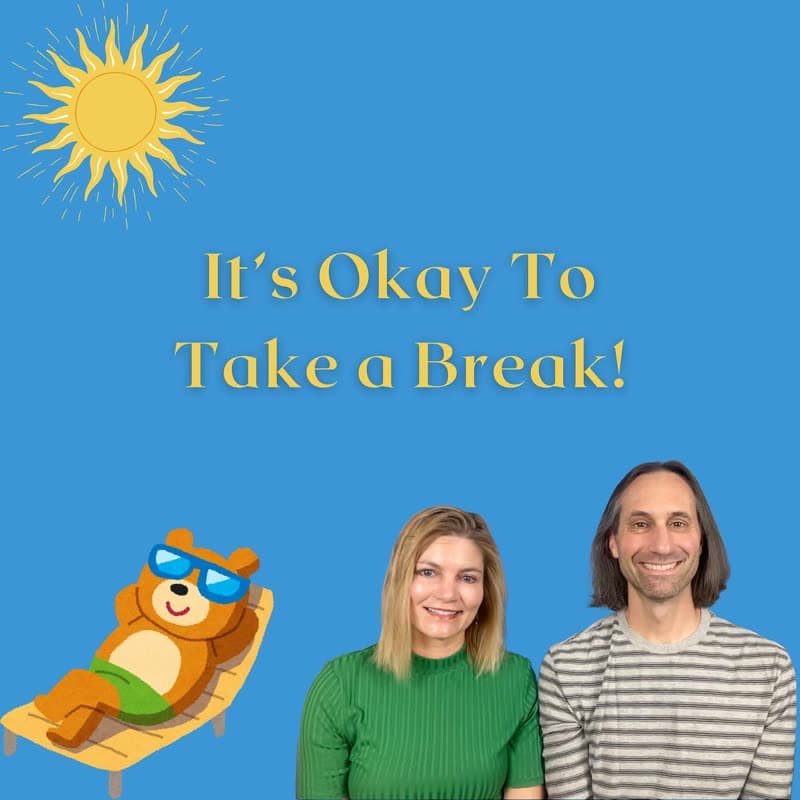
Why Your Dyslexic Kid Needs a Real Summer Break!
About this episode
It's tempting to encourage our dyslexic kids to keep working on their literacy skills over the summer, but they often need the break! In this video, we break down (pun intended) the reasons why they need breaks, the scientific evidence that breaks are ok, and give you some tips for a great summer.
Transcript
Full transcript · 3,289 words · about 16 min to read. Press a timestamp to jump to that moment.
Especially if you have a dyslexic kid, you might be tempted to use summer break as a way of making academic gains. But in this video, we want to encourage you to use summer as a real break.
It got me diagnosed when I was in third grade, and it was the most relieving day of my life because I finally had like kind of a place to hang my hat and say, see, I told you I'm not lazy, definitely not stupid. I just learned differently, like that's totally okay. We dyslexics, we were often, you know, just set up for failure because, you know, we were given books and tasks that really are not appropriate for the level that we were at.
So how do you expect anyone to be open to learning when their entire relationship with reading, with learning, is physical pain? Wish I had understood when I was younger that the fact that my brain worked differently than people meant that I would be good at things in ways that other kids were not going to be good at. I just assumed, I can't be dyslexic because letters don't jump up and down for me.
Dyslexia is not a disorder. It is not a disease. Once you sort of own it and embrace it, then you can have the power to deal with it. It's sort of empowering and also enriching to the whole community. To those who don't understand what dyslexia is, that it's not a negative, it's not a problem. It's like we keep saying superpower. Hey, everyone. We're Dick and Sonja, and this is Dyslexia Journey. And today we want to talk about summer break, that break that, I guess, in the northern hemisphere, it's summer, but the sort of largest break in the school year that kids usually have between one academic year and another.
And how having a real break, perhaps particularly for your dyslexic kid, is really important. And we're going to share with you, this is really our take on this, so it's going to be a pretty quick video here. But we're just going to share a little bit with you about why we think that's so important. And then just a couple tips at the end, too, about how to approach break. Yes. So to jump in, one tough reason why an extended break is so important, especially for your dyslexic child, is to give you a chance to connect with your child.
And this is because during the school year, especially with a child with learning differences like dyslexia, necessarily a lot of the time that you spend with your child is going to be around academic type things, helping them with homework, helping them deal with the stress from school, helping them deal with the school itself. And there's usually not a lot of time for just really relaxed, connective activities with your child. Right. And of course, we want you to have that during the school year as well.
But it's definitely easier when there isn't a full school day happening and homework happening in the same way and that kind of thing. And just to add, also, if you are forcing them to do something and they sort of need a break, which we'll get into the aspects of why they might feel like they're forced in the second year. But if you're forcing them to do that, that's also like almost like more of a breaking connection.
And so that's important to keep in mind, too. It's like a chance for you to have the more relaxed attitude even than normal. Hopefully you're able to have some of that during everyday time, but summer is such a, or whatever that break is for you. The academic break in the year is like a really great time for that. And then the second reason that we see for why summer break or the academic break between school years can be so important is in order to prevent burnout.
And this can be true for any kid, of course, but because there is a lot of time, right? There's a lot of time that there's the kids are spending at school or doing and doing homework and even other activities. But for dyslexic kids, it can often be especially true because they do tend to be more burned out. We've talked in many other videos about how they are actually, you know, having to often expend a lot more energy than other kids to do the tasks simply because it's requiring, you know, something that's not really in their learning style that they're trying to learn and to do in their natural way of learning.
And so they are going to have a tendency to have more burnout anyway. Yeah. And I think we often talk about really any child needing recovery time from school. And we really mean that literally. Like it takes a while when you've been under that kind of stress, that sort of ongoing daily stress of being in an environment that you don't necessarily enjoy being in. You feel required to be there. You feel required to do the work.
It really does take time to really have you really need a full break from that environment and everything associated with it in order to recover sometimes your interest instead of natural learning interests. And in addition to recovery from school burnout, everyone needs some amount of downtime as well. And this is so important for all aspects of your life and your well-being. Physically, mentally, emotionally, it's just so important. Everyone, whether you're in school or not, needs a certain amount of downtime.
And ideally, you're getting that during the school year. We've talked about that a certain amount where, you know, scheduling downtime in during each day. But it's just so much easier to do that during the summer when there's not the daily school activities and school stress and school homework. Right. So it's almost like thinking of it as sort of a precious time for having that downtime. And I mean, I think we all know this.
Just as adults, we need downtime. So, of course, kids do, too, need that. So I think, you know, they've done studies around people working more efficiently when they have enough downtime, that kind of thing. So so that's really important. And then that hopefully is another point here as to why it's important to take a real break in the summer with your dyslexic kid in academics is that it will set them up better than for the fall.
Right. You don't want them certainly you don't want them to start the fall burnt out, but even otherwise, if they've had rest and they've had time for, you know, the downtime that can help with creativity and can help their their mind go in all kinds of interesting directions just in that sort of looser, more flow state that can really set them up well for the beginning of the school year, which is which is always nice.
I mean, often the beginning of the school year can be a bit of a honeymoon anyway, but, you know, it might not be if the summer is really intense and it doesn't feel like it has enough of a difference. Between what the school year feels like and what the summer feels like. OK, and then finally, the last reason we're going to cover today for why we think it's so important to get a real break in the summer for your dyslexic kid around academics is that it will help to teach your dyslexic kid about balancing their life.
Now, of course, you can do this during the school year as well, but the summer is also a good time for showing taking real break, actually taking vacation, things like that. And that, you know, we've covered in other videos, too, that like we get really focused on the academic skills. But some of these life skills are so important. And, you know, when you are dyslexic and some things require more effort, it's perhaps especially important.
It's important for everyone, but perhaps especially important to learn how to properly balance your life and what you need and when when to do what, when to do something pretty intensively, when to take a break, all of that. So that's a really big life skill that they can be learning by taking a real break when that's warranted, like it is during academic years and when you have that break. And then so those are kind of our reasons for today.
If you have more, please put them in the comments. I'm sure there's many more reasons that we could have come up with. But that's just sort of coming from our hearts and how we see it. So what about because I remember hearing this possibly even growing up. I don't know when I heard it exactly. But I remember hearing over the years that kids sort of like a fretting in schools and by teachers and and talk about kids losing, you know, losing academic progress.
Over the summer, there is this that that and so I'm just it made me wonder about that. So we did look up just a little bit to see what's known about that, that that that supposed or or real phenomenon of kids losing progress over a break, a big break like that. Yes, I have some answers to that. There are actually quite a few studies on the effect of extended vacation time on school children and whether they lose academic skills during that time and and so on.
And so, you know, I say there's hundreds of studies out there, but I just want to summarize the findings from two of them that I thought were particularly interesting. OK, so the first study that I found particularly interesting is by S Health M. Conrad and B. Algozine called Recouping and Rethinking the Effects of Summer Vacation on Reading Achievement, which was published in the Journal of Research in Reading in 2008. And I'm just going to quote directly from the abstract of the article here because they summarize it pretty well.
So they say the purpose of the study was to analyze the effects of summer vacation on early literacy skills of young children. Participants included rising first and second graders, most of whom were at risk struggling readers. And here's the key point. No evidence of summer setback was evident for this sample of children. In fact, gains in reading or recoupment of any losses were more common in children performing at lower levels than for those with higher scores at the end of the school year.
It's really interesting, right? I mean, so there were some mixed results, we should say, just, you know, across different subjects. So I think it's probably quite a complex issue. But I do think that finding is really interesting that the people at the lower levels, not almost, we don't know this for sure, but it makes me think of what we said about about dyslexic kids and, you know, people who are struggling more having expended more effort and so being more likely to burn out.
I don't know. What do you think? Yeah, that was my initial thought as well. Yeah, as to why, just to, just say that line again, just because we went through it fast. Yeah, they said, no evidence of summer setback was evident for this sample of children. In fact, gains in reading were more common in children performing at lower levels than for those with higher scores at the end of the school year.
Yeah, so it's just really interesting. Yeah. And then the second study is by L. Campbell, C. Sutter, and G. Lambie. It was published in 2019. It's called An Investigation of the Summer Learning Effect on Fourth-Grade Students' Reading Scores. And it was published in Reading Psychology. And so this was a study of fourth graders, as it's said. And let me just, again, I'll just redirect it from the abstract here because I think they explained it pretty well.
So, quote, students' reading losses during the summer are a concern for schools in the United States. The purpose of this investigation was to examine fourth-grade students' reading development over the summer. The results indicated that students in the lowest two quartiles made achievement gains over summer, while these same students evidenced limited reading growth throughout the academic year. In contrast, students in the upper two quartiles evidenced reading losses over summer, although evidenced in continuous reading growth throughout the school year.
Yeah, so it sounds like for the students who were in the upper quartiles, quartiles, quartiles, I can't remember what you said. It sounds like for them, they had that loss, but it was kind of temporary, is how I would take that, because then they started just writing again. And then for the lower half, as measured by whatever tests they used, the students actually, I think they made perhaps even more gains over the summer than during the school year, which again is an argument for burnout and school stress being a major detriment to learning, actually, especially for kids with learning differences.
Right, so that's really interesting. And, you know, we're thinking about, heads up, we might or might not, we're thinking about doing, so there's actually a lot of research on this, we're thinking about doing an entire research video on this. So you might see that in the future, so keep an eye out for that. But let's move on to just a few tips that we have in sort of thinking about all this, because I don't think it's also, we're not trying to say it's all cut and dried.
And as we always, always say, you know, to go with your own intuition, your own kid, that kind of thing is like also involved. So we're just going to distill this into a few tips that we have right now or strategies. Okay. First tip is don't stop reading to your kids. If they're interested, continued reading to them is never a bad thing. Right. I mean, we're sort of assuming here that either you'd be starting in practice or have already done one that's more around connectiveness.
You know, it's not like it feels academic. Like it's more just something that you like to do together for the story and for the connection. Yeah. So we're not, we're not recommending that you like drop anything related to reading altogether during the summer. Right. And, and, and so a second tip is, you know, we're a big fan of using embedded opportunities. That just means sort of natural opportunities for reading that crop up.
But keeping in mind, perhaps especially for the summer, you know, that, that sometimes that can turn into like feeling like, oh, this is a big opportunity. We have to do this. And like, you don't want that kind of energy with it. It should feel really natural. So like, if they, if, if you're like, oh, what is, what's that menu item there? Could you tell me or something? And they, they don't like, you don't need to be insistent about that at all.
Right. But like, I guess what I'm trying to say is just because we said, oh, try to have a break from academics. You don't have to, I mean, you can certainly use natural opportunities as they, as they come up, even if you're taking a complete break from tutoring and from, from anything else like that. Yeah. And a couple of things we've talked about in the past, in terms of embedded opportunities are things like, if you're cooking with them, having them read something from the recipe.
If you're shopping, have them try to find a certain item. If you're at a museum, they could, you know, identify a few words on the placards or whatever. Right, right. And there's many others too. So, and, and so another tip that we have, and this is sort of around what I just mentioned, because maybe they do continue tutoring. So what if they do, like, is there a way that it could maybe feel a little different from the school year, whether that's that it's less often, whether, or maybe you talk to the tutor and you say, could, could we have the summer feel a little different?
Because maybe there's less practice that they do, but they're still touching base. You know, perhaps you intuitively feel like it really would be good for your kid to touch base. And they really like their tutoring sessions anyway, that kind of thing. But you also feel like they need more of a break. So maybe they could, you know, have less practice between and it'd be more like that's their time to touch base with, with reading.
Or perhaps the tutor can do things a little different, you know, do sort of activities that are a little more embedded themselves or fun with them to keep it up, you know, during the summer. So again, it's not that we're saying for sure, don't do any tutoring. It's, that's not the intention here at all. It's really more around making sure the break is really happening, whatever else is going on. Yeah, and that kind of leads into our final tip for how to help your dyslexic kid get a break over the summer is really to let them take the lead on anything that feels, well, really just let them take the lead on everything.
If they're interested in reading, if they pull out a book and start trying to read it themselves, that's great. And if they don't want to work on it at all, and they need a total break, that's great too. And I think the key is here to find out, to try to find out. Obviously, that looks a little different at different age levels. But, you know, like if you see, they're like, oh, I have to do tutoring.
I thought I wasn't doing school this summer or something like that's a big clue, right? Or you could ask them, you could say, hey, we're thinking of doing this for tutoring. Or maybe you say we're thinking of having you not do tutoring this summer and they're like, oh, I can't see whatever the tutor's name is anymore. I mean, so don't make assumptions. I guess the key is don't make assumptions with that and try to ask them and figure out what they're thinking for the summer so that you can base the decisions on what they're thinking of as actually a break versus not.
So that's an important thing to keep in mind as well. So we would love to hear if you have any more tips around this or particular experiences that you've had in the summer. And also, we really love it when you share ideas for topics with us or when, you know, if you have any particular questions, we sometimes occasionally do an episode where we answer questions, answer viewer questions and listener questions. So if you have those, you can go ahead and send that to us at our email, which is parentingdyslexajourneyatgmail.com.
Again, parentingdyslexajourneyatgmail.com. And whenever you're watching this, if it's the right time for that, or you can think ahead to when your next break is, we hope you have a wonderful break.
More from the show
When Phonics Isn't Enough
In the world of reading instruction, phonics has long been hailed as a cornerstone for teaching children to read, particularly for those with dyslexia. However, a recent article raises an important question: is there a limit to how much phonics can help as students progress into middle school? In this episode, we'll…

She Didn't Know She Was Dyslexic Until She Learned English ft. Haiyu Zhang
Haiyu Zhang grew up in China and moved to the US as a teenager. You can find her online at https://hz2784.github.io/.

Parenting the Child You Have ft. Pediatrician Kristen Cook, MD
Have you ever wished that you could sit down with your child's pediatrician and talk about dyslexia, neurodiversity, and parenting? Well, this is your chance! We recently enjoyed a conversation with Dr.
Never miss an episode
New episodes every two weeks. Follow wherever you listen.