
About this episode
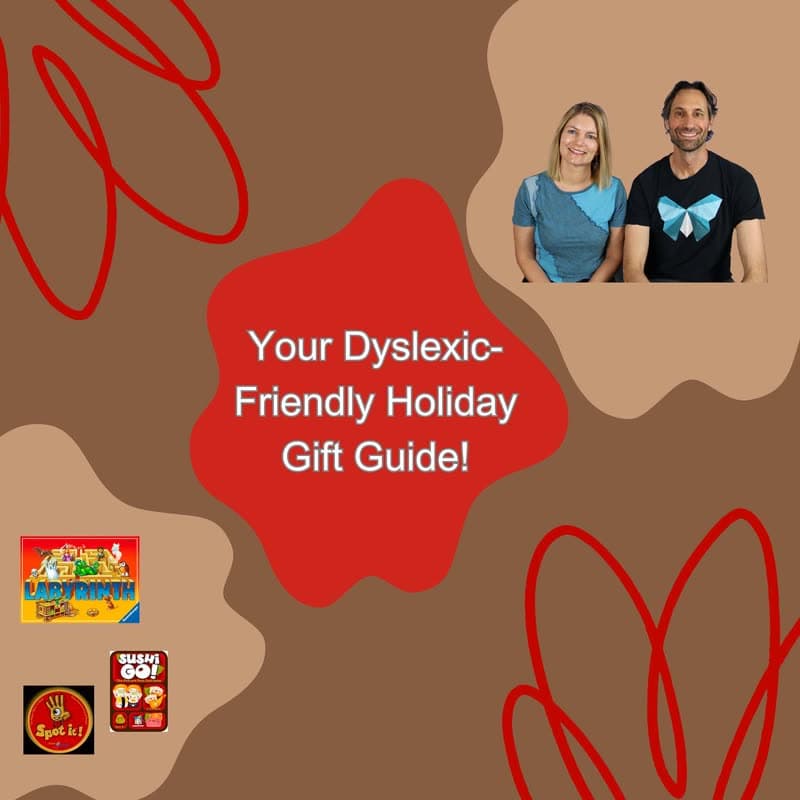
In this video we talk about some fantastic gift ideas for your dyslexic kids! Here are the games we mention:
https://boardgamegeek.com/boardgame/63268/spot-it
https://boardgamegeek.com/boardgame/1198/set
https://boardgamegeek.com/boardgame/7688/memory
https://boardgamegeek.com/boardgame/1219/labyrinth
https://boardgamegeek.com/boardgame/198773/codenames-pictures
https://boardgamegeek.com/boardgame/181304/mysterium
https://boardgamegeek.com/boardgame/39856/dixit
https://boardgamegeek.com/boardgame/133473/sushi-go
https://boardgamegeek.com/boardgame/929/great-dalmuti
https://boardgamegeek.com/boardgame/215/tichu
Transcript
Full transcript · 1,725 words · about 9 min to read. Press a timestamp to jump to that moment.
With the holidays coming up, you might be starting to think about your gift giving, and today we want to share with you some dyslexic-friendly gift ideas.
Hey everyone, we're Nick and Sonja and this is Dyslexia Journey, where we help you support the dyslexic kid in your life. And today we want to share some of our favorite tips and specifics for dyslexic-friendly gift giving. Yeah, so just a couple quick tips before we get into the specific ideas. One is, in our opinion, gifts should just be fun. So you might be tempted with your dyslexic kid to give them, like, an educational gift.
And, you know, dyslexic kids, they spend enough time in school trying to work on stuff. And really, I would encourage you to think about holiday gift giving as really playing on their strengths and giving them really something fun to do. Yeah, and so most of the things you give are likely to be more like activities, maybe even like tickets to a concert or show, or like building sets or crafts, kind of things that we associate with what dyslexic kids like to do and where their strengths are.
So that probably will be the bulk of your presence. But today we wanted to focus on two things, games and books, that you might be less obvious. Like maybe, because maybe your dyslexic kid doesn't like them. That could be pretty typical because of the instructions in games or because of just not liking to read because of being dyslexic. Yeah, so jumping in to the games, and we will have links to all of these games in our show notes so you don't have to, like, take notes while you're listening here.
And for those of you who are watching this in video form, we do have a lot of the games to show you. And if you're listening on the podcast, just click on the links and you can see what we're talking about. Okay, so to jump in, games, a category of games that we have found that are really good for dyslexic kids are ones that involve kind of speed of identifying visual elements.
And so two examples of those are the games Spot It and Set, which involve kind of recognizing patterns and matching pictures and those kind of things with a time element to it. And then a game we don't have right now with us, but that can be really fun, is a memory type of game. Usually these are for younger kids, and they're there where you turn over little tiles. I think the classic one is actually called memory.
And you turn them over two at a time, and you're trying to find the matching pairs and remember where they were, because you turn them back over, you know, if you're not right. So you guys have probably heard about that one, but that can be an especially fun one for dyslexic kids. They're often quite good at it. It really plays on their 3D spatial strengths. Okay, a more obscure one that is really, again, plays on the sort of 3D spatial strengths of dyslexic kids is a game called Labyrinth.
And I do have this one here as well for those of you watching visually. And this is a really interesting one because the board is made up of tiles that actually move around during the game. So it's a very, very 3D focused game that dyslexic kids often show strength in. So the next one we wanted to talk about is Codenames. So this is a set of different games, and we're going to talk about a specific one today that's especially good for dyslexic kids.
The classic one for Codenames, because it's words, they can still probably find fun, but they might find challenging just because they have to read the words on each card. But that is pretty easily solved if you read those out to them at the beginning of the game. But the one we really want to focus on today is the picture version. So this can be really fun for them to play because it's so visual.
So Codenames is a really interesting concept that's caught on. You may have heard of it or played it. It's become quite popular. The idea is one person, essentially one person on a team is giving clues to kind of as many different cards that are laid out as possible at a time.
With a single word, just one word, trying to give a clue to multiple cards. Right. So it's like you're trying to give a clue that will help who you're giving the clue to make the connections between the words in the case of the classic Codenames and then in the pictures in this case. The next, I'm actually going to talk about two games at the same time here, which are by the same designer, which are both very visual.
They're called Mysterium and Dixit, and they're called Mysterium and Dixit, and they both involve very interesting, creative drawings and kind of finding connections and such between those cards. And the gameplay is very different between these two games, and the gameplay is much more of a murder mystery, a very interesting ambiance to it. And Dixit is more similar to something like Apples to Apples, but they both involve these really visual elements. So card games can kind of go either way with how fun a dyslexic kid might find them.
It might take a little longer maybe sometimes to learn the ordering of the rule or that kind of thing. But we do have some that we think are particularly good in this case for card games. So one kind of specialized card game that is particularly visually appealing and that dyslexic kids tend to like is called Sushi Go. And this is a pretty popular one. You can find it at places like Target.
It's a really, again, creative and innovative take on a classic card game. It's really hard to explain the gameplay without actually sitting down and playing it. So I suggest you, you know, maybe check out a video on YouTube of the gameplay. Just take our word for it that it's really fun and that we think dyslexic kids might enjoy it. And then the next one is maybe a more obscure one. It's called The Great Dalmudi.
It's originally published by the same company that published Magic the Gathering. And it's a, again, a pretty innovative card game that you don't have to really do any reading, just be able to read numbers. And so kids pretty young can start to get a good grasp of it. And it's a particularly attractive one for dyslexic kids. And it's kind of extra fun, too, because it has an element where you move around and change positions actually around the table, things like that.
So, yeah. And then the last one is more for older kids. This is one that we've really enjoyed in our family as our kids have gotten older. It's called Tichu, and it's a really popular game in China. It's, again, I'm not going to attempt to explain the gameplay, which is pretty complex. So, again, I recommend you watch a video about it or something to learn about the gameplay. But especially if you have teenagers, this is a really good game that everyone in the family, including the dyslexic kids, can enjoy.
And one final word I wanted to add about what I said earlier about the order and learning it. I think what I really meant there is that often dyslexic kids will learn by doing. So you may want to just jump in with sort of practice rounds and that kind of thing. That's probably a good, like, step to take, I would say, when you're first learning a game together. Yeah, definitely. And maybe as the adult, maybe take some time to kind of learn the rules sort of on your own first.
And then you can, you know, it'd be easier just to jump in. All right. So we just wanted to talk briefly about books as well, you know, because I think it can be tempting not to get books for dyslexic kids if they perhaps won't enjoy them. But keeping in mind that you might also read to them, I think it can be important still to include books as a choice. And there's a couple of kinds that may be extra appealing that we'll talk about.
But even in general, if you think there's a particular storyline or story that they would enjoy, you can certainly consider getting something that's meant to be slightly easier to read and is focused that way for reluctant readers. But you can also get something more complex and then just plan to read it to them. Yeah, and in either case, whether you think they'll read it to themselves or you're planning to read it to them, giving books as gifts that are really visually appealing, I think, goes a long way here.
So for younger kids, that might be kind of interesting pop-up books, for example. For an older kid, for a teenager, that might mean a nice hardcover edition of a book with some nice artwork on the cover or something like that. And they even sometimes have pop-up books now for older ages, too. So that could be interesting to explore. And of course, you know, the topics, that the topics are interesting to them is important, like I said, storyline or topics, depending on if it's nonfiction.
And then categories that could also be good to consider are things like graphic novels or comic books. You know, those are appealing to, you know, everyone. We have a lot more of them these days, which is great. But they can also be more appealing to dyslexic kids and teens because of the fact that they have fewer words and they're so visual. So hopefully that was helpful. We'd love to hear your suggestions in the comments.
What kinds of gifts have been especially fun, whether it's books, games, or just all kinds of things, for your dyslexic kid or teen.
More from the show
Learn to Love Listening ft. Cliff Weitzman, Dyslexic Founder and CEO of Speechify
In this installment of our Dyslexic Voices series, Cliff Weitzman, founder and CEO of Speechify (https://speechify.com/), tells us about his experiences growing up dyslexic, and shares his advice for how to succeed as a dyslexic child and adult.
Make Real Progress on Big Goals For Your Dyslexic Kid!
We all have goals for our dyslexic kids, but they often seem overwhelming and out of reach. In this episode we provide specific, practical tips for organizing the goals into smaller chunks and making daily progress.

The Attacks On Your Kids’ Rights to a Free Appropriate Public Education ft. Attorney Laura Heneghan
With all the changes in the US recently, it’s hard to keep track of all the implications. In this episode we dig into the changes at the Department of Education, executive orders, lawsuits, and more in order to understand how these changes could directly affect your kids!
Never miss an episode
New episodes every two weeks. Follow wherever you listen.