
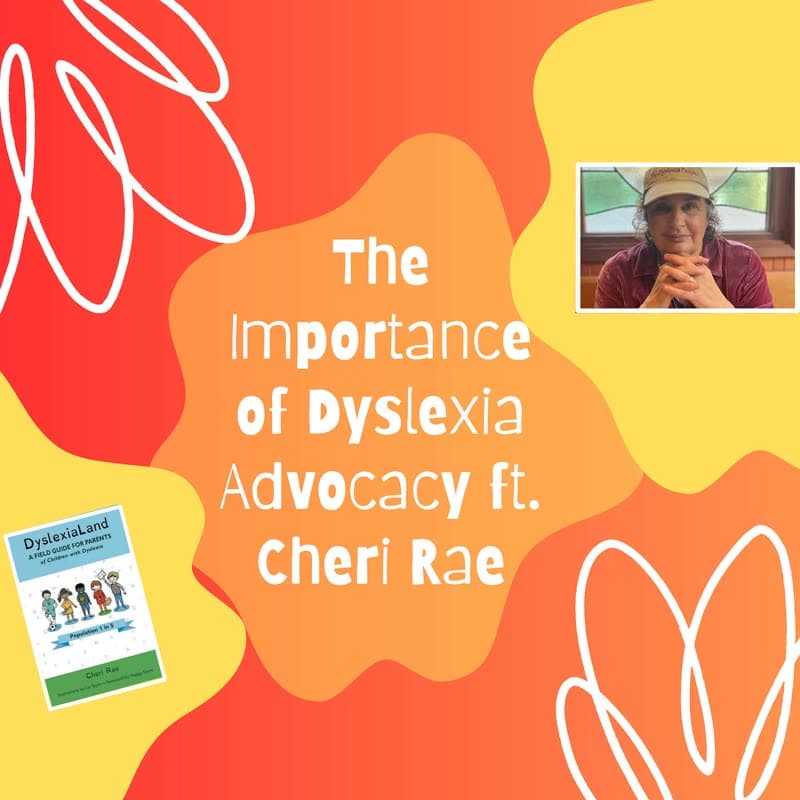
One Parent’s Journey To Dyslexia Advocacy Ft. Cheri Rae
About this episode
In part one of our three-part interview with author and literacy advocate Cheri Rae we explore her own journey with dyslexia starting as the parent of a dyslexic elementary school kid, her advocacy work, and her book, DyslexiaLand.
Here is a biography of Cheri:
Two words best describe the direction of Cheri Rae’s writing career: worthy causes. After graduating from California State University Northridge with a degree in Political Science, Cheri embarked on a path of good works that blended her desire to make a difference and her considerable editorial skills.
DyslexiaLand is a collection of hard-won wisdom gained over the course of ten years of advocacy for children with dyslexia, beginning with her own son. While serving as a consultant to the Santa Barbara Unified School District, Cheri established a Parent Resource Center, monthly “Dyslexia Dialogues” and the annual “Distinguished Dyslexic Speaker Series.” She collaborated with the Santa Barbara Public Library and produced several dyslexia-oriented events there as well. She was named a “Local Hero” by the Santa Barbara Independent for her fearless efforts on behalf of students with dyslexia, and awarded a Resolution from the
California State Assembly for her dyslexia work. She currently serves as the Director of The Dyslexia Project, a nonprofit organization dedicated to increasing awareness, providing resources, and encouraging action about dyslexia.
Cheri continues to work with parents leading parent empowerment seminars to help them advocate for their dyslexic children, writes articles, and shares the trials and tribulations of DyslexiaLand as a public speaker. Her dyslexia-related assemblage art has been featured in several galleries.
Learn more at www.DyslexiaLand.com or www.DyslexiaProject.com.
Transcript
Full transcript · 3,768 words · about 19 min to read. Press a timestamp to jump to that moment.
If you know what to look for, you get it. Unfortunately, except if you are personally dealing with it, you don't know what to look for. And it seems strange and it seems, this is weird. What's wrong with this kid? We're going to fix him, you know? And it's like, no, that's not what it is at all. So, yeah, it is this universal thing.
Hello, we are Nick and Sonja, and this is Dylexia Journey. And today, we are excited to welcome a special guest, Sherry Rae. She is the author of the book, Dyslexialand, which we both really enjoyed reading. And we are excited to have her on the show today. So, let me quickly introduce her. Two words best describe the direction of Sherry Rae's writing career. Worthy causes. After graduating from California State University, Northridge, with a degree in political science, Sherry embarked on a path of good works that blended her desire to make a difference in her considerable editorial skills.
Dyslexialand book is a collection of hard-won wisdom gained over the course of 10 years of advocacy for children with dyslexia, beginning with her own son. While serving as a consultant to the Santa Barbara Unified School District, Sherry established a parent resource center, monthly dyslexia dialogues, and the annual Distinguished Dyslexic Speaker Series. She collaborated with the Santa Barbara Public Library and produced several dyslexia-oriented events there as well. She was named a local hero by the Santa Barbara Independent for her fearless efforts on behalf of students with dyslexia and awarded a resolution from the California State Assembly for her dyslexia work.
She currently serves as the director of the Dyslexia Project, a nonprofit organization dedicated to increasing awareness, providing resources, and encouraging action about dyslexia. Sherry continues to work with parents, leading parent empowerment seminars to help them advocate for their dyslexic children, writes articles, and shares the trials and tribulations of dyslexia land as a public speaker. Her dyslexia-related assemblage art has been featured in several galleries. Sherry, welcome to Dyslexia Journey. Thank you. It's nice to be here.
Yeah, I can't think of a better person to have on. I mean, I don't even almost know where to begin, because you are such a resource yourself, too, for all of us. And I guess let's just start at the beginning. So could you tell us a little more about how your Dyslexia Journey started with your son? Well, as it happens with so many families, it was my son who was struggling in school. Bright boy, curious, great vocabulary. Everything seemed to be going great for him. And then suddenly he was struggling to read. And both my husband and I are writers. We even have a little small publishing firm. And words are our life.
So we didn't understand what was going on. And we just got on this journey. And it took a long time to figure out. We finally got him tested when he was in third grade. And they came up with specific learning disability. And when I read what the definition of that was, I'm like, this is really bad. This is not my son. And I don't understand. And so it took a while. We were very lucky here in Santa Barbara. We had a pioneer who knew a lot about dyslexia and had a resource center.
So I eventually met with her by word of mouth. And she was just so reassuring. But by this time, my son was in seventh grade reading at a second grade level. And so I pretty much went crazy about he's got to learn to read. He's a baseball player. He wants to play in high school and he's not going to be able to. And through a whole long series of negotiations, the school district ended up remediating him and paying for a lot of money to get him to read. And then I thought that was just really unfair that my son would be able to and other kids didn't. So that set me on the whole path of becoming an advocate.
Yeah, that that that that, you know, to some extent, mirrors our experience as well, as we've shared on the show on our show before that, you know, our daughter has dyslexia. And yeah, just the the sort of struggle and reading about it in your book, too. It's it's amazing how similar sort of all these experiences are as parents for When we sort of, you know, notice that that there there might be some issues and then the process of getting diagnosed. So I guess to continue, then, sounds like you you realize then that it sort of important would be important to to share what you've learned with the wider world.
Can you talk a little bit more about about how you decided to sort of make that transition into becoming an advocate? Well, I first started out realizing that if they weren't teaching properly and they knew there was another way to teach kids and my son ended up going to a private organization that that taught and the school district paid for it. So it's like, well, there's a big gap here and we need to train those teachers so that they could do it, too.
So I thought it was going to be really simple to make an institutional change and get teachers trained and everything was going to be fine, as so many of us do. And it became very clear very soon that this little bit and I did succeed in getting them trained. Thirty five teachers got trained, you know, you know, like a week long training that wasn't enough, but it was a beginning. And so I kind of pestered the school district so much that they ended up hiring me as a consultant.
And it was actually paid for by a dyslexic philanthropist here in town who was wanted more work done on dyslexia. We started that resource center. It's fabulous. We ended up getting a lot more help for kids and lowering the number of lawsuits. And we were very, very productive and it worked well. You mentioned all of the various outreaches that we did. Very successful. Five years worth of work. And then the superintendent retired and a new one came in and ended it all.
I never imagined that we would make progress and then it would not only stop, it would be obliterated. And so that was a very big learning experience. And that's when I decided, well, I'll write Dyslexia Land. At least I have all this knowledge. I can help other people in some way. If I can't do it through the school district, I can use my talent to get a book out. So that's what I did.
I'm curious, just a little more digging into that advocacy journey. So it was mainly, did it involve sort of the school board? And I'm sort of just curious of like what those pieces were a little bit more. Because it sounds like you were working with the specific school too, of course. Well, I was working with the school district. I was assigned to the special education department, but we ended up doing the work for the community.
Quite often, and I had a very good relationship at the time with the school board. They were very interested in learning more about it. I was constantly going to school board meetings and, you know, I'm the dyslexia lady. I also used to go to classrooms and talk to kids. It was mandated because there was a lawsuit in the school district. And so they had to do what they then called Disability Awareness Day.
So I would go into classes and talk to kids and end up helping educate teachers and students and who might even talk to their parents. So it was pretty complex. And really, I was running around doing everything I possibly could. I really was, you know, I would talk to anybody, the Rotary Club, the hospital, you know, it didn't matter. It was just like constant. And I, while I was funded, it was like I did about three times more work than it was just because it was like this mission.
And I believed so much. And, you know, when you're dealing with kids, I would go to teen court and the probation department and, you know, the DA's office. When you would find out what would happen to kids if they didn't get the help that they needed, that's what kept me going, was trying to make a difference early on. Yeah, I really have a picture of that, how widespread it is. It's sort of like the seed of it's the school and then very much so with still the school district.
But then there's all these community elements, too. Yeah, it's really a community issue, but most people are very confused about it. They don't understand it. It's what other word has a Y and an X in it? I mean, it's like, really, does it have to be that difficult? And so if they do know about it, it's, oh, you know, kids see things backwards. Or, you know, it's just this little thing. Or they think, oh, well, they'll never learn to read.
They don't know the journey that it takes and what specifically is needed. So I felt like I was in this great place to help educate not only for my own son, but for the rest of the community. Yeah. Yeah, actually, I wanted to follow up on one thing you said about going to sort of community courts. And do you want to talk a little bit about sort of the, like, worst case scenarios that can happen if dyslexia sort of isn't identified and addressed?
Yeah, it can be really sad. There was one case in particular where a girl had actually didn't want to live anymore. And twice, twice she tried to take her own life. And as we traced back, and, you know, some of these stories get very complicated. And in an IEP, you're not going to learn what you need to learn. So I would end up going to the IEPs and then meeting with the families and unraveling what was going on.
And that girl really, really was, that was the worst of all cases. And this does happen, and we don't like to talk about it, but it's true. She ended up in the probation department, and I vouched for her that she was going to get specific direct reading instruction. Because, you know, she started out, she was just Truett. That was all that was. And then it got bigger and bigger and bigger. And this is what happens.
And so that's why awareness is so important and understanding what the situation is. These are not bad kids. These are kids who have bad experiences in school. And I came up against more than I could have ever imagined, and it was really sad. And quite often, and here in Santa Barbara, we have a large population that's very, very beholden to the school district and to the teachers and to the institution. And oftentimes, those parents might think, oh, their kid just isn't working hard enough.
You know, they just have to work harder. They have to pay more attention. And that's a very difficult situation where you have to end up explaining, no, they're not teaching the kids the way that they learn. Yeah, so how much of your advocacy work is around educating the teaching professionals? And how much is around educating the parents? Whoa. That's a really interesting question, because what I've learned over all these years, and I've been doing this for about 15 years now, is that the education establishment doesn't want to hear from me.
As my son used to tell me years ago, Mom, why are you still doing this? They don't want to hear what you have to say. And it's like those words ring in my ears, and he's right. I work really hard to work with, to parents, to get them up to speed to understand what's, first of all, what's going on. And secondly, what we can do about it. And thirdly, yes, and I have to say, I get pulled in.
You know, it's like the godfather, you know, I just get pulled right back in again. Working on both dyslexia and literacy issues, because the trend to balance literacy has hurt our dyslexic population as well as many other kids. And that has not been well-known or well-received by the education community. So I'm really careful in what I say publicly. I write a lot of articles where I'm not quite as diplomatic, and I've got a flair for, you know, a turn of a phrase, perhaps, that maybe they don't like.
But I do have allies in the school district still, to this day, who are really appreciative of the work. But they can't necessarily say that. It's a very political, delicate dance that we do. Yeah. Yeah. And then I think the way I took dyslexia land, of course, that's because I'm a parent, and it was such a great resource. I really wished, when I read it, that I'd had it, of course, years ago, because it's just very comprehensive, too.
Thank you. And so that's, I think, it could be for anyone, but I think particularly families probably would find it the most useful. Do you agree with that? That was the whole point. The point of the book was to write it to be the resource that I, like you, that I would have wanted when I started out. And that's why I call it a land, because it kind of is unknown territory.
It has its own language, its own history, its own geography. You can't believe the obstacles that you have to work around. You know, there's all kinds of ways. And it turns out, you know, my husband writes hiking books, and so he's always doing guidebooks. And so it's like, well, you know, we're trying to figure out how to present this the best way. I was like, how about like a guidebook? And so that's what it is, a guide to navigating through this very strange place from kindergarten to high school.
And I did not finish the book until my son had graduated from high school, because I wanted to be an authority, at least to share the experience that I had that would, and to make it as universal as possible, and to be as knowledgeable as possible. Yeah, yeah, I really like the metaphor. I think it's a really, a really useful, useful metaphor. And it just, it feels, it's just as a parent of someone with dyslexia, right, it just feels right.
Like it is this, there's just so much there that, that you just don't even realize until you get into the land and experience it for yourself. And you know, what's crazy? It's like, we're all in a tribe that we recognize all across the country. Like you and I could sit down and have a conversation for two hours about dyslexia and what we've done. And, you know, and that happens with, and the Decoding Dyslexia movement made that happen, I believe.
And so I have what I call friends across the country who we can talk on the phone for hours about our experiences or how we're helping or whatever. We've never met, you know? So it's like this, sadly, it's going on everywhere. This is not like just here in my little town. And I don't think any parents realize that. They think they're the only ones when they first start on this journey. Oh my gosh, what, my poor kid, I didn't know.
Because you're so isolated. So the idea of being able to connect with others is, and it's happened in the last 10 years, much more than it had before. Yeah, one thing that, our daughter is 15 now, and one thing that still strikes me, I mean, even when I was reading your book, is the universality of our experiences and her experiences. And then some of the things that you describe in your book and some of the things that I read elsewhere or talk to other people.
It's things that we thought were sort of like, oh yeah, that's just our daughter. That's just how she is. And not even connecting necessarily that it was related to the dyslexia. But then reading and hearing about other people's experiences, it's sort of like, oh wow, this is all much more universal than we realized. Yeah. Even to the point of, if you look at the, in many cases, you look at the writing of a lot of kids, the writing is the same.
And it's like, I would go to classrooms and they would have work up on the board and I'd go, oh, that one, that one, that one, that one. And then the teacher would go, what? How did you know? And it's like, well, look, if you know what to look for, you get it. Unfortunately, except if you are personally dealing with it, you don't know what to look for. And it seems strange and it seems, this is weird.
What's wrong with this kid? We're going to fix him, you know? And it's like, no, that's not what it is at all. So yeah, it is this universal thing. And it's great that we're able to connect much more than we could like a generation ago. Yeah. And I think, you know, now so much further along in the journey, it makes more sense to me because I understand it more as a brain difference, you know, that has all these other pieces to it.
But it's reminding me too, in the book that we were also struck by that you said that the strength sometimes you see first, you know, which makes sense because the reading, you know, isn't always the very first thing. Do you want to say a little bit more about that? Like what might parents see first? Oh, you know, I'm all about supporting strengths. And if you look at the cover of the book, it's all happy and positive instead of a miserable kid, you know, with the book.
You know, when I look back, I can think about like my son, like I mentioned that he was a baseball player. At three years old, he could throw a ball and hit a ball with the bat. Like that's not usual. You know, there's a sense of oftentimes where you might look at the deficit of, oh, they can't, maybe they can't tie their shoes. But the empathy that this child shows or this incredible vocabulary or this artistic approach that this kid had, you know, there's like things that you just like see.
And so when they're ready to go to school, you're all confident and you're all like, this kid's so great. You know, they're doing great. Everything's going to be really wonderful when they go to kindergarten. And I remember the very first day my son goes to kindergarten, the teacher's like, sunshine. And I'm just like, yeah, it's going to be great. And then, you know, by the next year, it was like, oh, what is happening here?
So, yeah, it's recognizing and I always talk to parents. In fact, the first thing in the book is what is your child good at? It's like build on those strengths because that is what's going to get them through, whatever that strength is. So, yeah, it's very much about being positive and then addressing the challenges as we can. I've dealt with too many parents, though, who think that a good parenting thing to do is to take away those things.
It's like, oh, well, if you work harder on your reading, then I'll give you back. I remember one little kid, his biggest thing in life was going fishing with grandpa. And the mom took it away. She's like, no, until your grades get better, you're not going fishing with grandpa. It's like, that's the only thing the kid has that he loves to do in his life. You know, that's like, could you maybe give him back the grandpa fishing thing?
You know, so I do a lot of that. And it is a different way of parenting than a lot of people are used to. But I think you have to do it. But we actually, we interviewed a therapist a couple months ago. And she said the same thing that, you know, it's tempting to get dyslexic kids to just focus only on the schoolwork. But like, it's so important for them to have just free time to play or time to pursue the things that they like to do, sports or fishing.
With their grandfather or whatever it is. Whatever it is. Yeah. Yeah. So it's interesting when you ask the parents, you know, it's like, oh, well, they love to do art or this one loves to do science experiments. It's just fascinating. You know, there was one mom that did, she did something really wonderful. Her daughter was being kind of bullied in school and she was a ballerina. And so the mom arranged for the whole class to go and see her perform in the Nutcracker that she was in.
And like, it changed everybody's perception of this child. So, you know, really promoting what they can do. And in my son's case, he's a great baseball player and he was DMACC. You know, he was the kid who could hit a home run, a fourth hitter, you know, number four guy. And he could throw somebody out at home. And so he got a lot of self-esteem from his abilities and being seen in a positive way.
Yeah. I think it's so important having that sort of holistic approach to the child and to their experiences. And it's all interrelated. So we can't just separate it out like that. That's great advice. And reading can't be the whole focus of their lives because then it's just a downward spiral. Yeah. Yeah. Completely.
We'll see you next time.
More from the show
6 Tips for Helping Dyslexic Kids Learn Foreign Languages + Should They Even Have To?
It's hard enough for our dyslexic kids to learn to read and write in English, and now we expect them to learn a foreign language too?
Dyslexia Is NOT A Disease! Shifting Our Perspective
Your kid may be diagnosed with dyslexia, but dyslexia is not a disease. It's a brain difference that has implications for learning, and perceiving and interacting with information in the world. So let's shift our mindset to support our dyslexic kids.
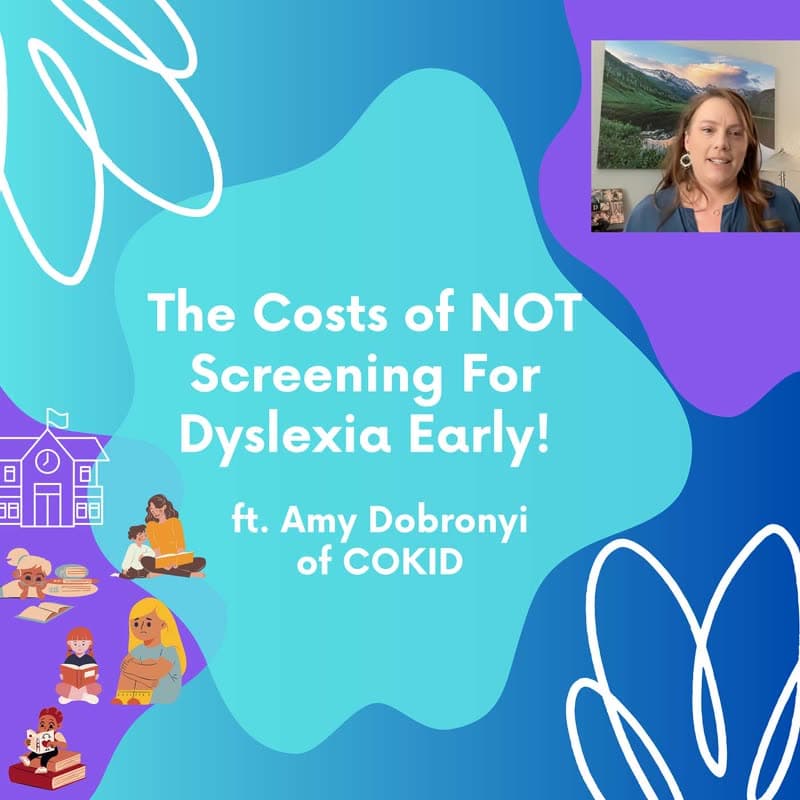
The Importance of Early Dyslexia Identification ft. Amy Dobronyi of COKID
Amy Dobronyi (pronounced duh-BRO-nee) is a Co-founder and Co-chair of COKID (Colorado Kids Identified with Dyslexia - https://www.cokid.org/), a grassroots parent group, whose mission is to improve the lives of individuals with dyslexia through advocacy, education, and legislation.
Never miss an episode
New episodes every two weeks. Follow wherever you listen.